Last Updated on October 9, 2026
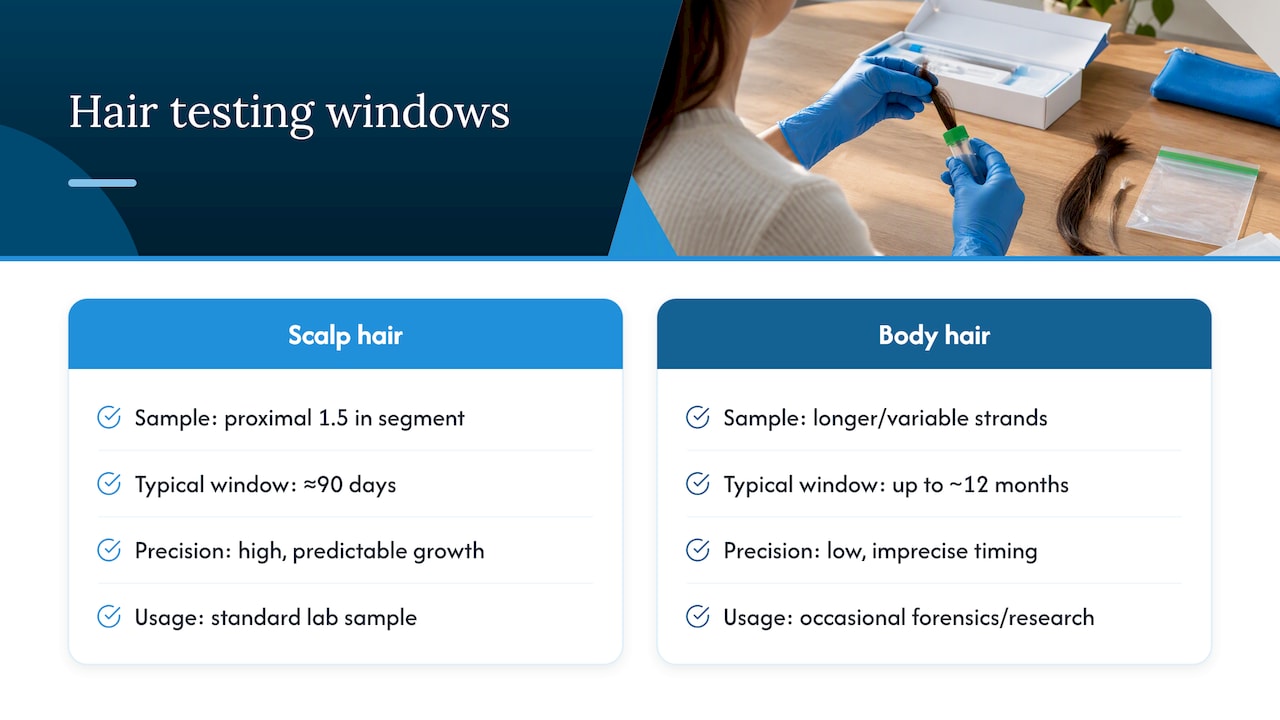
A standard hair drug test uses a 1.5-inch proximal scalp sample and typically covers about 90 days of past drug use. New use generally will not show up at the scalp until 5 to 10 days after the last dose, because hair has to grow out of the follicle before a lab can collect it. The exact window still shifts with drug type, hair growth speed, and individual biology.
TL;DR:
- Regular cocaine or amphetamine use commonly remains detectable throughout the standard window, while light or infrequent THC use may fall near the test’s sensitivity limit.
- Body hair can extend the apparent detection window toward 12 months, but its slower, uneven growth makes timing far less precise than scalp hair.
- Darker pigmentation can raise readings for cocaine and some opioids, while bleaching, dyeing, and repeated cosmetic treatment may lower concentrations inconsistently.
- Negative screens arrive within 24 to 72 hours of receipt; nonnegative screens require confirmation and can take 5 to 10 business days.
- Hair testing cannot detect impairment or very recent use; choose urine or oral fluid testing when the question concerns recent exposure.
Table of Contents
- How hair testing captures drug use over time
- What are typical detection windows by drug class?
- How hair growth rate creates the detection delay
- What factors can skew hair test accuracy?
- What to expect from sample collection and lab reporting
- How the Required Washes Calculator maps a preparation timeline
- Does drug detection in hair ever extend past 90 days?
- How do hair color, ethnicity, and hair type affect results?
- What are the most common myths about hair test timelines?
- How should you interpret a hair test result?
- What hair testing can and cannot tell you
- Which Macujo products fit which testing situation
- FAQ
- Sources
How hair testing captures drug use over time
Drugs enter growing hair mainly through the bloodstream as the hair shaft forms inside the follicle, though sweat and skin oils can also deposit trace amounts onto hair after it has grown out. Some researchers believe limited local metabolism within the hair or skin may also play a role, though this pathway is less understood than blood-based incorporation.
Because contamination from smoke, residue, or handling can land on hair without ever being ingested, labs that test for metabolites, not just the parent drug, have an easier time telling actual use apart from surface exposure. A metabolite-to-drug ratio helps confirm ingestion, though these ratios vary by substance and person, so interpretation still calls for caution.
- Drugs and metabolites get carried into the hair shaft as it forms in the follicle.
- Sweat and sebum add a secondary, less reliable layer of deposition after hair emerges.
- Metabolite testing helps labs separate true ingestion from external contact.
**A specialized technique called micro-segmental hair analysis can cut a single strand into segments as fine as 0.4 millimeters, mapping near-daily intake patterns. It demands plucked hairs and a specialized lab workflow, so it stays in forensic and research settings rather than routine workplace screening.
What are typical detection windows by drug class?
The 90-day convention comes from the standard 1.5-inch proximal sample, but how long a specific drug stays detectable inside that window depends on the substance itself. Frequency and amount of use also matter: a single light exposure may incorporate too little drug to detect, while heavier or repeated use raises the concentration and the odds of a positive result.
- Cocaine: commonly detectable throughout the full 90-day window when use was regular.
- Amphetamines: also tend to follow the standard 90-day pattern in scalp hair.
- THC: detectable but incorporates into hair at much lower rates than stimulants, which is why light or infrequent use can fall near the test’s lower sensitivity limit even within 90 days.
- Opioids and benzodiazepines: detection varies more by specific compound and dosing pattern than the stimulant classes do.
Body hair, when scalp hair is unavailable, can extend the apparent detection window toward 12 months because body hair grows more slowly and sheds less predictably. That slower, uneven growth also makes timeline estimates far less precise than a dated scalp segment, which is why labs prefer scalp hair whenever it is available in sufficient length, a point covered in more detail when long hair affects testing decisions.
How hair growth rate creates the detection delay
Head hair grows at an average of about 1 centimeter per month, or roughly 0.5 inches per month, according to the SOHT 2022 consensus on hair testing. That growth rate is exactly why a 1.5-inch proximal segment lines up with about 90 days of history. It also explains the 5 to 10 day lag between taking a drug and that drug becoming collectible at the scalp: the hair has to physically grow out before a lab can snip a sample containing it.
- A 1.5-inch (3.9 cm) proximal segment corresponds to roughly 90 days of growth.
- A 3 cm segment corresponds to roughly 3 months of growth.
- A 1 cm segment corresponds to roughly 1 month of growth.
This math is also the backbone of how far back a hair follicle test can reasonably reach, and why someone who stopped using more than 90 days before collection often tests clean in standard scalp hair even without any special preparation.
What factors can skew hair test accuracy?
Several variables push results higher, lower, or make them harder to interpret cleanly. Bleaching, dyeing, and perming can reduce analyte concentrations for some drugs, and sample manipulation research shows labs are studying biomarkers like PTCA to flag chemically treated hair, though no routine test yet catches every form of washout or adulteration.
- Darker, more heavily pigmented hair tends to show higher incorporation for some drugs due to melanin binding.
- Body hair grows slower and less predictably than scalp hair, so labs favor posterior vertex scalp hair when it is available.
- Regular hygiene and some over-the-counter products can lower analyte levels, though single applications generally produce inconsistent results.
- Repeated or prolonged cosmetic treatment appears more likely to reduce detectable levels in some studies, but not uniformly across every drug.
Pro Tip: A single “detox” wash rarely changes a lab result meaningfully; concentration reductions tend to show up only with repeated, sustained treatment over time.
What to expect from sample collection and lab reporting
Standard collection calls for about 100 milligrams of hair, roughly 90 to 120 strands, cut close to the scalp, according to USDTL’s lab requirements. Expanded multi-panel tests sometimes request up to 150 milligrams to cover a wider list of substances.
- Negative screens are typically reported within 24 to 72 hours of the lab receiving the sample, per Quest Diagnostics’ hair testing guidance.
- Non-negative results trigger confirmatory GC/MS or LC/MS testing, which commonly extends reporting to about 5 to 10 business days.
- Specimens flagged as non-negative are retained for the confirmatory run rather than reported immediately off the initial screen.
Hair testing is built for retrospective pattern detection, not catching someone in the act. For impairment or very recent use, urine or oral fluid testing fits the question better, since hair still needs those 5 to 10 days to grow out before anything is collectible.
How the Required Washes Calculator maps a preparation timeline
There are multi-step cleansing processes that use a shampoo and a washes calculator to estimate the number of washes based on last-use date and frequency over 90 days. Timing matters because the calculator’s recommendations still have to work within the same 5 to 10 day biological delay that governs every hair sample, covered in more detail in our guide to how far back a hair follicle test goes.
- A one-time use more than 60 days before a scheduled test generally needs a lighter wash count, since less drug has incorporated into the collectible segment.
- Recent, heavy use within the last 30 days generally calls for a higher wash count and leaves a narrower margin for error given the testing date.
Reviewing the full 12-panel preparation timeline alongside the calculator gives a clearer picture of what realistic preparation looks like for a specific use history.
Does drug detection in hair ever extend past 90 days?
Standard scalp testing is capped at 90 days because labs collect only the proximal 1.5-inch segment closest to the scalp, not the full length of someone’s hair. That cap is a collection choice, not a biological ceiling: drug residue can remain embedded in hair that grew out months or years earlier, it just sits further down the strand, beyond the segment a standard test actually analyzes.
This is why long hair rarely changes the outcome of a standard test. Even someone with hair reaching their waist is tested only on the newest 1.5 inches closest to the scalp, a distinction covered in our explanation of long hair and drug testing. The older growth sits untested unless a lab specifically requests a longer segmental analysis, which is unusual outside research or forensic casework.
Body hair is the one practical exception. Because body hair grows much more slowly than scalp hair and does not shed on a predictable monthly cycle, a body hair sample can reflect drug use from considerably further back, sometimes approaching 12 months. The tradeoff is precision: without a reliable growth rate, a lab cannot translate a body hair result into a specific window the way it can with scalp hair.
How do hair color, ethnicity, and hair type affect results?
Melanin content affects how strongly certain drugs bind to hair, and darker, more heavily pigmented hair tends to show higher incorporation for basic drugs such as cocaine and some opioids compared to lighter or gray hair exposed to the same amount of the substance. This creates a documented interpretive challenge: two people with identical use patterns can produce different concentration readings purely because of pigmentation differences.
Hair texture and growth rate add another layer of variability. Coarser or curlier hair types do not grow at a meaingfully different monthly rate on average, but structural differences in the hair shaft can affect how evenly a drug distributes along its length, which matters for segmental analysis more than for a standard single 90-day test.
Labs that rely on metabolite ratios rather than raw parent-drug concentration reduce some of this bias, since metabolite formation is tied more to the body’s processing of a drug than to how much pigment binds it. Even so, melanin bias is a known limitation that toxicologists factor into interpretation rather than treating hair test concentrations as a precise, color-blind measurement across every demographic group.
What are the most common myths about hair test timelines?
The biggest misconception is that the 90-day window is a hard biological limit rather than a sampling convention. In reality, the 90 days reflects the length of the proximal segment labs choose to collect, roughly 1.5 inches, not some fixed point where drug residue simply vanishes from hair.
Another persistent myth is that a single detox shampoo application can reliably clear a result. Research on sample manipulation shows single-use products tend to produce inconsistent effects, while repeated, sustained treatment over time appears more likely to reduce analyte levels for some drugs, though not uniformly.
A third myth treats hair testing as equivalent to urine or blood testing for catching recent or current impairment. Hair cannot do that job: the 5 to 10 day delay before new use becomes collectible at the scalp, confirmed in Quest Diagnostics’ guidance, makes hair testing a poor tool for anything other than retrospective pattern detection.
Finally, many assume long hair means a longer detection window. It does not, since labs cut only the newest 1.5-inch segment regardless of total hair length, a point addressed directly in our piece on long hair and drug testing.
How should you interpret a hair test result?
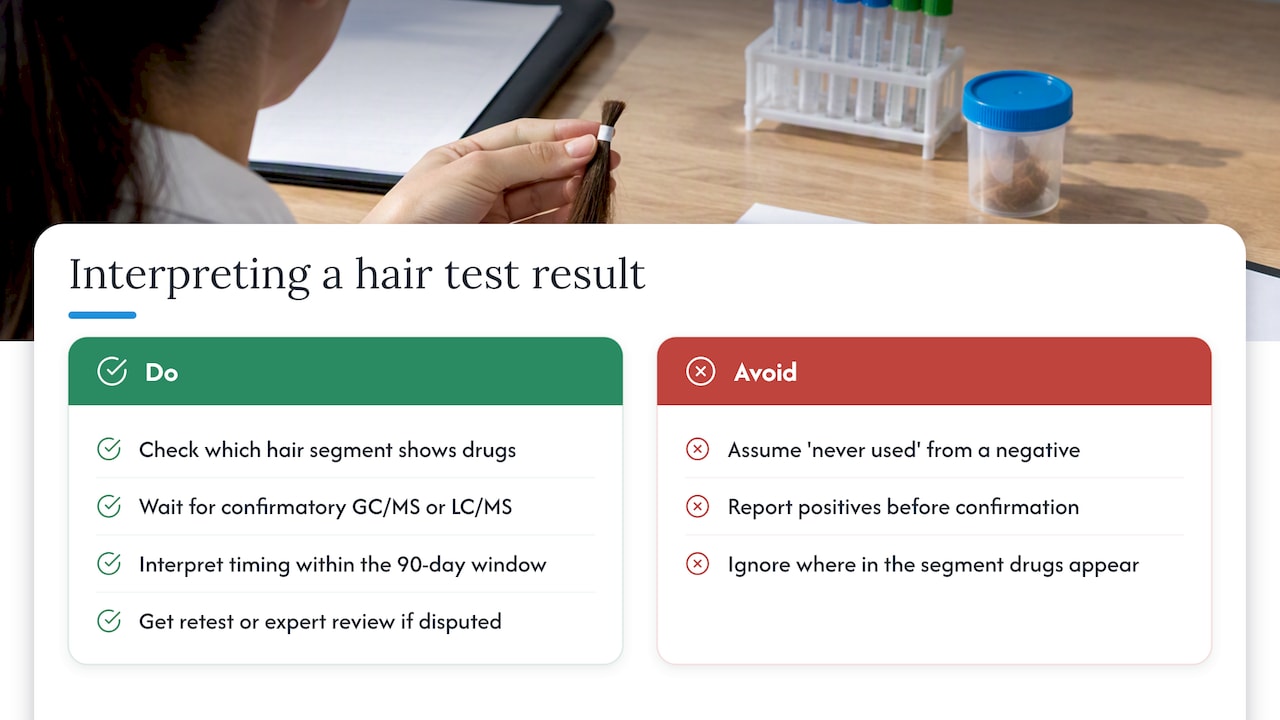
A negative result means the lab found no detectable drug or metabolite above its cutoff in the collected segment, generally the most recent 90 days of growth. It does not mean someone has never used a given substance, only that no qualifying use occurred within that specific window and above that threshold.
A positive or non-negative screen triggers confirmatory GC/MS or LC/MS testing before being finalized, which typically adds several business days, per Quest Diagnostics’ reporting timelines. That confirmatory step exists specifically to rule out false positives from contamination before a result is reported as conclusive.
Timing matters most when interpreting what a result implies about someone’s behavior. A positive result near the far edge of the 90-day window suggests use happened closer to three months ago, while a positive concentrated in the newest centimeter points to more recent use, within the last month or so, based on the growth math covered earlier. Reading a result without accounting for where in the segment the drug appears, or without knowing whether confirmatory testing has run, leads to the kind of misinterpretation that fuels most hair test myths. Anyone facing a disputed or unexpected result benefits from understanding what to do after a failed hair test before assuming the worst.
What hair testing can and cannot tell you
Hair testing is a pattern-detection tool, not an impairment test. It answers “did this person likely use this substance at some point in the past few months,” never “is this person impaired right now.” That distinction gets lost constantly in how people talk about these tests.
Choosing the right matrix matters more than obsessing over a single timeline number. Urine and oral fluid answer the recent-use question hair cannot; hair answers the longer-pattern question urine cannot. When a result carries real consequences, a job offer, a custody decision, a licensing requirement, it is worth confirming lab policy on confirmatory retesting and talking to someone who understands the specific panel and cutoffs involved rather than relying on general assumptions.
— MIchael
Which Macujo products fit which testing situation
Different timelines call for different tools. A Home Hair Test kit works well as a pre-check before a scheduled test, giving an early read before committing to a full preparation plan. For tight timelines or complicated use histories, our Afterhours Personal Consultation connects you directly with guidance on timing and wash counts when a calculator result alone leaves questions.
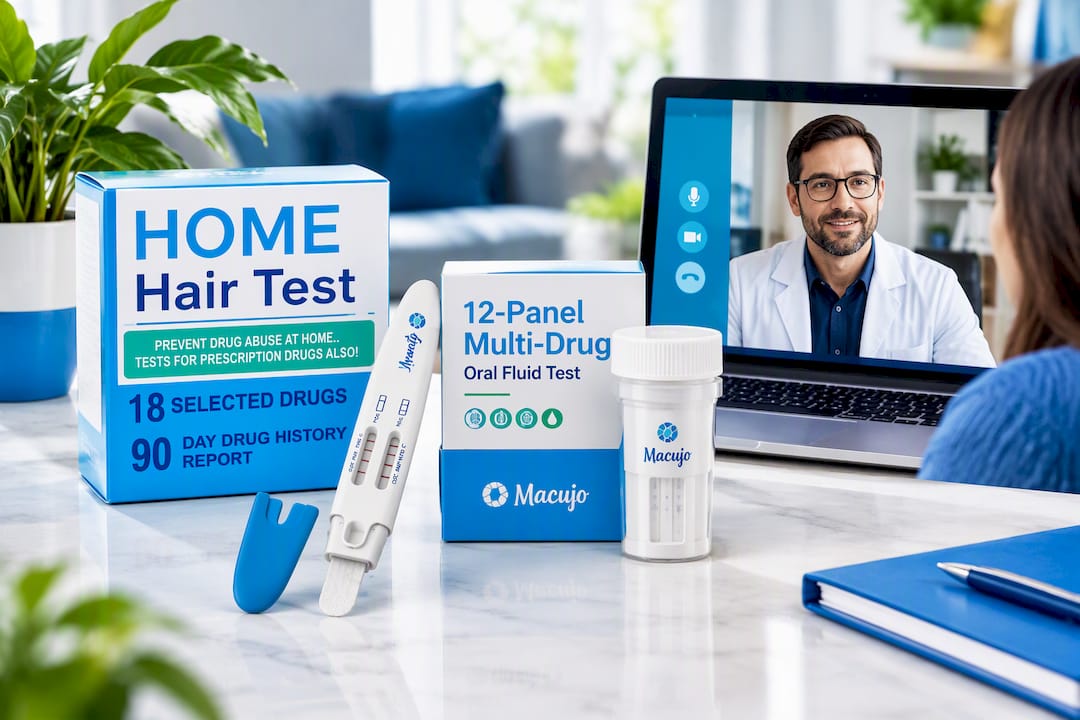
When the concern is a recent oral fluid test rather than hair, our 12-Panel Multi-Drug Oral Fluid Test covers that shorter detection window directly. The Required Washes Calculator ties all of this together by mapping your last-use date and frequency to a realistic number of washes with Macujo Aloe Rid Shampoo, available through our hair products line, so preparation lines up with the actual biology of hair growth rather than guesswork. Browse the full range of hair, urine, and saliva test products to find the option that matches your situation.
This article is general information, not a substitute for advice from a qualified doctor. Consult a qualified healthcare professional about your own circumstances before acting on anything here.
FAQ
How long will a hair follicle test detect drugs?
A standard scalp hair test typically covers about 90 days of past use, based on a 1.5-inch proximal sample and an average hair growth rate of roughly 1 centimeter per month, per the SOHT consensus on hair testing. Body hair, when used instead, can extend the apparent window toward 12 months but with far less timing precision.
What can throw off a hair follicle test?
Cosmetic treatments like bleaching or repeated washing can lower analyte concentrations for some drugs, and melanin content affects how strongly certain substances bind to darker versus lighter hair. Labs are researching biomarkers such as PTCA to flag manipulated samples, but no routine test yet catches every form of washout, according to sample manipulation research.
How to pass a hair follicle test in 2026?
There is no guaranteed shortcut, but preparation that respects the biology, specifically the 5 to 10 day detection delay and the length of time since last use, gives the most realistic outcome. Mike’s Macujo Method uses a Required Washes Calculator to estimate a wash count based on last-use date and frequency, paired with authentic Macujo Aloe Rid Shampoo.
Can you pass a hair test in 2 months?
It depends heavily on the substance, frequency of use, and how recent that use was relative to the 90-day collection window. Light or infrequent use further in the past has a better chance of falling below detection thresholds than recent, heavy use, and a personalized consultation can help map a specific history against realistic expectations.