
Last Updated on September 21, 2026
Yes, body hair can substitute for scalp hair when a donor is bald, shaves, or otherwise lacks enough head hair to test. It gives a broader, less time-precise detection window than scalp hair, often reaching back closer to a year, and it is excluded from drug testing programs regulated by the Department of Transportation (DOT).
TL;DR:
- Body hair can extend detection windows up to a year, but it cannot precisely pinpoint the timing of drug exposure unlike scalp hair.
- Tests from body hair are subject to variability due to growth phase differences and are influenced by factors like hair color and chemical treatments.
- Collection sites include armpit, leg, arm, chest, back, and beard hair, requiring a sample size comparable to a cotton ball for accurate analysis.
- Federal DOT regulations prohibit hair testing for safety-sensitive workers, limiting drug testing to urine or oral fluids.
- Disclosing recent chemical hair treatments helps labs interpret results accurately, as treatments can reduce detectable drug metabolites.
Table of Contents
- How Does Body Hair Drug Testing Actually Work?
- Scalp Hair vs. Body Hair: How Do the Detection Windows Compare?
- Where Do Collectors Take Body Hair, and How Much Do They Need?
- What Throws Off Accuracy, and How Do Labs Correct for It?
- Where Do DOT Rules and Employer Policy Draw the Line?
- When Body Hair Testing Makes Sense, and What to Do Before Collection
- A Note From Michael on Reading Body-Hair Results
- Testing Options and Consultation Support From Macujo
- Sources
- FAQ
How Does Body Hair Drug Testing Actually Work?
Drugs enter hair through the bloodstream at the follicle, where metabolites bind into the growing shaft and stay locked in place as the hair grows out. That’s the basic biology behind every hair follicle drug testing program, whether the sample comes from your scalp or elsewhere. Root-to-tip orientation matters because the portion closest to the skin reflects the most recent exposure.
Labs perform sample decontamination to remove surface contaminants, then conduct an initial immunoassay screen (typically ELISA) to identify potential positives. Samples that screen positive are then subjected to confirmatory testing with GC-MS or LC-MS/MS, which identify specific drug compounds and metabolites. Panels commonly cover THC metabolites, cocaine, amphetamines, opioids, and PCP. That two-step screen-then-confirm process exists specifically to catch false positives before they ever reach a report, and the Medical Review Officer Guidance Manual requires identification of both parent drug and metabolite before a result counts as confirmed.
Scalp Hair vs. Body Hair: How Do the Detection Windows Compare?
Scalp hair testing runs on a fairly predictable clock. A standard 1.5 inch sample corresponds to a period of several months of history, based on an average growth rate near half an inch per month, according to Labcorp’s overview of hair follicle testing. There’s also a short blind spot: it takes 5 to 10 days after use before drug-laden hair grows long enough near the scalp to be collectible.
Body hair doesn’t follow that same tidy math. Hair on the arms, legs, chest, and back cycles through growth and resting phases at different rates depending on the site, which is why the window commonly cited runs closer to 12 months rather than a fixed 90 days. Some peer-reviewed comparisons have found higher drug concentrations in certain body hair types than in head hair for the same person, which can extend the detection window, per research comparing head and body hair testing.
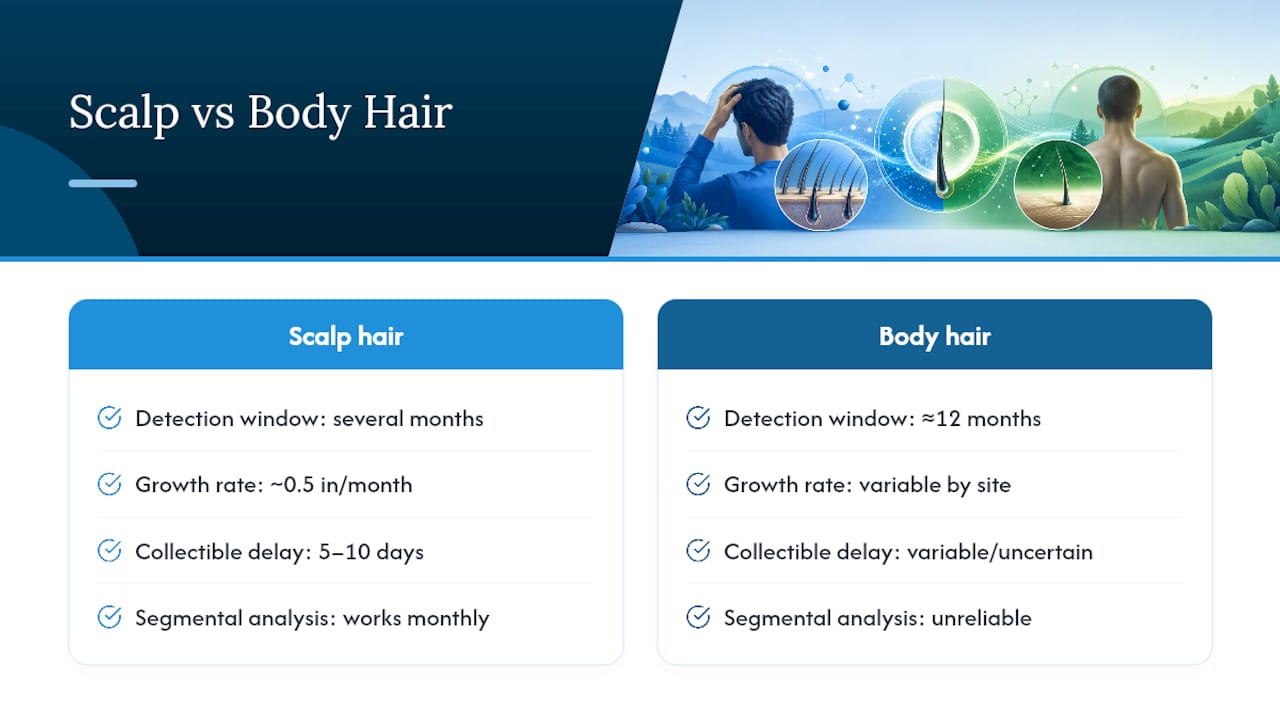
The practical takeaway: a body-hair positive confirms exposure sometime over an extended stretch, but it cannot pinpoint when. Segmental analysis, the technique labs use to break scalp hair into monthly sections, doesn’t work reliably on body hair because growth cycles vary too much from strand to strand and site to site. That limitation is well documented in studies on segmental analysis limitations, and it’s one reason interpretation deserves care rather than a quick assumption.
Where Do Collectors Take Body Hair, and How Much Do They Need?
When scalp hair isn’t available, collectors turn to a defined list of acceptable sites, all backed by Quest Diagnostics’ hair testing guidance:
- Underarm (armpit) hair
- Leg hair
- Arm hair
- Chest hair
- Back hair
- Beard hair
Because body hair strands vary so much in length and thickness compared to scalp hair, collectors don’t measure by inches. They aim for a sample mass roughly similar to a cotton ball, generally sufficient to ensure the lab has enough material for a full screen and confirmation. This is usually more hair than a scalp collection requires, due to body hair’s thinner and less dense strands.
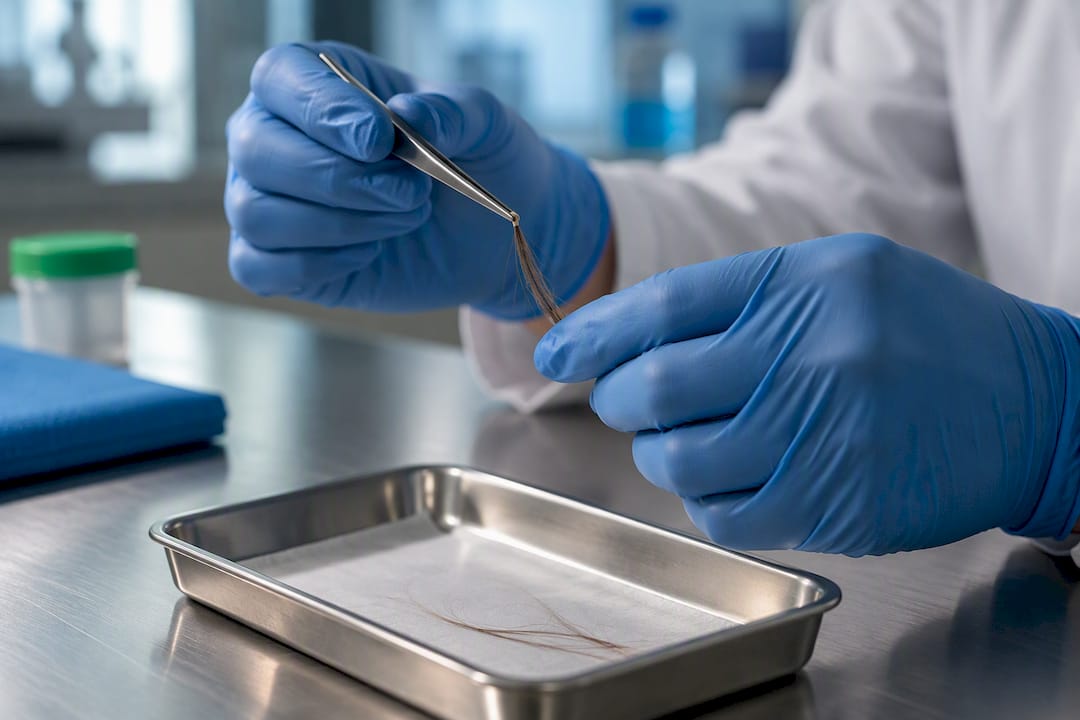
Collectors follow a few firm rules during an armpit hair drug test, leg hair drug test, or any other body-site collection. Collectors mark the root end so the lab knows which portion represents the most recent growth, and they avoid mixing scalp and body hair in the same specimen to maintain meaningful timeline interpretation. Combining hair from two different body sites is sometimes allowed, but only when the hair types are similar and the collector documents exactly where each portion came from.
What Throws Off Accuracy, and How Do Labs Correct for It?
Body hair vs. head hair testing carries a few known sources of bias, and reputable labs build safeguards around each one.
- Melanin content: Darker hair binds certain drug compounds more readily than lighter hair, which can produce higher concentrations in Black or dark-haired donors for the same level of use. Labs and Medical Review Officers factor this into interpretation rather than treating every number at face value.
- Chemical treatments: Bleaching, dyeing, and perming can strip out a meaningful share of detectable metabolites, according to research on hair treatments and melanin effects. Always tell the collector about any recent treatment.
- External contamination: Secondhand smoke exposure or contact with a surface can leave trace drug residue on hair without any actual use.
Pro Tip: Disclosing chemical treatments before collection isn’t an admission of anything. It’s the detail that helps a lab and an MRO interpret your result correctly instead of flagging a false concern.
The decontamination wash step exists specifically to knock out that last problem, and confirmatory testing that requires both parent drug and metabolite detection filters out most contamination-only cases. The Society of Hair Testing’s 2021 consensus recommends real caution when reading quantitative body-hair results, precisely because growth cycles and incorporation rates shift from one body site to another.
Where Do DOT Rules and Employer Policy Draw the Line?
DOT-regulated testing, governed by 49 CFR Part 40, does not authorize hair specimens at all. Truckers, pilots, and other safety-sensitive workers under DOT programs are tested with urine or oral fluid only, full stop. That’s a hard regulatory line, not a lab preference, and it applies regardless of whether scalp or body hair is in play.
Outside DOT programs, the picture opens up. Federal civilian agencies operating under SAMHSA guidance can authorize hair and oral fluid testing under their own rules, sometimes pairing hair with a second specimen type to cover the short window hair testing misses. Private employers and individual states set their own policies too, so the honest answer to “can they test my body hair” depends on reading your employer’s actual written testing policy and confirming whether MRO review is part of the process.
When Body Hair Testing Makes Sense, and What to Do Before Collection
Body hair becomes the practical option once scalp hair is too short, chemically stripped, or simply absent. It’s not a downgrade so much as a different tool with a different tradeoff: a wider window in exchange for less precision about timing.
If you anticipate a body-hair collection, disclose any chemical treatments beforehand, avoid further processing before collection, and follow the collector’s guidance on sample sites. For anyone uncertain about what a specific result timeline means for their situation, general hair testing guidance covers the basics, but a direct conversation with someone who reviews these cases regularly tends to answer the specific “what does this mean for me” question faster than any article can.
A Note From Michael on Reading Body-Hair Results
Since 1999, I’ve worked with people trying to understand exactly what a hair test can and can’t tell them, and body hair questions come up constantly. My advice stays consistent: trust the confirmatory science, not the first screening number, and remember that MRO review exists to catch legitimate explanations before a result becomes final. If your situation is complicated, a tailored conversation beats guesswork every time.
— MIchael
Testing Options and Consultation Support From Macujo
You can get a faster, clearer path than guessing your way through an employer’s testing policy blind. If you’re staring down a body hair drug test with no idea what your result might show, the Home Hair Test kit lets you screen yourself before the real one, so you’re not walking in without any information.
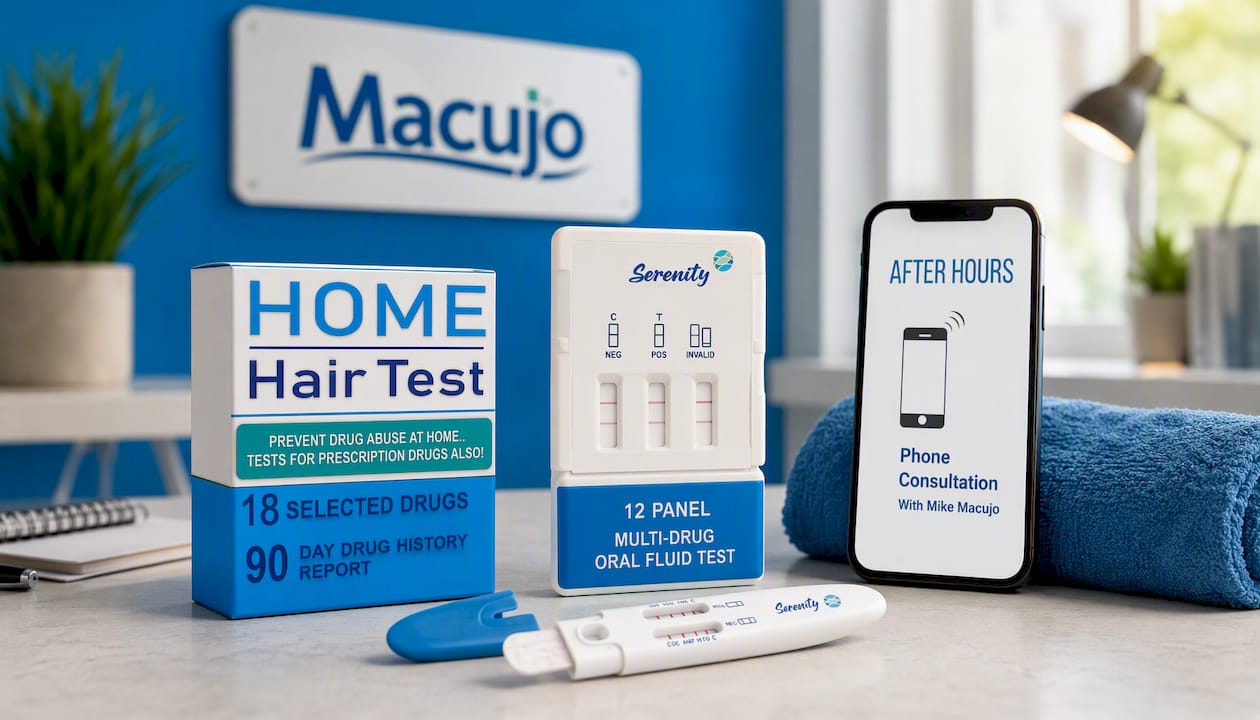
If your employer accepts saliva instead of hair, the 12-Panel Multi-Drug Oral Fluid Test Saliva Drug Test covers recent use across a wide drug panel and skips the hair-timeline question entirely. And when the real issue isn’t which kit to buy but what your specific timeline and prep plan should look like, the Afterhours Personal Consultation connects you directly with someone who can walk through your last-use date, frequency, and body hair specifics and tell you what to actually expect. Book a consultation or browse the full product catalog to get started before your test date arrives.
Sources
- Hair testing — FAQ (Quest Diagnostics)
- 49 CFR Part 40 (DOT guidance on specimen types)
- SoHT Consensus on Drugs of Abuse Testing in Hair (2021)
- Comparison of patterns of drug levels in head and body hair for medico-legal and workplace testing (PubMed)
- Medical Review Officer Guidance Manual (SAMHSA/HHS)
FAQ
Can You Pass a Hair Follicle Test in 30 Days?
Thirty days is tight because scalp hair testing typically covers about 90 days, and the newest 5 to 10 days of growth may not even be collectible yet, per Labcorp’s testing overview. Whether you can affect your result in that window depends heavily on your usage history, which is exactly what a required-washes calculation is designed to estimate.
How Can You Detox Hair Follicles Before a Test?
Detox approaches for hair generally focus on repeated, targeted washing designed to strip surface-bound metabolites from the shaft rather than altering what’s already incorporated internally. Mike’s Macujo Method uses Macujo Aloe Rid Old Formula Shampoo in a structured nine-step process, with the number of washes calculated from your substance, last-use date, and 90-day usage frequency.
Is a Body Hair Drug Test as Accurate as a Scalp Hair Test?
Both rely on the same lab confirmation process, screening followed by GC-MS or LC-MS/MS, so the chemistry is equally rigorous. The difference is timing precision: body hair’s variable growth cycles make it harder to date exposure, which is why the SoHT consensus urges caution interpreting quantitative body-hair results.
Does Hair Color Affect Body Hair Test Results?
Yes. Melanin-dependent binding means darker hair can retain higher drug concentrations than lighter hair for the same level of use, an effect documented in research on hair treatments and melanin. Labs and Medical Review Officers account for this rather than reading raw concentration numbers at face value.
Can Nail Samples Replace Hair for Drug Testing?
Nail testing exists as a specimen type in some forensic and clinical contexts, but it’s far less standardized for employment drug screening than hair or oral fluid. Most employer programs that move away from scalp hair turn to body hair or oral fluid first, not nails, because those methods have clearer, more established collection and interpretation protocols.