Last Updated on October 21, 2026
Vinegar will not reliably clear drugs from a hair sample, and apple cider vinegar is no different. Drinking it does nothing to hair that has already grown, and rinsing with it does not strip drug metabolites from inside the hair shaft. Below you will find what the research says, what vinegar can do to your hair and scalp, and what a person with a test coming up should do instead.
TL;DR
- No scientific evidence supports drinking vinegar or using it as a hair rinse to remove drug metabolites, according to the research summary on vinegar rinses and Healthline’s review of vinegar claims.
- A hair test reads a 1.5-inch piece of hair shaft covering about 90 days, so what you drink today cannot rewrite that history.
- Undiluted vinegar can irritate the scalp and damage hair, and damaged hair is no help on test day.
- A real plan starts with your substance, your last use date and how often you used in the previous 90 days. That is what our required-washes calculator is built around.
Table of Contents
- What a hair test actually measures
- Why people think vinegar might work
- What the research shows
- What vinegar can do to your hair and your scalp
- Common scenarios, and where vinegar fits
- Perspective: why we don’t treat vinegar as the method
- What to do instead of reaching for vinegar
- How our offer fits
- What if the result is positive anyway?
- What a hair test costs, in case you are weighing a retest
- FAQ
- Sources
What a hair test actually measures
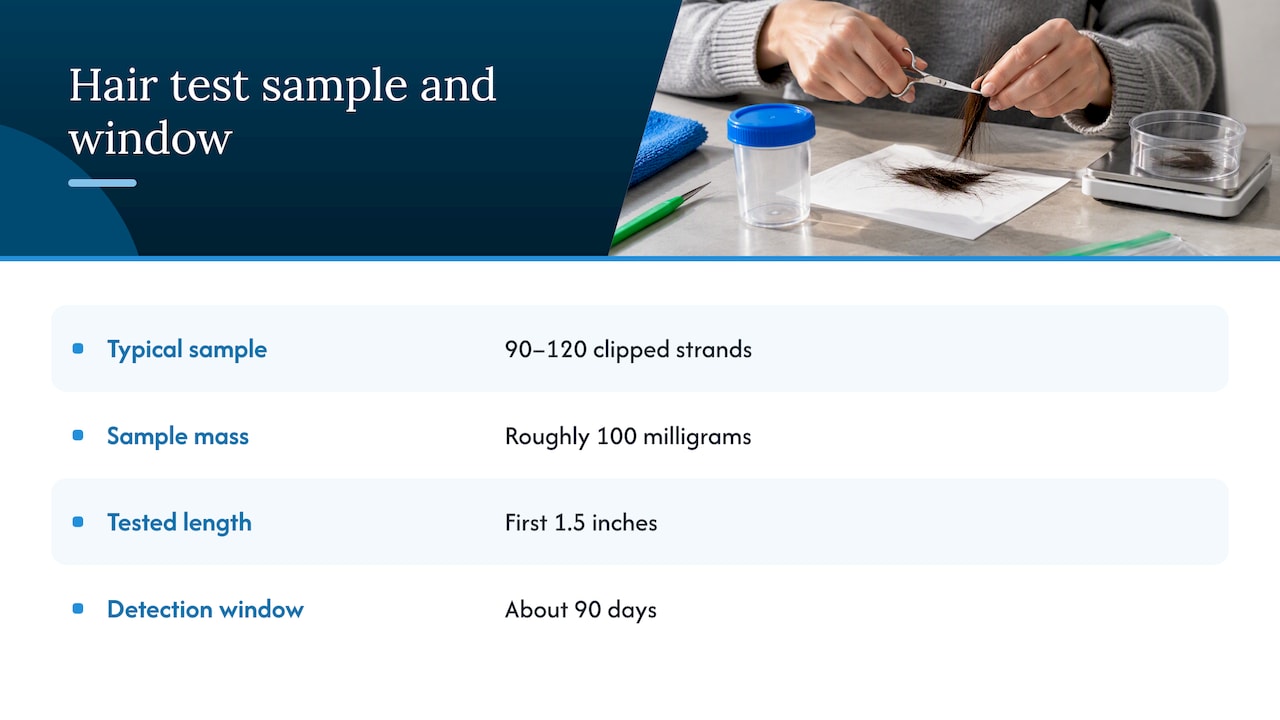
Most people say “hair follicle test,” but the lab does not examine the follicle. A hair strand test analyzes clipped strands, not the root under the skin. The collector typically takes about 90 to 120 strands, roughly 100 milligrams, cut close to the scalp. Labs generally test the first 1.5 inches, which gives a detection window of about 90 days, according to US Health Testing.
That design is why vinegar myths fall apart. Drugs reach hair from the bloodstream as it grows, and they also reach it from sweat and oils at the scalp. Once a segment of hair has formed, its content does not change because of what you eat or drink afterward. A drink cannot flush out something that is already embedded in keratin.
If you want the full picture of how the process works, our guide All About Hair Drug Testing walks through collection, lab screening and confirmation.
Why people think vinegar might work
The vinegar idea comes from a few places. Online guides often list it as one step in a multi-part home routine, usually with baking soda, salicylic acid, laundry detergent or dandruff shampoo. The reasoning is that acid will “open” the hair cuticle so something else can pull drugs out. Others suggest drinking apple cider vinegar to speed up metabolism and flush out THC.
Both claims sound chemical enough to feel believable. Neither has good evidence behind it, and the two ideas need to be separated.
Drinking apple cider vinegar
Healthline’s review is direct: there is no medical proof that vinegar clears drug metabolites faster, including in a 24-hour window. For hair, drinking anything is the wrong tool for a structural reason. The sample is hair that has already grown.
The same Healthline piece notes that adding vinegar to a urine sample, or drinking it to mask a urine test, is something labs can detect. They check pH, creatinine and specific gravity, and an irregular sample can mean an automatic fail or a supervised retest. That is a urine problem, but it matters if you face both kinds of test.
Rinsing hair with vinegar
Here the argument is that acid softens the cuticle. Dermatologists quoted by Byrdie say vinegar may help shine or pH balance when properly diluted, but it is not a potent chemical agent and should never go on undiluted. Treating it as a detox agent often means damage to the hair without the result people hope for.
What the research shows
The strongest recent work on homemade routines is a forensic study in Drug Testing and Analysis. Researchers looked at homemade hair treatments and their effect on drug concentrations in the keratin matrix. Its findings, as summarized in our research, are worth knowing in detail:
| Finding | What it means for you |
|---|---|
| Some chemical treatments, such as bleaching and repeated washing, reduced drug concentrations by 37% (methadone) up to 90% (cocaine) | A reduction is not a pass. Cutoffs are fixed numbers, so a 50% cut can still leave you above the line |
| Results varied by drug and by hair type | Two people using the same routine can get very different outcomes |
| THC and methadone were harder to reduce than cocaine or opioids | Cannabis users, the largest group of job applicants who worry about hair tests, face the hardest case |
| Vinegar alone was not a validated cleanse | A rinse step in a long routine does not make vinegar the active ingredient |
A separate paper, Manipulation of THC Hair Concentrations by Commercially Available Products, asked whether commercially available products can change THC results in hair at all. The question itself shows how unsettled the field is. Anyone who tells you a single pantry item solves it is selling certainty that the science does not offer.
The lesson from the data
Notice what the numbers say. Even the aggressive treatments in the study, which involve far more than a vinegar rinse, produced inconsistent results and no guarantee. A rinse with a splash of vinegar is at the weakest end of that spectrum.
What vinegar can do to your hair and your scalp
The risk side is more certain than the benefit side. Experts consistently warn that DIY treatments built on vinegar or harsh chemicals can cause scalp irritation, dryness and chemical burns. Undiluted vinegar is acidic enough to sting broken skin, and a scalp already irritated by repeated scrubbing is more vulnerable.
There is also a testing risk. Forensic reviews note that labs are working on ways to flag chemically altered hair, including microscopic examination and specialized markers such as PTCA. The same review is honest about the limit: there is currently no routine workflow that separates ordinary cosmetic treatment, such as dyeing or bleaching, from deliberate manipulation. Labs lean on drug concentrations and cutoffs instead. Still, brittle, stripped hair is no advantage, and it can look odd during visual inspection.
This is also why many abstinence programs tell participants to avoid all cosmetic treatment during the testing period. The point is to avoid ambiguity.
Common scenarios, and where vinegar fits
You tested last week and your test is in two days. A vinegar rinse will not close that gap. What matters is the substance, your use pattern and what a structured wash protocol can realistically address. Talk to someone who knows the process before you spend your last days on a myth.
You shaved your head. This does not solve it. Collectors can take body hair from arms, legs or chest, and body hair can extend the window to about 12 months. We cover that in Up to 12 Month Window for Body Hair Drug Tests.
You have a short window and light use. Time is your most dependable ally. Hair grows, and older segments are cut away from the tested portion. Our piece on when 90 days isn’t enough explains how timing and use frequency interact.
You also face a urine test. Vinegar is a bad idea there too, for the reasons above. Our comparison, Hair vs. Urine Tests at Work, explains how the two tests differ in what they can see.
Perspective: why we don’t treat vinegar as the method
We have helped people prepare for hair tests since about 1999, and vinegar has come up in nearly every era of the conversation. Our honest view is that it belongs in the same category as most kitchen remedies: easy to buy, easy to believe, and not a basis for a decision when a job is on the line.
Hair testing punishes guesswork for a simple reason. The result depends on how much of a drug is in the hair, which depends on what you used, how recently and how often. That is why our current approach, Mike’s Macujo Method, introduced in 2018, does not start with a product. It starts with a number: how many washes your situation requires, calculated from the substance, the date of last use and your frequency of use over the previous 90 days. The nine-step process then has to be completed with authentic Macujo Aloe Rid® Shampoo, with every required wash done correctly. When that happens, we report a success rate better than 99%, and the hair stays clean unless you use drugs or alcohol again.
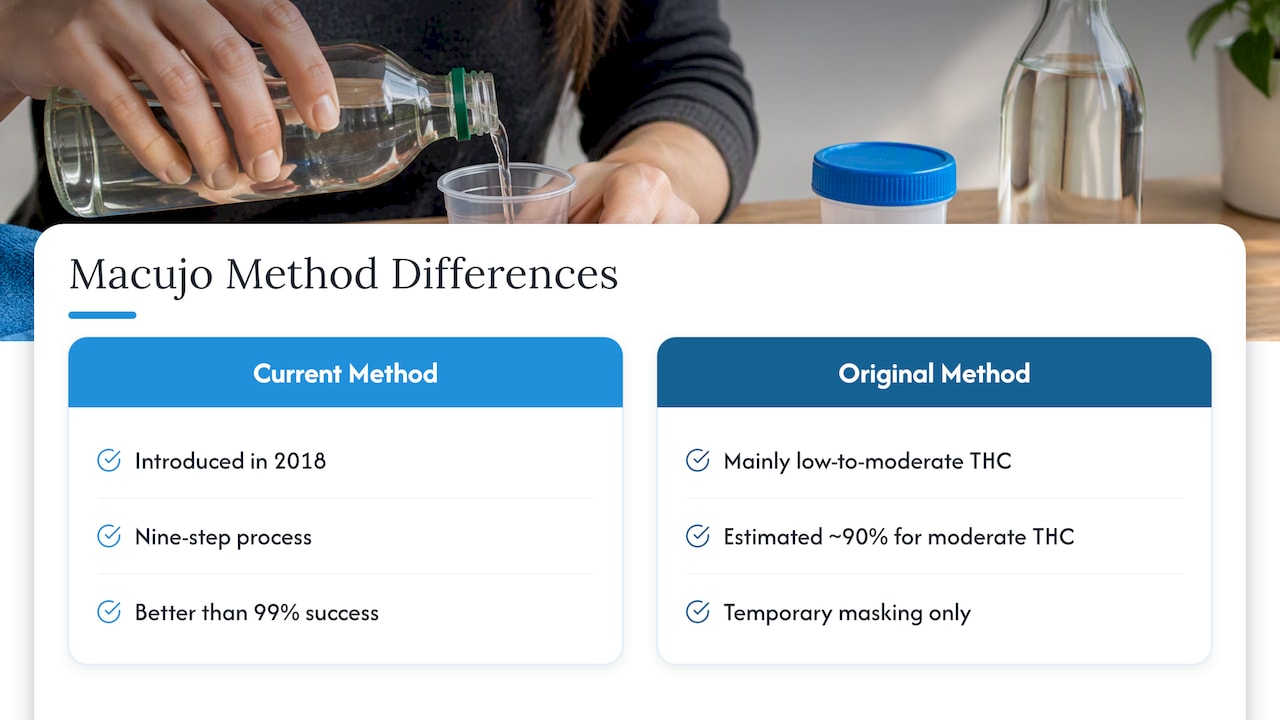
We also want to be clear about the older approach. The original Macujo Method was designed mainly for low-to-moderate THC exposure, with an estimated success rate of about 90% for moderate THC, and it only masks temporarily. It is not the same as the current method, and neither one is a vinegar rinse.
If your use was light and your test is far away, you may not need us at all, and we would rather tell you that than sell you something. If your test is close, the wrong move is losing days to a remedy with no evidence behind it.
— MIchael
What to do instead of reaching for vinegar
- Write down your facts. Which substance, the date of last use, and how often you used in the last 90 days. Every sound plan starts here.
- Find out the test type. Ask the employer or the testing company whether it is a hair test, which panel it covers, and whether head hair is expected. A standard 5-panel screen covers cocaine, opiates, THC, amphetamines and PCP, according to US Health Testing. Our article on what drugs show on a hair follicle test goes through each class.
- Count the days. Hair test timing is about collection date, not the date you started worrying.
- Stop adding damage. No undiluted acids, no bleach experiments, no scalp scrubbing to the point of irritation.
- Get a plan sized to your situation. Our step-by-step guide on how to pass a hair follicle drug test lays out the timeline, and our calculator gives the number of washes.
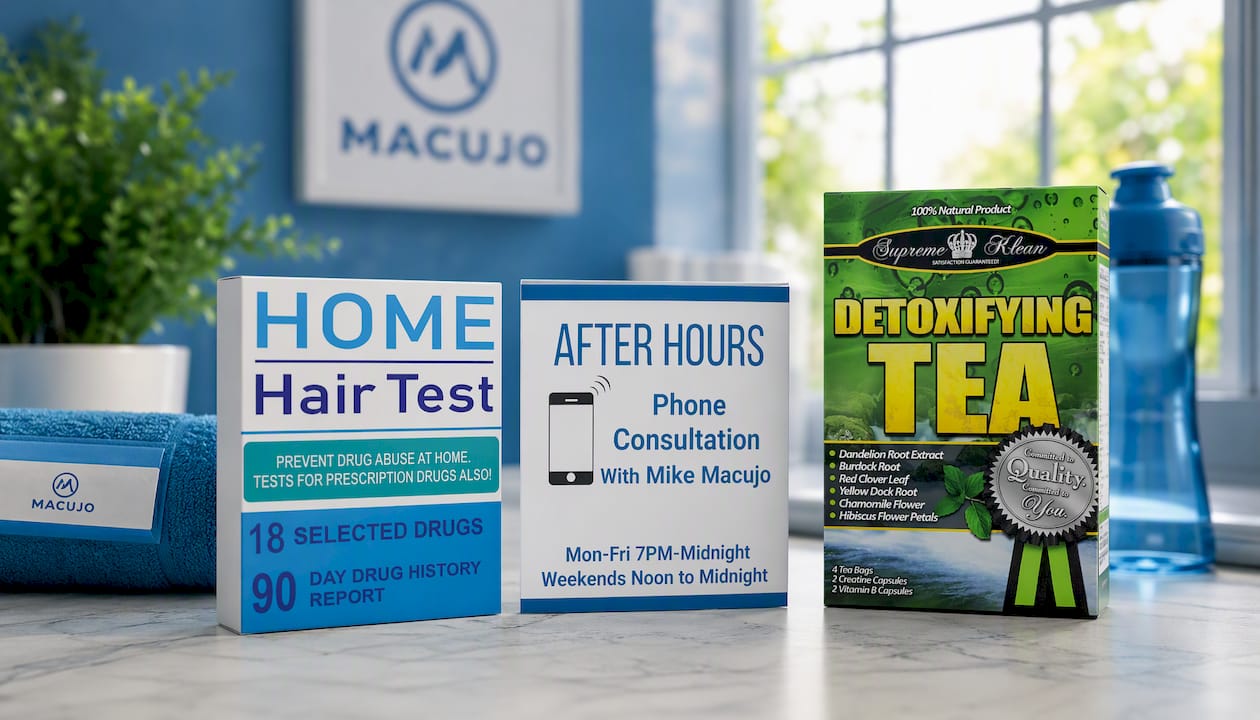
- Consider a home test. A home kit can help you check where you stand before the real collection. See our Home Hair Test kit.
A note on testing rules
Workplace hair testing is a regulated field. SAMHSA’s Drug Testing Advisory Board has spent years reviewing the federal guidelines for hair testing, including questions about how samples that may have been chemically treated should be handled. Expect labs to keep tightening their procedures, which is one more reason to rely on a documented method rather than folklore.
How our offer fits
When your test is near, you have two practical routes with us.
Macujo Aloe Rid Old Formula Shampoo: the shampoo used in our method, priced at $100 to $150 depending on the product. You can see the range on our hair products page.
Afterhours Personal Consultation: a one-on-one phone session for $100, for the person who needs an answer tonight and a plan tomorrow. Details are on the consultation page. We also offer ongoing support so you are not left guessing mid-process.
If you are unsure which route fits, begin with the required-washes calculator on our site and then call.
What if the result is positive anyway?
A positive result is not always the end of the road. Our guide on using the 90-day window to verify and retest explains your options, including how timing affects a retest. If your test is on eyebrow hair instead of scalp, the rules shift as well, and we cover that in Eyebrow Hair Drug Tests.
For more on timelines, see how far back a hair follicle test goes, or browse our blog.
What a hair test costs, in case you are weighing a retest
Prices vary by provider and panel. A standard 5-panel hair test generally runs about $99 to $189, and expanded panels can cost $400 or more, according to US Health Testing. Results typically arrive in 3 to 5 business days. If you are checking your own status, that is the range to expect from a lab-based option.
FAQ
Does apple cider vinegar help you pass a hair drug test?
No evidence says it does. Drinking it cannot change hair that has already grown, and Healthline’s review finds no scientific support for vinegar cleansing your system. Using it only as a rinse is also unproven and can irritate your scalp.
Can I use white vinegar instead of apple cider vinegar?
The type of vinegar does not change the result. Neither has evidence as a way to remove drug metabolites from hair. White vinegar is typically more acidic than some other types, so dilution matters even more if you use it for ordinary hair care.
Will vinegar damage my hair before a test?
It can if you use it undiluted or too often. Experts cited by Byrdie warn of dryness, irritation and burns, and of harm to the hair’s keratin matrix. If you want a shine rinse, dilute it in water, and avoid using it as a “detox.”
Does vinegar work for urine tests?
No. Labs check pH, creatinine and specific gravity, so a sample tampered with vinegar can be flagged. That may mean an automatic fail or a supervised retest, as Healthline explains.
What actually works for a hair test?
Results depend on your substance, last use date and frequency over the previous 90 days. We built Mike’s Macujo Method and its required-washes calculator around those inputs. If you want help for your own situation, our $100 Afterhours Personal Consultation is the quickest way to talk it through.
Sources
- Hair analysis: Assessment of homemade hair treatment effects on drug concentrations in the keratin matrix
- Advances in testing for sample manipulation in clinical and forensic toxicology, part B: hair samples
- Manipulation of THC Hair Concentrations by Commercially Available Products
- Does Vinegar Really Clean Your System in 24 Hours? (Healthline)
- Hair Strand Drug Test: How It Works, Uses, and What to Expect (Healthline)
- Apple Cider Vinegar for Hair (Byrdie)
- Hair Drug Test (US Health Testing)
- SAMHSA DTAB open meeting summary minutes, June 2023