Last Updated on August 13, 2026
Key Takeaways:
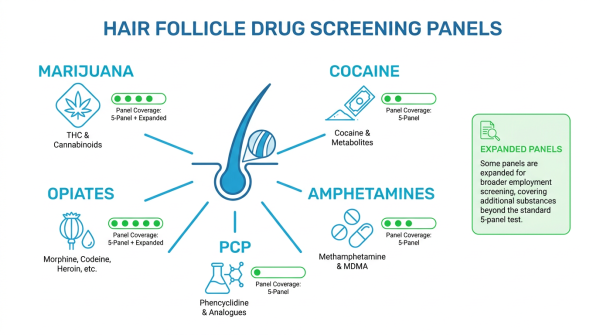
- Employment hair tests usually screen multiple drug classes at once, including marijuana, cocaine, opiates, amphetamines, and PCP, and some employers add even more substances to the panel.
- A standard scalp sample can reveal roughly 90 days of use, and body hair can extend that look-back period, so occasional or older use may still show up on test day.
- When the risk comes from a broad panel, the safest move is a full preparation protocol like Mike’s Macujo Method, supported by home testing and expert guidance, instead of guessing which substance matters most.
Most people approaching a hair drug test are solving the wrong problem. They're calculating how long ago they last used a single substance. But standard employment panels routinely screen for marijuana, cocaine, opiates, amphetamines, and PCP in one simultaneous sweep — and expanded panels go further still. The lab isn't interested in your most recent use; it's building a 90-day composite picture across every category at once.
That combination of breadth and depth is what makes hair testing categorically different from a urine or saliva screen. Hair analysis can flag substance use going back roughly 90 days, which means past use that felt occasional, distant, or irrelevant can still fall squarely within the detection window. Preparing for one substance while ignoring the full panel is the most common and most costly miscalculation people make. Mike’s Macujo Method is built around that reality: panel-wide preparation, not single-substance guesswork.
Which Drugs Are Included in Hair Follicle Testing Panels?
If you're preparing for an employment hair test, knowing exactly what's on the panel changes how seriously you need to take preparation. The answer is almost never "just one drug" — and the assumption that it is, has cost more people more opportunities than any individual substance ever could.
Does a standard hair follicle test panel check for multiple drugs at once?
Yes. The standard five-category panel screens for marijuana, cocaine, amphetamines, opiates, and PCP together in a single test. Employers don't run separate tests for each substance. One hair sample covers the whole panel at once.
Can employers expand the panel beyond those five categories?
They can. Agencies and employers may add substances like prescription opioids, benzodiazepines, or other Schedule I/II drugs depending on their testing policy. Expanded panels are increasingly common in safety-sensitive roles, so assuming a basic five-panel is the ceiling can be a costly mistake.
What does marijuana detection mean for someone who only uses occasionally?
It means occasional use still leaves a record in hair. Hair follicle testing detects THC metabolites that become embedded in the hair shaft as it grows. Infrequent use doesn't reliably fall below detection thresholds the way it sometimes might with urine testing.
Do cocaine and opiates in hair follicle screening carry risk even when use wasn't recent?
Yes, and this is one of the more misunderstood aspects of this test format. A standard sample covers approximately 90 days of history. Past use that felt distant can still fall well within the detection window.
Where can I find a full breakdown of what hair tests screen for?
Macujo's hair drug testing resource covers the commonly screened substances, cutoff levels, and the factors that influence whether a drug shows up. It's a useful starting point before deciding how to approach preparation.
How Long Can Drugs Stay Detectable in Hair?
The detection window is where hair testing separates itself from every other screening method. Understanding how far back a hair sample can reach, and what affects that range, helps you see why panel-based testing creates real risk even when use feels like old news.
What is the typical hair drug test detection window for employment screening?
A standard scalp hair sample covers roughly 90 days of history. According to federal workplace testing guidelines, hair grows approximately 1 cm per month, and the standard 1.5-inch sample collected closest to the scalp maps to about three months. That's a significantly longer look-back period than urine or saliva can provide.
Why can marijuana detection in hair tests remain a concern even after the immediate effects are gone?
THC metabolites travel through your bloodstream and become embedded in the hair shaft as it grows. According to clinical research, metabolites typically appear in hair within 7 to 10 days of use and stay there. The high wearing off days or weeks ago doesn't reduce what's recorded in the hair strand.
How do amphetamines and PCP hair test detection timelines compare with other panel substances?
Amphetamines and PCP follow the same basic principle as other substances: once deposited in hair, they remain within the standard 90-day window. No commonly screened panel substance clears hair faster than the hair itself grows out. That means the timeline risk is consistent across the full panel, not substance-specific.
Do hair length, body hair, and sample location affect how far back a test can look?
Yes, and this matters more than most people expect. When scalp hair isn't long enough or available, collectors can use body hair, which can extend the detection window considerably beyond 90 days because body hair grows more slowly. The federal guidelines also note that hair site, pigmentation, and cosmetic treatments can influence how results are interpreted.
How is a hair test different from urine or saliva testing when it comes to detecting past use?
Urine and saliva tests are designed to catch recent use, often within a few days. Hair testing is specifically built for longer retrospective detection. As SAMHSA confirms, hair is an accepted specimen type for employment screening precisely because it captures a broader historical picture. That's a fundamentally different standard of scrutiny.
What Should You Do If a Broad Hair Test Panel Puts You at Risk?
Knowing which drugs a panel screens for is only half the picture. The more pressing question is what you do with that information before test day.
Where should you start when you find out a hair follicle test is coming?
Start by assuming the panel is broad. Labcorp's overview of hair drug testing confirms that employment screening typically covers multiple drug classes with mass spectrometry confirmation. Preparing for a multi-drug panel from the outset is far safer than betting on a narrow screen.
Why does a proven cleansing protocol beat guessing which drug category the lab will flag?
Labs don't share their internal prioritization, and they don't need to: mass spectrometry confirmation catches everything the initial screen flags, across every category simultaneously. Preparing only for the substance you're most concerned about is a structural mistake — you're covering a fraction of what the test actually screens. Mike’s Macujo Method is built for the full panel: every category, every detection window, every treatment step in the right sequence.
How does Mike’s Macujo Method actually work to help you prepare?
The method combines Macujo Aloe Rid® Shampoo — a proprietary detox shampoo whose authenticity is independently verifiable — with Zydot Ultra Clean Shampoo and supporting products including Clear Skin Deep Cleansing Astringent with 2% Salicylic Acid and Tide. Each component targets the hair at a different level of the cleansing process, working together in a specific sequence rather than as standalone treatments.
When does a Home Hair Test Kit make sense before your official screening?
If you want a concrete read on where you stand before the official test, Macujo's Home Hair Test Kit screens for 18 drug analytes using the same GC/MS/MS and LC/MS/MS confirmation methods that accredited labs rely on. Results come back within 3 to 7 business days after the lab receives your sample, giving you actionable information while there's still time to act.
How does expert support reduce the risk of mistakes when the timeline is tight?
Following steps out of sequence or underestimating the number of treatments needed are the most common preparation errors. Macujo's unlimited expert support means you can get direct guidance on your specific situation — timeline, hair type, usage history — rather than piecing together generic advice under pressure. That kind of personalized support is especially valuable when you can't afford a misstep.
Get the Right Hair Detox Products for Drug Testing Before Test Day
Every substance a panel screens for carries the same implication: months of history embedded in your hair, available to any accredited lab. Knowing what drugs show on a hair follicle test is the starting point; having a preparation protocol equal to the full panel is what actually protects you.
Mike’s Macujo Method carries a 99.9% success rate when authentic Macujo Aloe Rid® Shampoo is used, every direction is followed, and all calculator-recommended washes are completed because it addresses the test as labs actually run it: a multi-drug panel with a 90-day memory, not a single-substance spot check. Supported by Macujo Aloe Rid® Shampoo, Zydot Ultra Clean Shampoo, and Clear Skin Deep Cleansing Astringent with 2% Salicylic Acid, the method works across every category because that's exactly what your test is doing too. The gap between what most people prepare for and what accredited labs actually screen is precisely where outcomes are decided. The right hair detox products for drug testing, used in the right sequence with the right support, close those gaps before they close on you.