Last Updated on October 15, 2026
Yes, delta-8 use can result in a detectable cannabinoid finding in a hair (hair-follicle) test. Whether a lab reports it depends on the method used: a generic immunoassay screen may flag it as a cannabinoid, while a confirmed finding specific to delta-8 requires LC-MS/MS testing with proper chromatographic separation. We work with people facing exactly this uncertainty every day.
TL;DR:
- A typical scalp sample measuring 1.5 inches represents roughly 90 days, but growth rate, sample length, segmentation, and laboratory cutoff can shorten or extend that window.
- An immunoassay screen can react to delta eight without distinguishing it from delta nine; validated liquid chromatography with tandem mass spectrometry can report them separately.
- A validated study of 5,863 hair specimens confirmed delta eight in 9.0%, and some results showed it without delta nine.
- Before testing, ask the laboratory whether its confirmation panel includes delta eight, whether it reports the cannabinoids separately, and which cutoff concentration it applies.
- A nonnegative screen is presumptive, so request the full report for the confirmed cannabinoid and concentration, and consult a Medical Review Officer when applicable.
Table of Contents
- How hair testing works and typical detection windows
- Screen versus confirm: the delta-8 and delta-9 isomer problem
- Factors that change whether delta-8 is detected in hair
- What a non-negative hair result actually means
- Preparing when a hair test is imminent
- Cleansing protocols for delta-8 specifically
- Why test-specific guidance matters more than generic advice
- Get test-ready before your scheduled test
- FAQ
- Sources
How hair testing works and typical detection windows
Hair testing relies on a basic biological process: as hair forms beneath the scalp, it draws nutrients and compounds from your bloodstream, and anything circulating there, including cannabinoid metabolites, can become locked into the hair shaft as it grows. That is the primary incorporation pathway, but it is not the only one. Cannabinoids can also deposit onto the hair from sweat, oils, or environmental smoke, which is why interpretation matters just as much as detection itself.
Hair grows at a fairly predictable rate, which is why labs collect a standard sample length, typically about 1.5 inches from the scalp, and treat that segment as roughly a 90-day window. You’ll often see “up to about 90 days” cited as the standard detection estimate, but that figure is an approximation tied to average growth speed, not a fixed biological rule. Growth rate varies by individual, by body region, and even by season, so the actual look-back period can run shorter or longer than the textbook estimate.
A few variables shift that window in practice:
- Sample length: a longer collected segment extends the look-back period beyond the standard 90 days.
- Growth rate differences: faster or slower individual hair growth compresses or stretches the window that a 1.5-inch sample actually represents.
- Lab cutoff concentration: a lower cutoff can detect lighter or more distant exposure; a higher cutoff may miss it.
- Segmenting: some labs analyze hair in sections rather than as one piece, which can localize use to a narrower timeframe within the 90-day estimate.
Because of this variability, two people with identical use patterns can get different-looking results depending on which lab processed their sample and how it was collected. Understanding how hair drug testing actually works before a scheduled test gives you a realistic sense of what that 90-day number does and doesn’t guarantee.
Screen versus confirm: the delta-8 and delta-9 isomer problem
Every hair drug test starts with a screening step, and most screens use immunoassay technology. Immunoassays work by detecting chemical structures that resemble a target compound, which is efficient but imprecise. Delta-8 and delta-9 THC are structural isomers, meaning they share the same molecular formula and very similar shapes, so an immunoassay built to catch delta-9 can also react to delta-8 without distinguishing between them.
That cross-reactivity is well documented in urine testing, where Aegis Sciences Corporation reports delta-8 carboxy-THC cross-reactivity of 87% to 112% across commercial immunoassay platforms at a 50 ng/mL cutoff. That figure describes urine testing specifically, and Aegis is clear that it should not be assumed to transfer directly to every hair assay, since hair testing uses different extraction methods and screening targets.
A non-negative immunoassay screen is considered “presumptive,” not definitive. To get a reportable, legally defensible result, labs run confirmatory testing using liquid chromatography combined with tandem mass spectrometry, or LC-MS/MS. This method physically separates compounds by their chemical behavior before measuring them, which means a properly validated LC-MS/MS method can distinguish delta-8 from delta-9 rather than lumping them into one generic “THC” finding.
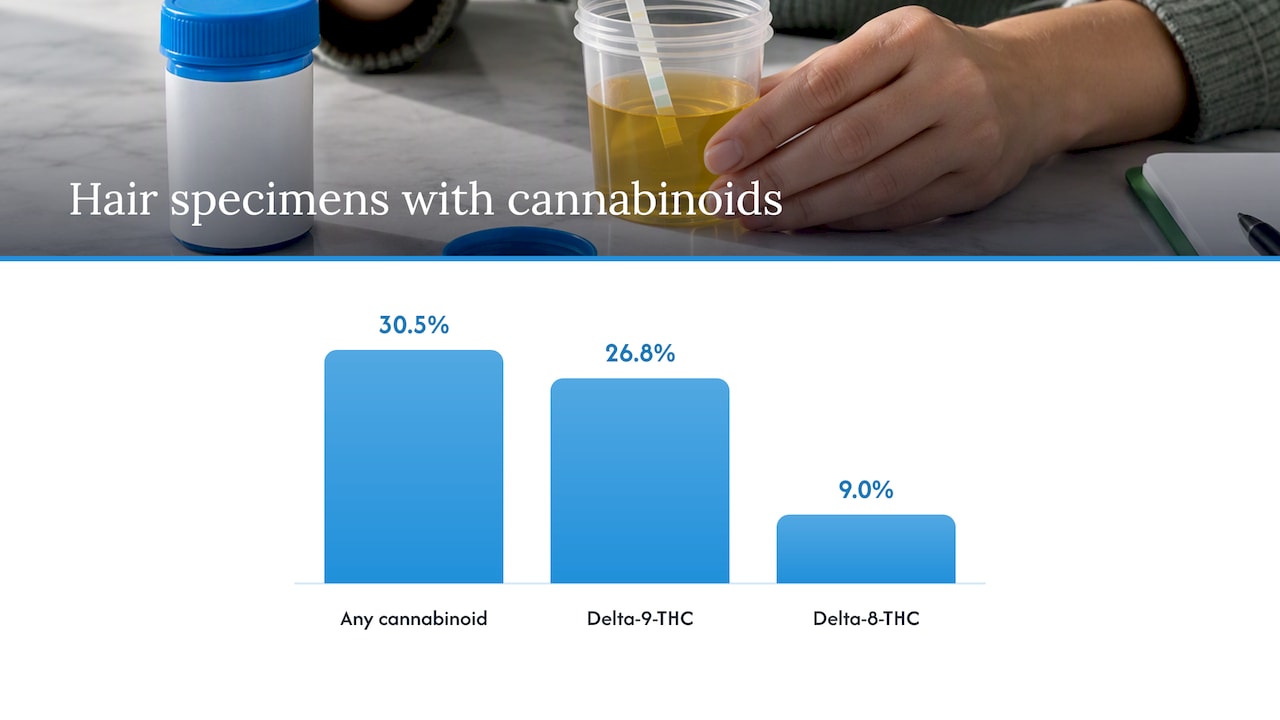
A validated hair LC-MS/MS method applied to 5,863 hair specimens between February and October 2024 found that 30.5% confirmed at least one cannabinoid, with delta-9-THC the most common at 26.8% and delta-8-THC confirmed in 9.0% of specimens according to peer-reviewed hair testing data, with some specimens showing delta-8 alone. That detail matters: delta-8 is not a hypothetical blind spot. It is actively being found, isolated, and reported in real hair samples when labs use validated confirmation methods.
A separate 2025 hair study confirmed that validated assays can measure delta-8, delta-10, and CBD as distinct, separately reported analytes in hair, which means the old assumption that hair testing only catches generic “THC” is outdated. The practical takeaway for anyone facing a hair test:
- Ask the lab directly whether delta-8 is included in their confirmatory panel, not just their screening panel.
- Ask whether delta-8 and delta-9 are reported as separate analytes or combined into one cannabinoid result.
- Ask what cutoff concentration they use, since a lower cutoff increases sensitivity to lighter exposure.
Lab policy, not product labeling, determines what actually gets reported on your result.
Factors that change whether delta-8 is detected in hair
Detection isn’t a yes-or-no switch. Several variables raise or lower the probability that a specific use pattern will show up on a hair test.
- Frequency and dose: regular or heavy use increases the amount of cannabinoid incorporated into the hair shaft; occasional or light use lowers the odds of detection but never guarantees a clean result.
- Product purity: delta-8 products are inconsistently regulated, and mislabeled products can contain delta-9 THC or other cannabinoids a buyer never intended to use, which means the compound actually detected may not match what the label promised.
- Hair characteristics: hair color, structure, and whether it has been bleached or dyed can change measured concentrations; bleaching may affect measurable drug levels, which complicates straightforward interpretation.
- Environmental exposure: secondhand smoke or surface contact can deposit cannabinoids externally without any personal use, muddying the distinction between use and exposure.
- Lab-specific variables: cutoff concentration, sample segment length, and whether delta-8 was included in the confirmatory panel all shift the final reported outcome.
Pro Tip: If you’ve used dyed or bleached hair as a strategy to reduce detectable levels, treat that as a variable that affects a test, not a guarantee of a clean result.
Because so many of these factors interact, two people using delta-8 with the same frequency over the same period can land on different outcomes depending on hair type, product quality, and which lab processes the sample.
What a non-negative hair result actually means
A non-negative screening result is not the same thing as a confirmed positive, and the distinction matters enormously for anyone trying to understand their actual standing.
- Identify which stage produced the result. A presumptive non-negative comes from an immunoassay screen and reflects chemical similarity, not certainty; a confirmed positive comes from LC-MS/MS and specifically identifies the compound.
- Request the full report. Ask the lab or the ordering party whether the result was confirmed, and if so, which cannabinoid was identified and at what concentration relative to the cutoff.
- Ask what analytes were tested. Confirm whether delta-8 and delta-9 were reported separately or combined, since that single detail changes how the result should be interpreted.
- Consult a Medical Review Officer when applicable. In employment contexts, an MRO reviews non-negative results and can request additional information or confirmatory testing before a final determination is made.
- Consider an independent retest. Official retesting of the original specimen, when available, can resolve disputes over lab error or borderline cutoff results; our piece on using the 90-day window to verify and retest walks through that process.
- Use a home hair test kit beforehand to get a preliminary read before an official test is scheduled, rather than waiting to find out through a high-stakes result.
Treating a screen as a final verdict skips the step that actually determines what a lab is prepared to report.
Preparing when a hair test is imminent
When a hair test is already on the calendar, the practical question shifts from “could this show up” to “what can I do right now.” A few concrete options exist for someone in that position.
- Pre-check with a home test. Our Home Hair Test kit gives you a way to check before the test that actually counts.
- Get a tailored plan. Booking an Afterhours Personal Consultation gives you personalized guidance rather than a generic routine.
- Use method-paired products. Mike’s Macujo Method is built around Macujo Aloe Rid Old Formula Shampoo specifically.
- Follow every step precisely. The method was developed for high THC exposure and other substances, and partial completion undermines the result it’s designed to produce.
If saliva testing is also a possibility, our Multi-Drug Oral Fluid Test covers that scenario separately, since saliva and hair operate on very different detection windows and mechanisms.
Cleansing protocols for delta-8 specifically
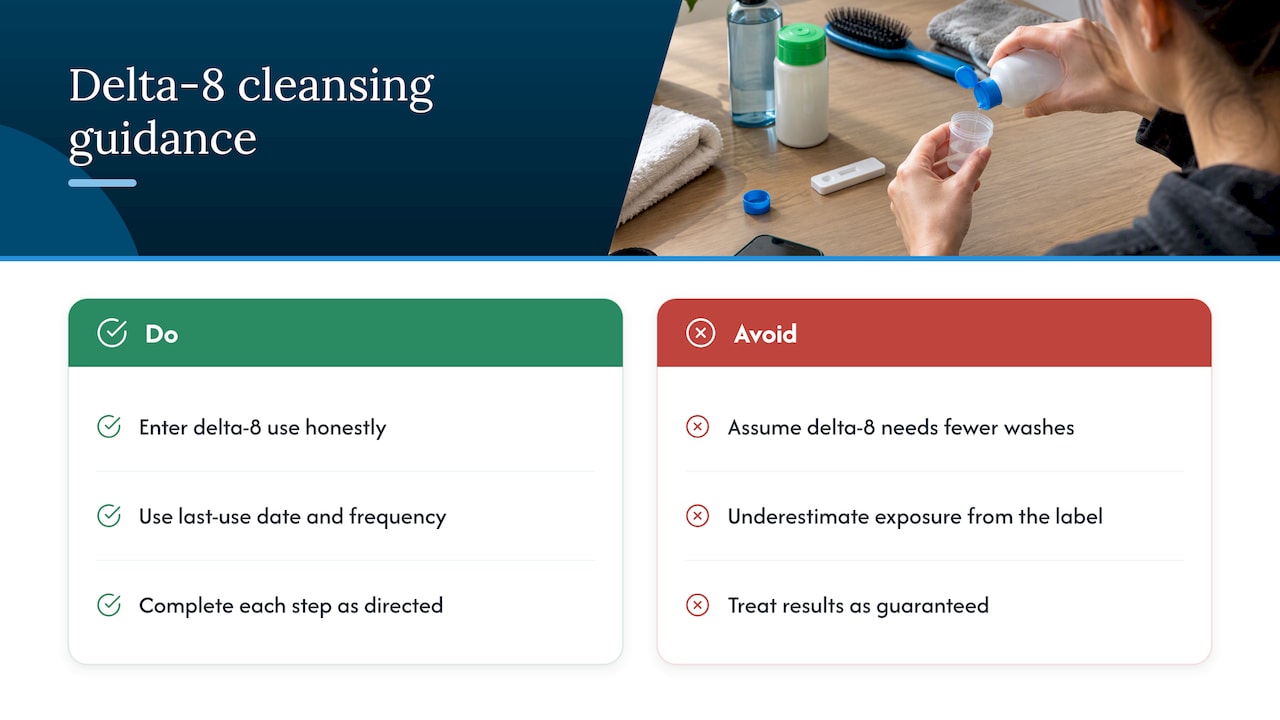
Delta-8 doesn’t require a separate cleansing chemistry from delta-9 THC, since both are cannabinoids that bind to hair in similar ways, but the required-washes calculation still needs to reflect delta-8 use accurately. Mike’s Macujo Required Washes Calculator factors in the substance, date of last use, and frequency over the past 90 days, and entering delta-8 use honestly, rather than assuming it’s a “lighter” compound that needs less attention, produces a more reliable wash count.
The method itself doesn’t change based on which cannabinoid is involved; what changes is how many times each step needs repeating, which depends on your personal use history. Given that delta-8 products vary widely in purity and may contain unlabeled delta-9 THC, we recommend calculating washes as though your actual exposure could be higher than the product label suggests, rather than underestimating based on the softer reputation delta-8 has compared to standard THC.
When every step and every required wash is completed as directed with authentic Aloe Rid shampoo, Mike’s Macujo Method is promoted as a cleansing method, but results are not guaranteed, and hair stays clean afterward unless drugs or alcohol are used again.
Why test-specific guidance matters more than generic advice
I created the original Macujo Method and later developed Mike’s Macujo Method after years of watching generic detox advice fail people facing real, high-stakes tests. We’ve been doing this for many years, and the pattern hasn’t changed: people get tripped up not by the drug itself but by not understanding what their specific lab is actually testing for.
That’s why our focus stays on test-specific protocols rather than one-size-fits-all tips. A required-washes calculation based on your actual substance, timeline, and frequency gives you a real number to work from, and a personal consultation lets us address the details a generic article can’t.
— MIchael
Get test-ready before your scheduled test
Uncertainty before a hair test is worse than the test itself. We built our tools around removing that uncertainty: the Home Hair Test kit gives you a preliminary read before the official one counts, and an Afterhours Personal Consultation walks you through your required-washes estimate based on your own use history.
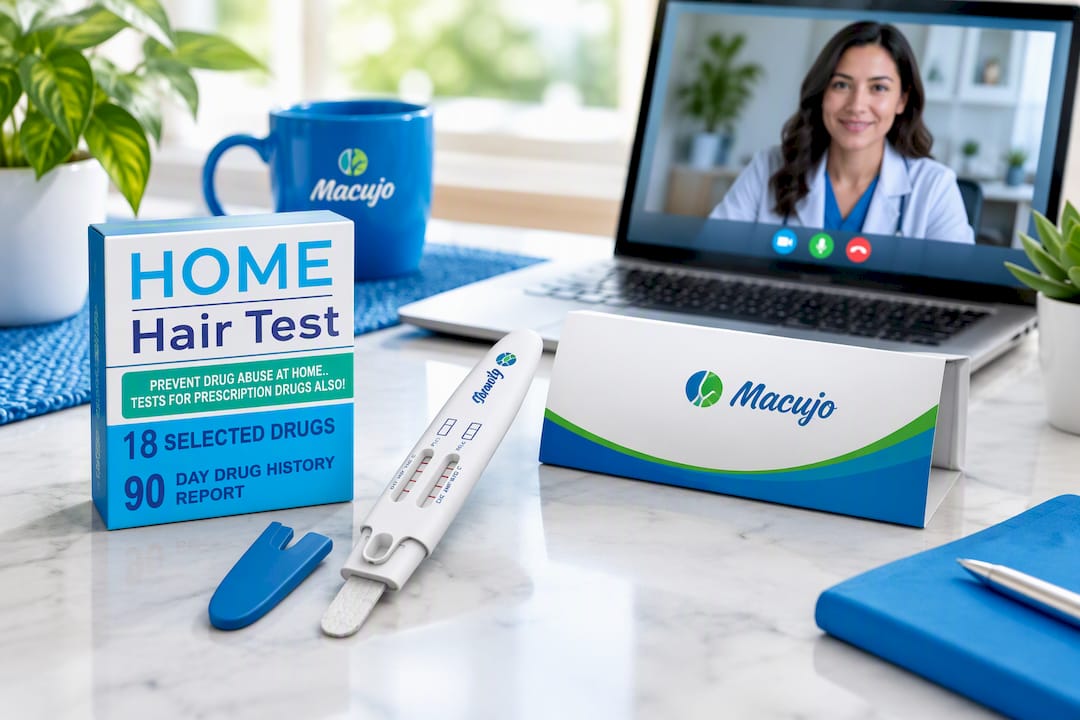
Mike’s Macujo Method is built specifically around Macujo Aloe Rid Old Formula Shampoo, priced between $100 and $150, because the method and the product were developed together. We also carry hair, urine, and saliva test products for anyone who needs to check multiple test types before a deadline. Book your consultation now and get a plan built around your actual situation.
FAQ
Does delta-8 show up on hair follicle drug tests?
Yes, delta-8 can produce a detectable finding on a hair test, particularly when the lab uses a validated LC-MS/MS confirmation method capable of identifying it as a distinct analyte. Whether it’s reported separately from delta-9 THC depends on the specific lab’s testing panel and policy.
How long does delta-8 stay detectable in hair?
Hair testing commonly uses a standard 1.5-inch sample length, which is treated as representing roughly a 90-day window, though individual growth rate and lab protocol can shift that estimate shorter or longer. Frequency of use and dose also influence how much cannabinoid gets incorporated into that window.
How long do I need to stop using before a hair test to pass?
There’s no single universal timeframe, since detectability depends on your use frequency, dose, hair growth rate, and the specific lab’s cutoff and confirmation methods. A personalized required-washes calculation based on your actual use history gives a far more accurate answer than a generic rule of thumb.
Is delta-8 harder to clear from your system than delta-9 THC?
Delta-8 and delta-9 are structural isomers that behave similarly once incorporated into hair, so clearing one isn’t meaningfully harder or easier than the other through a cleansing approach. The bigger variable is usually how much was actually used and how reliably it was labeled, since mislabeled delta-8 products can contain unexpected amounts of delta-9 THC.
Can delta-8 cause a false positive on a hair test?
Delta-8 itself isn’t a false positive; if it’s present in hair, a validated confirmation method is identifying something real. The confusion usually comes from immunoassay cross-reactivity between structurally similar cannabinoids, which is why confirmatory testing that separates delta-8 from delta-9 matters before drawing conclusions.
Sources
- The detection of delta-9-tetrahydrocannabinol, delta-8-tetrahydrocannabinol, delta-10-tetrahydrocannabinol, and cannabidiol in hair specimens - PMC
- An Overview of Testing Capabilities to Identify Use of Marijuana (THC) and Other Natural Cannabinoids - Aegis Sciences Corporation
- Pubmed