Last Updated on September 24, 2026
The only urine drug test detox method backed by real evidence is metabolic clearance: abstaining long enough for your body to naturally eliminate the substance before the test. Detox drinks, pills, and home remedies mostly work by diluting urine or masking it with additives, and modern labs are built to catch exactly that. The realistic outcome of a last-minute shortcut is a flagged or invalid result, not a clean pass, and some products carry documented health risks on top of the failure risk.
TL;DR:
- Natural metabolic clearance remains the only proven method to pass a drug test, as detox drinks and home remedies primarily dilute urine or mask substances, which labs can detect.
- Detection windows vary greatly depending on the drug, usage frequency, and individual factors like body fat and hydration, with some substances like THC potentially detectable for over a month.
- Labs use multiple specimen validity markers such as creatinine and temperature to identify dilution, substitution, or adulteration attempts before confirming drug presence.
- Most detox products and home remedies pose health risks and are unlikely to succeed, as they are often caught through routine validation tests designed to prevent cheating.
- The best strategy involves estimating your detection window accurately, verifying your status with a home test beforehand, and abstaining until the drug metabolites are naturally eliminated.
Table of Contents
- How Urine Drug Tests Detect Substances and Detection Windows
- Do Detox Drinks and Home Remedies Actually Work?
- How Labs Catch Dilution, Substitution, and Tampering
- The Real Risks of Detox Kits and Extreme Dilution
- What Actually Works: Timing, Abstinence, and Preparation
- Facing an Imminent Test: A Short Action List
- Where Macujo Fits Into This Picture
- The Gap Between What Detox Marketing Promises and What Labs Actually Catch
- Macujo’s Urine and Saliva Test Support Options
- Sources
- FAQ
How Urine Drug Tests Detect Substances and Detection Windows
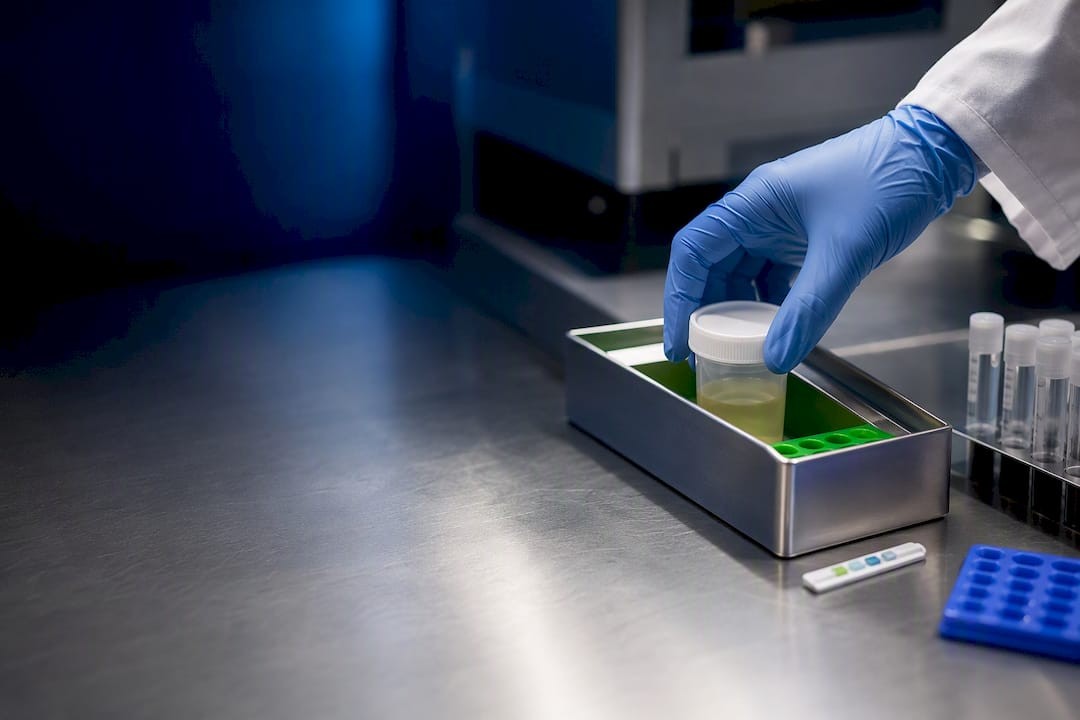
Every urine drug test runs through two possible stages. The first is an immunoassay screen, a fast chemical test that flags the presence of a drug class within minutes. If that screen comes back positive, labs move to gas chromatography-mass spectrometry or liquid chromatography-mass spectrometry, the confirmatory testing methods that identify the exact substance and its concentration. Screens can misfire; confirmatory tests rarely do.
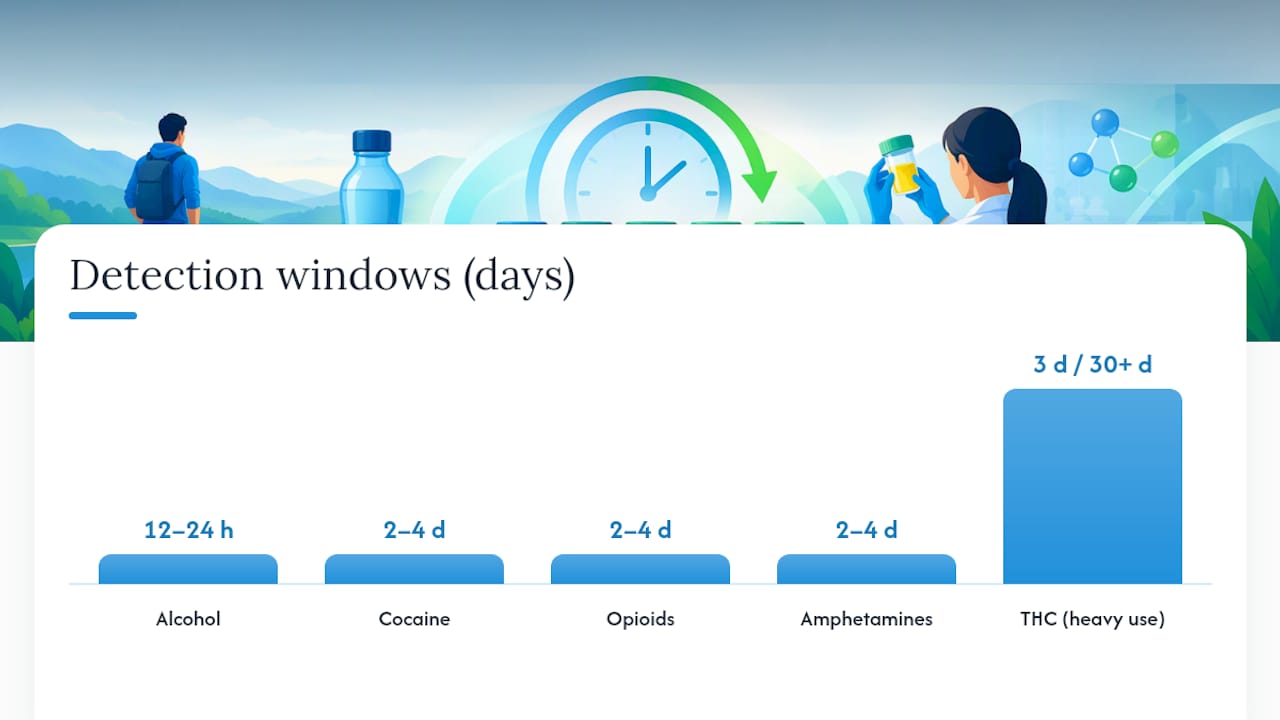
Detection windows vary enormously depending on the drug, how often you use it, and your own physiology. Rough ranges for common substances:
- Alcohol: typically 12 to 24 hours, though metabolite tests can extend that window.
- Cocaine: usually 2 to 4 days for occasional use.
- Opioids: generally 2 to 4 days, longer for extended-release formulations.
- Amphetamines: commonly 2 to 4 days.
- THC: 3 days for a single use, but 30 days or more for daily, heavy use because it stores in fat tissue and releases slowly.
Body fat, hydration habits, metabolism, and frequency of use all shift these windows, sometimes by weeks in the case of cannabis. A person who uses THC daily for months can test positive well beyond the ranges quoted in casual online charts, which is why generic timelines are only a starting point, not a guarantee.
At the point of collection, staff also run specimen validity checks. They measure temperature within four minutes of collection (it should read between 90 and 100 degrees Fahrenheit), and labs later test creatinine, specific gravity, pH, and oxidant levels to catch tampering before the drug panel is even considered.
Do Detox Drinks and Home Remedies Actually Work?
Most commercial detox drinks and pills do not accelerate how your body clears drug metabolites. Their real mechanism is dilution, sometimes paired with masking agents like B-vitamins and creatine meant to disguise the fact that the sample has been watered down.
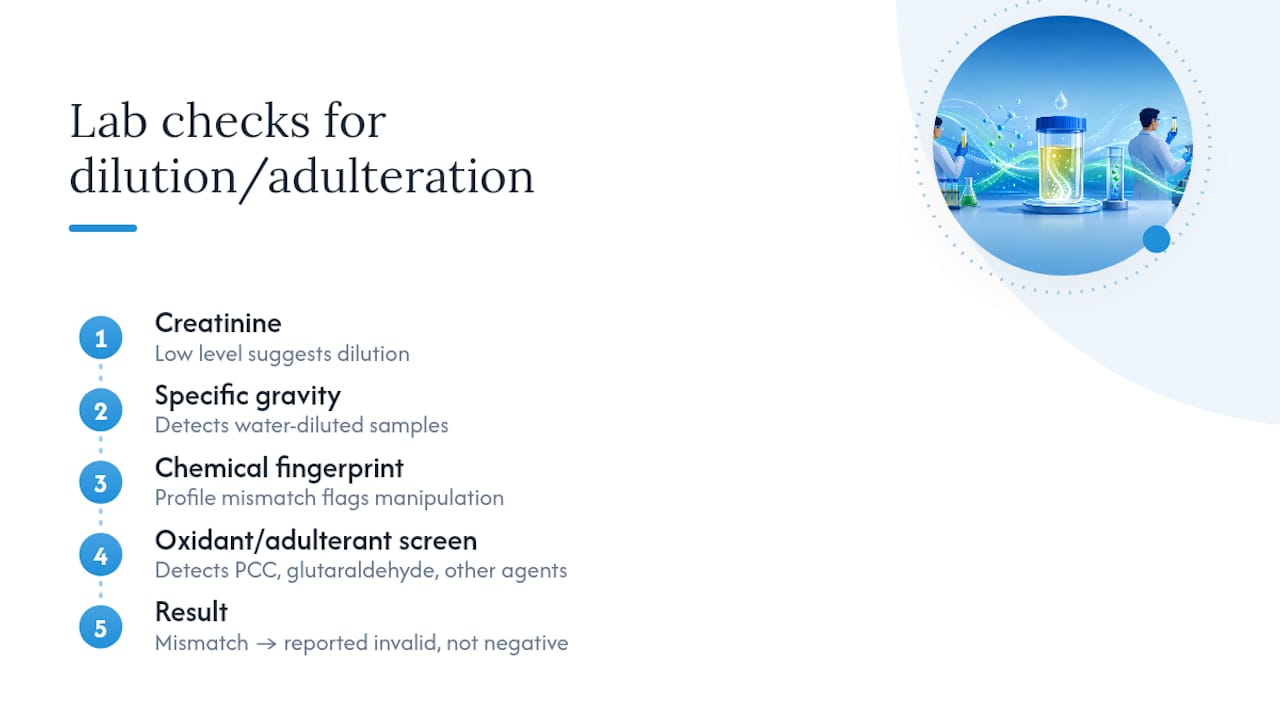
That combination is precisely what specimen validity testing exists to catch. Labs check creatinine and specific gravity levels specifically because dilution is the most common cheating method, and a diluted sample gets reported as invalid rather than negative. Adding synthetic creatine to a diluted sample can raise creatinine readings, but it does nothing to correct specific gravity or the sample’s overall chemical fingerprint, so trained labs still catch the mismatch.
Home remedies fare no better. Cranberry juice, vinegar, niacin, and gallons of water have no reliable evidence behind them for speeding up metabolite clearance. The National Center for Complementary and Integrative Health states plainly that no commercial detox or cleanse product has been proven to remove toxins faster than the body already does on its own. High-dose niacin in particular carries real risk: flushing, liver stress, and in some documented cases, hospitalization.
Nearly all detox kits on the consumer market operate through dilution or in vitro adulteration, not genuine detoxification — that is the core finding of a peer-reviewed case review published in a clinical journal, which also documented a case of acute psychosis linked to use of a detox kit. Adulterants like PCC (pyridinium chlorochromate), glutaraldehyde, and other oxidizing agents can interfere with certain immunoassays, but labs run spot tests for these compounds and can still flag a sample as adulterated even when the initial screen looks clean. The gap between what these products promise and what a lab actually sees is the entire reason the detox industry exists without matching evidence to back it.
How Labs Catch Dilution, Substitution, and Tampering
Specimen validity testing is the layer that catches most cheating attempts before the drug panel result even matters. Labs and collection sites rely on a specific set of markers, each with its own cutoff:
- Creatinine below 20 mg/dL signals a dilute specimen; below 2 mg/dL signals substituted urine.
- Specific gravity outside the normal physiological range points to dilution or a non-urine substitute.
- pH outside 4.5 to 9.0 suggests adulteration.
- Oxidants or nitrites above threshold levels indicate an added chemical adulterant.
- Temperature outside the expected human body range within minutes of collection suggests substitution or a smuggled sample.
| Marker | Normal range | Flag threshold | What it suggests |
|---|---|---|---|
| Creatinine | Above 20 mg/dL | Below 20 mg/dL (dilute), below 2 mg/dL (substituted) | Water loading or fake urine |
| Specific gravity | normal physiological range | Outside that range | Dilution or substitution |
| pH | 4.5–9.0 | Outside that range | Chemical adulteration |
| Temperature | 90–100°F | Outside that range at 4 minutes | Substituted or smuggled sample |
When a specimen trips one of these markers, the SAMHSA/HHS collection protocol calls for a specific escalation path: the result gets reported as invalid or adulterated, a direct observed recollection is scheduled, and a Medical Review Officer reviews the case before any final decision. DOT guidance on specimen validity thresholds confirms these same cutoffs apply across federally regulated testing programs, which is why the numbers above are not arbitrary. Some labs go further, using multi-marker biomarker panels that combine endogenous and exogenous compounds to catch synthetic urine and sophisticated substitution attempts that older single-marker tests might miss.
The Real Risks of Detox Kits and Extreme Dilution
The risk here isn’t only a failed test. The peer-reviewed case report cited earlier documented psychosis following use of a detox kit, a stark reminder that these products are not medically inert. Drinking excessive water in a short window to force dilution can also cause dangerous electrolyte imbalances, including hyponatremia, which has landed people in emergency rooms.
- Most detox drinks and kits sit outside FDA oversight, meaning ingredient lists can be incomplete or misleading.
- A flagged or invalid result at work typically triggers an observed retest, not automatic termination, but repeated flags or refusal to retest often leads to disciplinary action.
- Some states have passed laws specifically targeting the sale or use of products marketed to defeat drug tests, so legal exposure varies by location.
Pro Tip: If a job offer or legal matter hinges on the result, treat any product promising an “instant flush” as a red flag rather than a shortcut. The health and disciplinary downside almost always outweighs the slim chance it works.
What Actually Works: Timing, Abstinence, and Preparation
Metabolic clearance, simply waiting out the detection window, is the only method with real evidence behind it. There’s no product that reliably beats your own liver and kidneys at their job. The practical work is in estimating your window accurately and confirming clearance before the real test.
- Estimate your detection window based on the substance, your frequency of use, and body fat, since fat-soluble drugs like THC clear much slower in regular users.
- Buy a reliable home urine test kit and use it several days before the official test to check your actual status, not just a guess based on a chart.
- Skip last-minute flushing or extreme water intake. It rarely helps and can trigger a dilute flag that creates its own problem.
- Keep hydration normal, not excessive, in the days leading up to the test.
- Gather documentation for any prescribed medication that could otherwise trigger a false positive on the initial screen.
Pro Tip: A home test taken 48 to 72 hours before the real one gives you enough time to react if it’s still positive, without being so early that your status changes before the actual collection.
If your result seems inconsistent with your actual use, or you have a legitimate prescription that could cross-react with a screening panel, ask for confirmatory testing or a Medical Review Officer review rather than accepting a screen result at face value. For high-stakes situations, a short paid consultation with someone who has reviewed testing procedures for years can save you from a costly guess.
Facing an Imminent Test: A Short Action List
With days or hours left, the checklist gets simple:
- Confirm the test type and whether collection will be directly observed.
- Take a home urine test now to know your real starting point.
- Ignore any product claiming an instant or same-day clear. None of them have that track record.
- Write down any prescription medications and dosages in case the MRO needs to review a cross-reactive result.
- If the outcome affects employment or a legal matter, consider a paid consultation before the test rather than after a failed one.
If a last-minute dilution or masking attempt gets flagged, the likely sequence is an invalid result, a scheduled observed retest, and then possible disciplinary steps if the pattern repeats. If you have a legitimate medical explanation, such as a prescribed medication, tell the MRO directly and provide documentation. That conversation, handled early, resolves far more cases than people expect.
Where Macujo Fits Into This Picture
A company named Macujo has focused on hair follicle test preparation since around 1999, led by Mike, creator of Mike’s Macujo Method. This includes hair testing products and support, urine and saliva test support products, a required-washes calculator for hair testing, and Aloe Rid Old Formula Shampoo. For urine-specific questions, the company offers home test kits and consultation services for readers who want expert advice before a high-stakes test.
The Gap Between What Detox Marketing Promises and What Labs Actually Catch
The detox industry sells certainty. Labs sell verification. That mismatch is the whole story here.
Most of the marketing around urine drug test detox leans on vague language: “flush,” “cleanse,” “clear.” None of that describes a real mechanism, and the peer-reviewed evidence backs up why. Dilution gets caught by creatinine and specific gravity checks. Masking agents get caught by the same checks plus oxidant screening. The conventional wisdom that “everyone knows someone who passed with a detox drink” ignores survivorship bias. Nobody posts online about the failed attempt that got flagged as invalid and led to an observed retest.
What actually deserves priority is boring but effective: know your detection window, verify your status with a home test before the real one, and don’t improvise with chemicals or excessive water in the final 24 hours. If a prescription is in play, documentation beats concealment every time. The people who get burned aren’t usually the ones who understood their situation and waited it out. They’re the ones who trusted a bottle promising a shortcut science hasn’t found yet.
— MIchael
Macujo’s Urine and Saliva Test Support Options
If you’re weighing product-backed options rather than waiting out a detection window, Macujo carries a few specific items worth knowing about. The Ultra Pure Synthetic Urine 2oz. Kit, sold as three for the price of two, and the larger Ultra Pure Synthetic Urine 4oz. Kit, sold under the same multi-pack pricing, are both available on the site. Macujo also carries the Supreme Klean Ultra Mask Detox Drink for readers exploring that category.
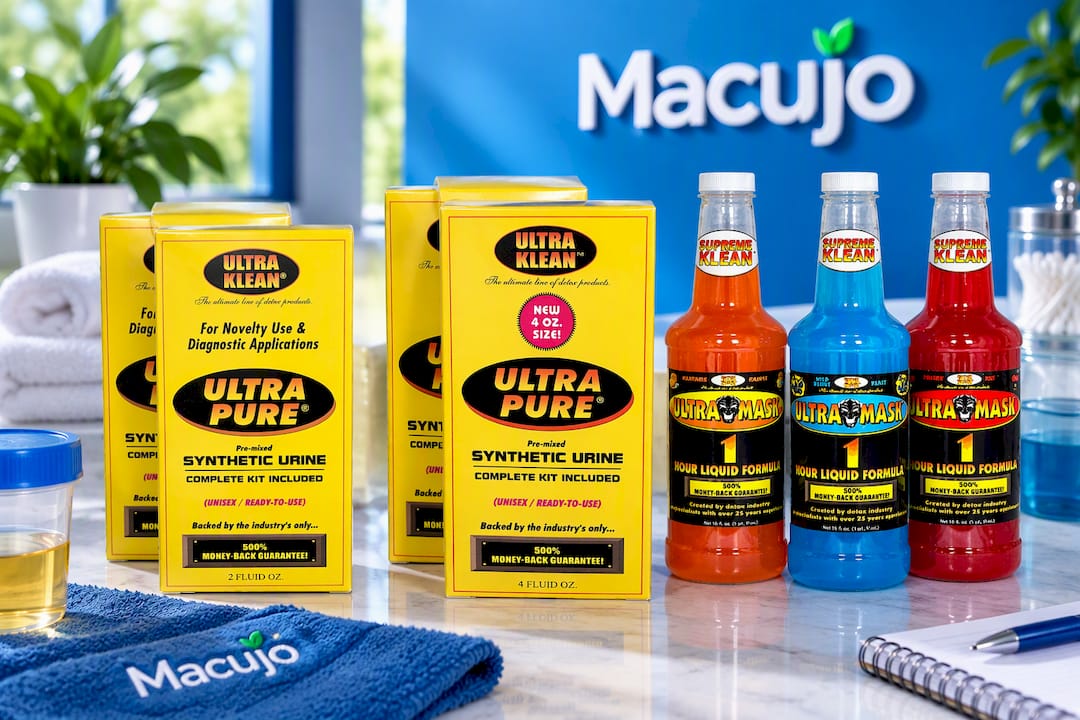
None of these are presented as guaranteed solutions, and the safety and detection risks covered earlier in this guide apply to any product in this category, including these. For tests tied to employment decisions, legal proceedings, or anything with real consequences attached, the safer move is talking it through first. Macujo’s Afterhours Personal Consultation connects you directly with someone who can walk through your specific timeline, substance history, and test type before you spend money on a product that may not fit your situation. Browse the full urine and saliva test product catalog or book a consultation slot if your test is coming up fast and the stakes are high enough to warrant a second opinion.
FAQ
How Long Does It Take to Detox for a Urine Test?
It depends entirely on the substance and how often you’ve used it. THC can clear in about 3 days after a single use but take 30 days or longer with daily heavy use, while most other drug classes clear within 2 to 4 days for occasional use, according to clinical detection window data.
How Can You Make a Drug Test Come Back Negative?
The only reliable route is abstaining long enough for your body to clear the substance naturally before the test. Products claiming to speed this up mainly cause dilution, which specimen validity testing is specifically designed to catch and flag as invalid rather than negative.
What Should You Drink to Cleanse Urine Before a Test?
There isn’t a drink proven to cleanse metabolites out of urine faster than your body already does. The National Center for Complementary and Integrative Health confirms no commercial detox product has reliable evidence behind it, and normal hydration beats excessive water intake, which risks a dilute flag.
Can Labs Detect Detox Products or Tampering?
Yes. Labs check creatinine, specific gravity, pH, and oxidant levels specifically to catch dilution and masking agents, and a suspicious result typically leads to an invalid report and an observed retest rather than a passed test.
Does Macujo Sell Products for Urine Drug Tests?
Yes. Macujo carries synthetic urine kits and detox drink options, and offers a paid Afterhours Personal Consultation for readers who want to discuss their specific timeline and test type before deciding on an approach.