Last Updated on November 5, 2026
Almost certainly not. Being in a room where someone smoked is very unlikely to produce a positive hair follicle result, because labs wash the hair, look for metabolites your body makes, and set cutoffs above what passive exposure produces. But smoke can land on hair, and that is why the question keeps coming up. Below, we explain what the research shows, where the real risks sit, and what to do if you have a test coming up.
TL;DR
- Ordinary secondhand smoke, such as a smoker in the same room or car, is very unlikely to cause a positive hair test result.
- Smoke can deposit on hair fibers, so extreme exposure (sealed spaces, heavy and repeated, or living and working around heavy use) is the realistic worry.
- Labs wash samples, test the wash, and look for metabolites that point to ingestion rather than surface contamination.
- A hair sample covers about 90 days, so what counts is what happened over that whole window, not just the last few days.
- If you have actually used, secondhand smoke is not the issue. A test-specific cleansing plan is.
Table of Contents
- The short answer: secondhand smoke rarely causes a failed hair test
- How smoke gets onto hair
- How labs separate contamination from use
- Cutoffs: why passive exposure usually stays below the line
- When the exposure is not ordinary
- If a result comes back positive and you did not use
- How long to stop smoking, and why that is a different question
- Practical steps before your test
- Our perspective
- Get a plan built for your timeline
- FAQ
- Sources
The short answer: secondhand smoke rarely causes a failed hair test
A drug testing company’s overview of hair testing myths says you likely will not inhale enough secondhand smoke for it to show up, and that very excessive smoke in a very tight space is the only scenario where it could. The same page notes that the THC in secondhand smoke is far less potent than what an active smoker takes in, and that participants in confined-space studies did not test positive.
A 2021 Bloomberg Law analysis of environmental exposure claims reaches a similar view. It reports that reputable hair labs use washing techniques to deal with environmental contamination, and that in most situations the cutoffs labs use make it impossible for secondhand smoke or the environment to have caused a positive.
So for the typical situation, a roommate who smokes on the balcony, a concert, a party, a car ride, the realistic answer is no. The rest of this article covers the exceptions, because a few of them are real.
How smoke gets onto hair
Hair is porous, and smoke particles stick to it. This is not a myth. A 2004 laboratory study in Clinical Chemistry exposed hair to marijuana smoke and found that cannabinoids were deposited on the hair fibers. The amount depended on how concentrated the smoke was in the air and on how the hair had been treated. Untreated hair took up less than pretreated hair. Damp hair took up more, and greasy hair took up the most.
A 2025 review in the Journal of Applied Laboratory Medicine lists the usual routes of outside contamination: smoke, dust, aerosols, powders, sweat, or dirty surfaces carrying drug particles. It says marijuana, methamphetamine and crack cocaine smoke can easily settle on hair.
That same review points out that THC-COOH, a cannabis metabolite, is present in sweat and sebum. Transfer to another person’s hair is possible, especially for children or adults living with cannabis users, through close contact and shared pillows. A 2015 study in Scientific Reports found the same pattern: THC-COOH turned up in the hair of people who did not use cannabis, which the authors tied to transfer from consumers through hands, sebum, sweat or smoke.
This matters for one reason. Having drug on your hair is different from having drug in your body, and the lab’s job is to tell those apart.
How labs separate contamination from use
Labs do not simply grind up hair and read a number. The process has layers.
- Washing. One major hair testing lab says it uses extensive chemical washing before screening and analyzes the wash itself. Hair testing facts from Psychemedics explain that drug deposited from outside shows up as the parent drug, not as the metabolites associated with ingestion.
- Metabolite measurement. Because the body creates metabolites, finding them in the hair supports the conclusion that the drug was taken in. The same lab uses cutoff levels set above what passive internal exposure can produce.
- Wash analysis. A UK-based testing provider’s US learning center says the washing solution can also be analyzed to back up the result.
A health-screening provider puts the logic simply: labs test for metabolites the body makes after smoke is inhaled, so trapped smoke alone does not produce a positive if you did not inhale it.
The system is not perfect, and the academic literature says so. The 2025 Journal of Applied Laboratory Medicine review states that washing protocols may not remove every contaminant, especially after repeated exposure, and that metabolites help distinguish contamination from use, with limitations. The 2004 study found that methanol and dichloromethane washes removed contaminants completely only in untreated hair.
The research on THC specifically is also worth knowing. A 2019 study of 672 THC-positive hair samples found that in 38.5% of them, neither 11-OH-THC nor THC-COOH was detectable. The authors concluded THC alone cannot settle active use versus passive exposure. This is exactly why labs rely on the metabolite and its cutoff, not on THC alone.
Cutoffs: why passive exposure usually stays below the line
Hair tests have two stages: an initial screen, then a confirmation on anything that screens positive. The cutoffs for marijuana metabolites are tiny numbers, measured in picograms per milligram of hair.
| Stage | Marijuana metabolite cutoff | Source |
|---|---|---|
| Initial screen | 1.0 pg/mg | Quest Diagnostics |
| Confirmation | 0.1 pg/mg | Quest Diagnostics |
| Proposed federal confirmation | 0.05 pg/mg | LegalClarity |
| Society of Hair Testing recommendation for THC-COOH | 0.2 pg/mg | Giorgetti et al., 2019 |
A drug testing company that publishes its labs’ cutoffs says they are designed to give donors the benefit of the doubt, ruling out secondhand smoke and over-the-counter medications. A laboratory manufacturer’s FAQ says something similar for screening in general: cutoffs are intentionally set higher to limit false positives from trace contamination or passive exposure.
One caution: the cutoff numbers differ between labs and between proposed and current rules. Hair is also not part of the federally mandated testing programs. Drugtest.co notes hair is not federally approved under SAMHSA Mandatory Guidelines or DOT rules, so the employer’s chosen lab sets the specifics. Ask your employer or the collection site which lab runs your test.
When the exposure is not ordinary
Most of the worry around this topic is about normal life. A few situations are different, and they deserve honest attention.
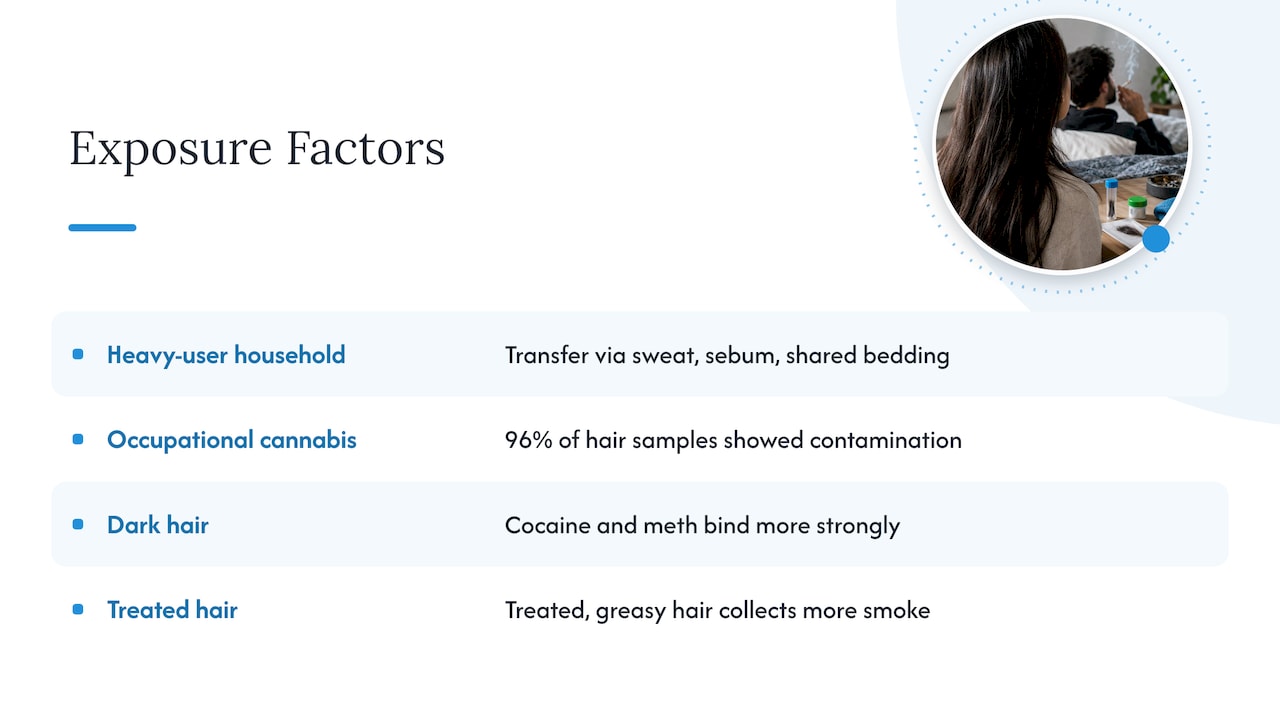
Living with a heavy user. The cannabis metabolite can transfer through sweat, sebum and shared bedding. The 2025 review names adults living with cannabis users as a group where transfer is possible. Shared pillows and close contact matter more than a single smoky evening.
Working around cannabis, cocaine or methamphetamine. A Mood.com article reports occupational exposure to cannabis, such as cultivation or processing, produced contamination in 96% of hair samples, though labs account for it through washing and metabolite analysis. Drugtest.co also says interpretation should account for contamination, particularly for cocaine and methamphetamine in occupational settings.
Hair color and treatment. The same page notes that cocaine and methamphetamine bind more strongly to darker, melanin-rich hair than to lighter hair, so identical exposure can give different results. The 2004 study also shows treated and greasy hair collects more smoke.
If any of these describe you, tell the testing lab’s medical reviewer when a result comes back, and keep your hair clean and dry of smoke residue in the weeks before your test. Wash routines that work for everyday hygiene are covered in our guide on what works and what doesn’t when you wash hair before a drug test.
If a result comes back positive and you did not use
There is a review step, and you should know how it works.
Under federal workplace programs, a medical review officer (MRO) cannot report a positive hair test to the agency without corroboration, such as the donor admitting use. If the donor denies use and offers no medical explanation, the MRO must cancel the hair test and direct testing of another specimen, according to LegalClarity’s explanation of the process. The federal MRO guidance manual tells reviewers to ask the donor whether there is any possible explanation for the result.
Two cautions follow:
- The same explainer says MROs categorically reject certain explanations, including hemp or CBD products and claims that someone slipped drugs into your food or drink. Do not lead with those.
- Many private employers do not run federal programs. Your rights depend on your employer’s policy and your state. If you face an adverse decision, talk to an employment attorney in your state.
The Drug Policy Project’s 2021 guide to workplace marijuana testing adds that hair tests can produce false positives and false negatives, which is why they argue an alternative specimen should confirm results in almost all circumstances. If you did get a result you dispute, our page on a failed hair test and the 90 day window to verify and retest walks through the next steps.
How long to stop smoking, and why that is a different question
Secondhand exposure and your own use work on very different clocks.
Your own use is recorded in the hair as it grows. Scalp hair grows about half an inch a month, so a standard 1.5-inch sample gives a snapshot of roughly 90 days. There is also a delay: Drugtest.co says roughly 7 to 10 days pass between use and detectable incorporation into the part of the hair that is cut.
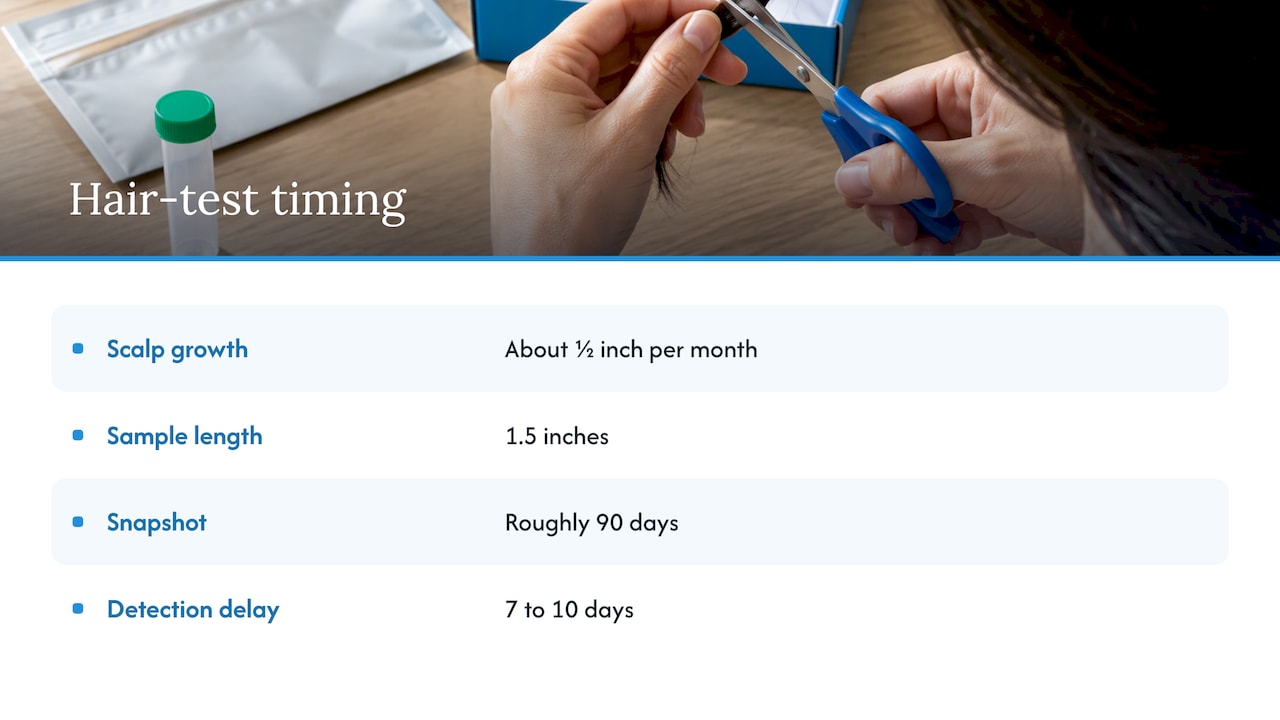
That means stopping a week before a test does not clear anything you used earlier in the 90-day window, because the older drug is still sitting in the hair. How the window works is explained in more depth in how long drugs stay in your hair and how hair drug testing actually works.
Secondhand exposure, by contrast, is mostly about surface contamination and a short moment in time. That is why avoiding heavy smoke in the weeks before the test is sensible, but it is not equivalent to abstaining from use.
The Drug Policy Project also notes that people who were frequent users may still test positive after months without use, and that bleaching or dyeing can compromise results. Our own data on this is in the piece on how occasional marijuana users tested in a hair study, and the cannabis testing facts infographic summarizes the numbers visually.
Practical steps before your test
- Ask which lab and which panel. Employers set the policy, and the lab sets the cutoffs.
- Limit smoke exposure in the weeks before. Avoid enclosed spaces with heavy smoke. Do not sleep in bedding shared with a heavy user if you can help it.
- Do not use anything you would have to explain. The reviewer will not accept most excuses, as noted above.
- Keep your own timeline straight. Write down the date of your last use and how often you used in the previous 90 days. Those facts decide everything.
- Do not guess at washes. Random shampoo and home recipes have no method behind them.
Our perspective
We have helped people prepare for hair follicle tests since about 1999, and the question we hear most from people who did not use is this one. Our honest answer matches the research: ordinary secondhand smoke is not what fails people.
What we see is the other situation. Someone used in the past 90 days, maybe once a week, maybe heavily, and hopes the cutoffs will forgive it. The hair keeps the record, and the lab is built to read it.
That is why we built Mike’s Macujo Method in 2018: a nine-step process designed for high THC levels and other drugs and alcohol, done with authentic Macujo Aloe Rid Shampoo. The number of washes is not a guess. Mike’s Macujo Required Washes Calculator sets it from the substance, the date of last use and how often you used in the previous 90 days. When every required wash and direction is completed correctly, the method has a reported success rate of better than 99%, and the hair stays clean unless you use again.
Our older Macujo Method was designed mainly for low-to-moderate THC exposure and only masks temporarily. We do not recommend confusing the two. If you are unsure which applies to you, call us. We would rather talk it through than have you work from a forum post.
MIchael
Get a plan built for your timeline
If you did use during the last 90 days, secondhand smoke is not your problem and the question becomes how many washes you need. Mike’s Macujo Method is built around that answer. Start with the calculator on our site, then use Macujo Aloe Rid shampoo, listed at $100 to $150, which the method requires.
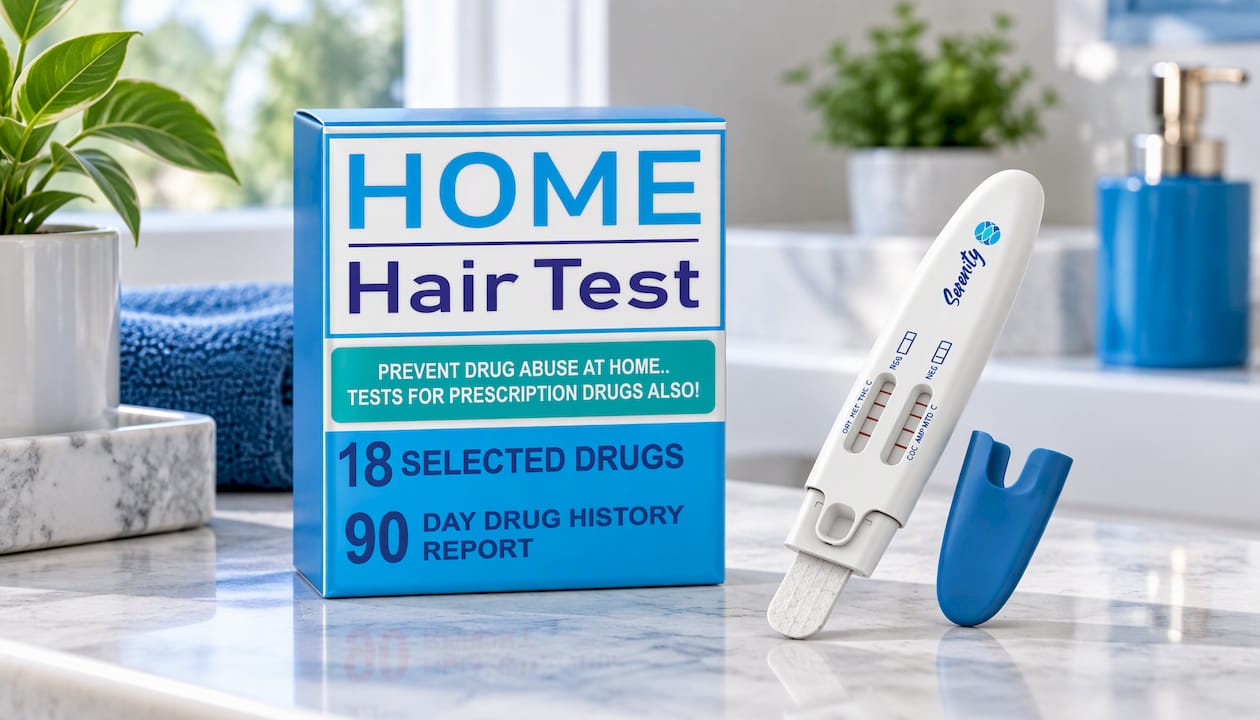
If you would rather talk to a person, the Afterhours Personal Consultation is $100 and gets you on the phone with an expert about your test. For a closer look at the method for THC, see how to pass a hair follicle test for THC with Macujo, and if your test is imminent, read about our hard water hair detox research. You can also buy a home hair test kit to check your situation before the real test.
FAQ
Can you fail a hair test from secondhand smoke?
It is very unlikely. Labs wash the hair, analyze for metabolites, and use cutoffs set above what passive exposure produces. Only extreme, repeated exposure in tight spaces is considered a realistic way for surface contamination to cause trouble, and even then the metabolite analysis is designed to catch it.
Can secondhand smoke get into the hair follicle?
Smoke can deposit on the hair shaft, as a 2004 laboratory study showed. That is surface contamination, though, not the drug being taken in through the bloodstream. Labs look for metabolites produced by the body, which a surface deposit does not supply.
What can cause a false positive hair follicle test?
Contamination from heavy environmental exposure is the main cause discussed in the research, particularly for cocaine and methamphetamine in occupational settings. Transfer from a heavy user through sweat or shared bedding is another. A medical review officer can cancel a federal-program hair test if there is no corroboration of use.
How long do I have to stop smoking for a hair follicle test?
A standard sample covers about 90 days, and there is a delay of roughly 7 to 10 days before use shows up in hair. Stopping a week before a test does not remove earlier use from the window. A required-washes calculation based on your own history is a better planning tool than a guess.
Sources
- The Hair Follicle Drug Test: Myth Vs. Fact
- Employee Drug Testing: Addressing Environmental Exposure Claims, Bloomberg Law
- In Vitro Contamination of Hair by Marijuana Smoke, Clinical Chemistry
- Review on Toxicology Testing in Hair, Journal of Applied Laboratory Medicine
- Finding cannabinoids in hair does not prove cannabis consumption, Scientific Reports
- Hair Drug Testing Facts, Psychemedics
- Hair Drug Testing, Health Street
- How to Pass a Drug Test, AlphaBiolabs USA
- 11-OH-THC in hair as marker of active cannabis consumption, Forensic Science International
- Hair Testing Certifications and Cutoff Levels, Quest Diagnostics
- How Long Does a Hair Follicle Test Go Back, LegalClarity
- Standard Drug Testing Cut-Off Levels, National Drug Screening
- Frequently Asked Questions, Abbott Toxicology
- Hair drug testing, Drugtest.co
- Hair Follicle THC Test False Positives, Mood.com
- Hair Follicle Drug Test: How It Works and Detection Windows, LegalClarity
- Marijuana Testing, Drug Policy Project
- How far back does a hair follicle test detect drugs?, Drugs.com