Last Updated on November 21, 2026
There is no single US law on hair drug testing. Federal rules do not authorize hair for DOT-regulated jobs, while most private employers can use it under their own written policy and whatever their state adds. If you have a hair test coming, the practical questions are what your employer may ask for, what rights you keep, and how to prepare for a 90-day lookback. That last part is where we come in: Mike’s Macujo Method has been built around hair tests since 1999.
TL;DR
- Hair testing is not authorized for federally mandated DOT tests. Only urine and oral fluid are, and the federal hair guidelines are still proposed, not final.
- Outside DOT, employers mostly follow state law. Maryland, Iowa and Georgia show how different those rules can be.
- You cannot be physically forced to give a sample, but in most states an employer can fire you for refusing.
- A standard hair sample covers about 90 days, so what matters is your use history over the previous three months.
- Our required-washes calculator turns your substance, date of last use and frequency into a wash count for Mike’s Macujo Method.
Table of Contents
- The federal picture: what applies and what doesn’t
- Outside DOT, states and employer policy decide
- If you refuse a hair test
- Courts and hair tests
- What a hair test actually measures
- How to get ready when the law won’t help
- Questions worth settling before test day
- Perspective
- Start with your own wash count
- FAQ
- Sources
The federal picture: what applies and what doesn’t
Two federal frameworks matter here. The first is the Department of Transportation’s Part 40, which governs drug testing for truck drivers, pilots, rail workers and other safety-sensitive transportation jobs. Under 49 CFR 40.210, DOT testing uses urine and oral-fluid specimens screened and confirmed at HHS-certified laboratories. Hair is not on the list.
The second is the HHS (Department of Health and Human Services) program for federal workplace testing. HHS published proposed hair-testing guidelines in September 2020, but they have not been finalized. Until they are, hair cannot satisfy a federally mandated test.
Congress has pushed on this for over a decade. The FAST Act of 2015 told HHS to develop hair-testing guidelines, and the FY2026 Consolidated Appropriations Act reaffirmed that directive. In spring 2026, lawmakers wrote to HHS urging it to finalize the rules, as Safety+Health Magazine reported on May 5, 2026. Regulated employers could use hair only if HHS finishes that rule.
If you drive commercially, our page on the DOT hair follicle testing policy walks through what that means for pre-employment screening. Many carriers still ask for a hair test on their own, outside the DOT-mandated panel, because DOT rules set a minimum and do not forbid a company from adding its own requirements.
Outside DOT, states and employer policy decide
For most private-sector jobs, there is no federal statute telling an employer which specimen to use. The employer writes a drug policy, and state law sets guardrails. Those guardrails vary a lot, so check the state where you will work.
Maryland: pre-employment only, with a length cap
Maryland is one of the more specific states. Health-General §17-214 lets employers use hair as a specimen for job-related drug testing only before hiring. It also bars using a hair specimen longer than 1.5 inches measured from the body, or using it for anything other than testing for controlled dangerous substances. The state regulation, COMAR 10.10.10.06, repeats the 1.5-inch limit for applicants.
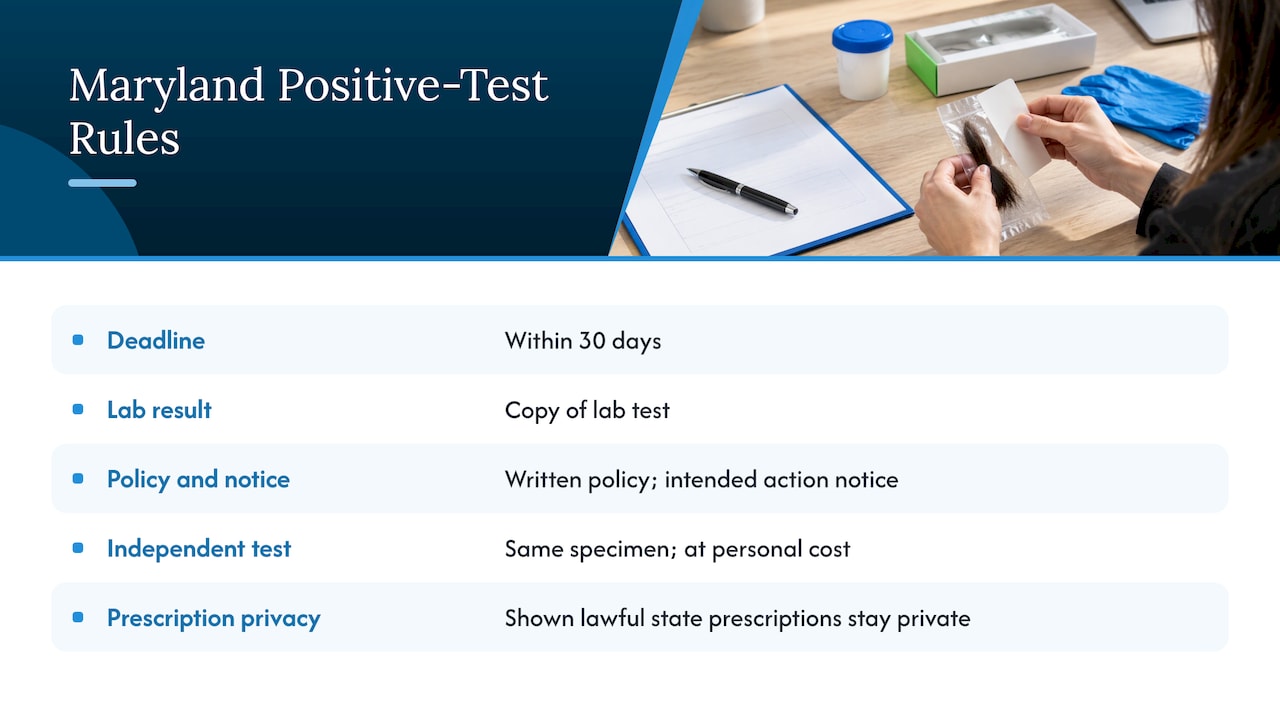
After a confirmed positive, the same statute requires the employer to deliver certain documents within 30 days. You must receive a copy of the lab test, the employer’s written drug policy, notice of any intended disciplinary action, and a statement of your right to request independent testing of the same specimen at your own cost. The law also protects medical privacy: a lab or physician may not reveal to the employer use of a lawfully prescribed drug that you can show was prescribed under state law.
Iowa: hair is expressly allowed for applicants
Iowa’s statute lists hair testing among the permitted test types for prospective employees, according to a 50-state survey of drug testing laws. Testing must follow a written policy given to the employees it covers. If you receive a confirmed positive, you can ask for a second confirmatory test at an approved laboratory you choose, but you must request it and pay within seven days of the employer’s mailed notice. That deadline is short, so read the notice the day it arrives.
Georgia: notice and a right to explain
Georgia’s Code § 34-9-414 requires employers to give employees and applicants a one-time notice before testing. Employees get a written policy that covers the types of testing, the consequences of a positive result or a refusal, and confidentiality. They also get the right to contest or explain a confirmed positive within five working days of written notification.
What this means for you
Three questions will tell you most of what you need:
- Did you get the policy in writing? Several states require it, and it tells you the test type, the consequences and your deadlines.
- Is this pre-employment or during employment? Some states, such as Maryland, limit hair to pre-employment.
- What is the deadline to contest a positive? It can be as short as five working days in Georgia or seven days in Iowa.
State rules change, so confirm the current text for your state before you rely on any summary, including ours.
If you refuse a hair test
Nobody can physically force you to give a sample. The consequences are a different matter. In most states an employer can terminate an employee who refuses, and other outcomes can include demotion, suspension, loss of unemployment benefits, and possible denial of workers’ compensation, according to FindLaw’s overview. For an applicant, refusing usually ends the application.
DOT-regulated employees face a stricter rule. Under 49 CFR 40.191, a refusal brings the consequences set by DOT agency regulations, and those cannot be overturned by arbitration, a grievance or a state court. The employer alone decides whether a refusal occurred.
So refusing is rarely a strategy. Preparing is.
Courts and hair tests
Most readers never see a courtroom over a hair test, but two cases show how courts think about it.
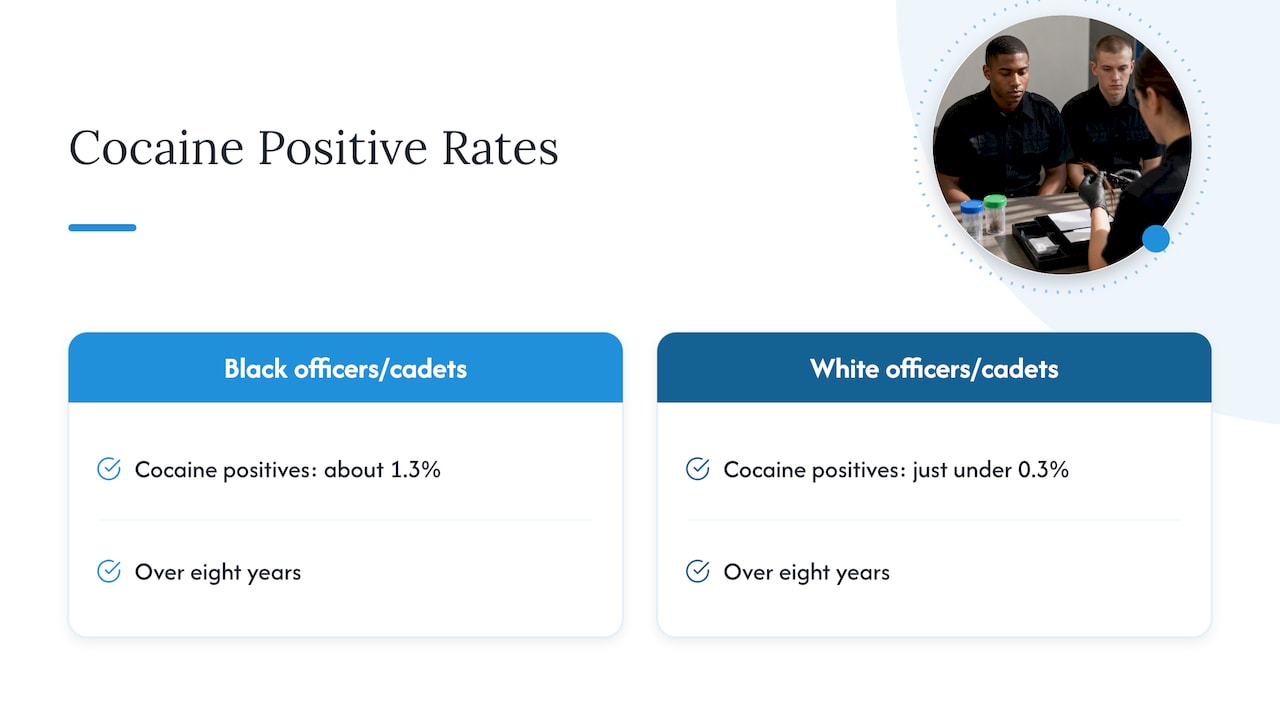
In Jones v. City of Boston, the First Circuit looked at a police department’s hair-testing program. Over eight years, Black officers and cadets tested positive for cocaine about 1.3% of the time, against just under 0.3% for white officers. The court found the plaintiffs had made a prima facie Title VII disparate-impact case and sent the question back to be decided, as the court’s opinion explains. The takeaway for individual test-takers is that a positive hair result is a lab finding employers must handle under their own policy and the law, and independent retesting rights exist in several states for that reason.
Family courts are a separate setting. In California, Deborah M. v. Superior Court (2005) held that a family court could not order hair testing in a custody case because the incorporated federal standards then allowed only urine. Voluntary hair results may still be considered as evidence, according to one California family law firm’s summary. If you face a court-ordered test, talk to your attorney about what the order requires.
What a hair test actually measures
Law aside, the reason hair tests worry people is the lookback. The standard sample is the first 1.5 inches (3.9 cm) of hair from the scalp. That length covers approximately 90 days and shows a pattern of repeated use, according to Quest Diagnostics’ hair testing FAQ. Head hair grows about half an inch per month, and drug-containing hair takes roughly 5 to 10 days to reach the scalp surface.
That is why employers treat hair and urine differently. Urine reflects recent days. Hair reflects months. Hair is poorly suited to post-accident or reasonable-suspicion testing, because it cannot show use right before an incident. Employers who want both a long lookback and recent-use coverage often pair the two, which we cover in hair vs. urine tests at work.
Two practical points from the same laws:
- Length: Maryland caps the specimen at 1.5 inches from the body. If you have long hair, see when long hair actually affects a drug test.
- Body hair: If head hair is not available, collectors can sample body hair, and the window can be much longer. Our page on the body hair drug test window explains what that means.
For a deeper explanation of collection and lab steps, read how hair drug testing actually works.
How to get ready when the law won’t help
The legal rules above protect your process: notice, a written policy, a chance to contest. They do not change what is in your hair. If you have used in the past 90 days and a hair test is coming, the preparation window is what counts.
Mike’s Macujo Method is our current standard. Introduced in 2018, it is a systematic nine-step process developed for high THC levels and for other drugs and alcohol. It must be completed with authentic Macujo Aloe Rid® Shampoo. When every required wash and direction is completed correctly, the method has a reported success rate of better than 99%, and the hair stays clean unless drugs or alcohol are used again.
The number of washes is not a guess. Mike’s Macujo Required Washes Calculator sets it from three inputs:
- The substance involved
- Your date of last use
- How often you used during the previous 90 days
That is why a heavy user and an occasional user get different wash counts rather than one generic routine. If your test covers many substances, our guide to preparing for a 12-panel hair test shows how the 90-day window and the method fit together. Methamphetamine users can read the methamphetamine hair test timeline first.
One caution: Mike’s Macujo Method should not be confused with the old Macujo Method. The old method was designed mainly for low-to-moderate THC exposure, has an estimated success rate of about 90% for moderate THC, and provides only temporary masking. If you found instructions online under the Macujo name, check which method they describe.
Questions worth settling before test day
Before your test, write down the answers to these:
- What substances are on the panel?
- When was your last use, and how frequent was it over the previous 90 days?
- When and where is the collection?
- Did you receive the employer’s written policy?
If you are unsure how to answer the first three, a call helps. Our list of questions to ask before a hair test shows what a consultation covers.
Perspective
Since about 1999 we have watched hair testing move from a niche screen to a routine step in hiring. The law has not kept pace. Federal hair guidelines have sat unfinished for years, so each employer and each state sets its own terms, and applicants are left sorting out their own situation under a deadline.
What we have learned is that the people who do best are the ones who stop guessing. A wash count based on your substance, your last use and your 90-day frequency is a plan. A generic routine is a hope. That is why we built the required-washes calculator and why Mike’s Macujo Method is tied to authentic Macujo Aloe Rid® Shampoo.
We also believe nobody should face this alone. Our customers get unlimited support and after-hours phone consultation, so a question on the night before your collection gets an answer from a person who knows the method.
MIchael
Start with your own wash count
If your test is coming and your history falls inside the 90-day window, start with the required-washes calculator and Mike’s Macujo Method. Authentic Macujo Aloe Rid Old Formula Shampoo is listed at $100 to $150 in our hair products category. If you would rather talk it through, the Afterhours Personal Consultation is $100 and gives you a call with an expert about your own situation.
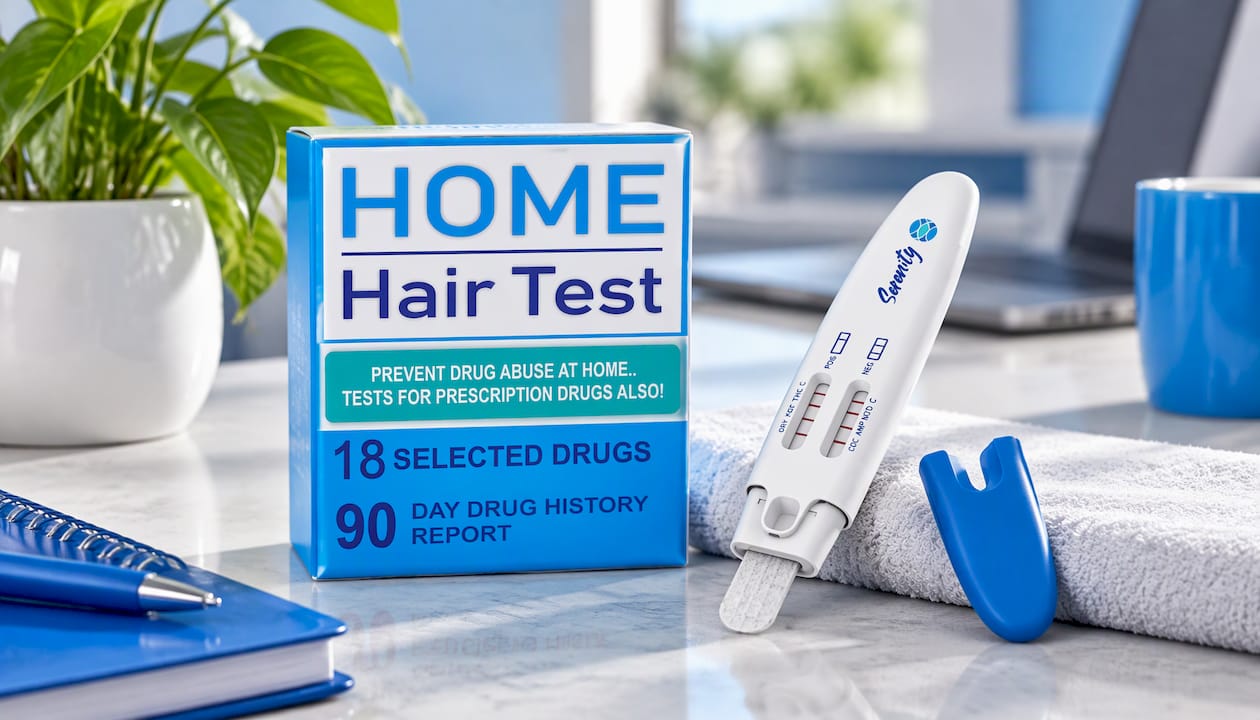
We also carry hair, urine and saliva test kits, including a home hair test kit, for people who want to know where they stand before the real collection.
FAQ
Is hair drug testing legal in the US?
Yes, for most private employers, subject to state law and the employer’s written policy. It is not authorized for federally mandated DOT tests. Some states limit it: Maryland, for example, allows hair only for pre-employment testing, with a 1.5-inch length cap.
Can an employer fire me for refusing a hair test?
In most states, yes. You cannot be physically forced to give a sample, but a refusal can lead to termination, suspension or loss of unemployment benefits. For DOT-regulated jobs, refusal carries federal consequences that arbitration or state courts cannot undo.
How long does hair need to be for a test?
The standard sample is the first 1.5 inches from the scalp, which reflects about 90 days. Collectors can use body hair if head hair is not available. Our page on long hair and drug tests covers what changes with length.
Can I contest a positive hair test result?
Often, yes, and deadlines are short. Georgia gives five working days to contest or explain a confirmed positive. Iowa lets you request a second confirmatory test within seven days of the mailed notice. Maryland requires the employer to tell you of your right to independent testing of the same specimen. Read your employer’s notice as soon as it arrives.
Is a hair test admissible in court?
It depends on the court and the purpose. A California appeals court held in 2005 that a family court could not order hair testing under the standards then in place, though voluntary results may be considered. Talk to your attorney about a court-ordered test.
Sources
- eCFR: 49 CFR 40.210, what kinds of drug tests are authorized
- eCFR: 49 CFR 40.191, what is a refusal to take a DOT drug test
- Safety+Health Magazine: lawmakers urge HHS on alternative DOT drug testing methods
- Maryland Health-General §17-214
- Maryland COMAR 10.10.10.06
- Justia: drug testing laws in the workplace, 50-state survey
- Georgia Code § 34-9-414
- FindLaw: can I be fired for refusing a drug test
- First Circuit opinion, Jones v. City of Boston
- The Geller Firm: drug testing in California custody cases
- Quest Diagnostics: hair testing FAQ