
Last Updated on October 18, 2026
A hair test cutoff is the concentration of a drug or metabolite, measured in picograms per milligram of hair (pg/mg), at which a laboratory reports a result as positive. For a standard US employment panel, the commonly published numbers are 500 pg/mg for cocaine and amphetamines, 200 pg/mg for opiates, 300 pg/mg for PCP, and a very low 1.0 pg/mg screen and 0.1 pg/mg confirmation for the marijuana metabolite. But there is no single national chart. The lab, the panel and the analyte decide which number applies to you.
Below we walk through the published figures, explain why charts disagree, and show you how to find the cutoffs that matter for your own test.
TL;DR
- Typical US hair cutoffs: 500 pg/mg for cocaine and amphetamine-class drugs, 200 pg/mg for opiates, 300 pg/mg for PCP, and 1.0 pg/mg (screen) and 0.1 pg/mg (confirmation) for the marijuana metabolite.
- Screen and confirmation cutoffs are different numbers. A result must clear the exact figures on your lab’s report, not a chart from the internet.
- No finalized federal rule sets hair cutoffs for employers, so each laboratory and employer program can differ.
- Hair covers roughly 90 days of history. The cutoff tells you how the lab decides, not how much you used.
Table of Contents
- What a hair test cutoff actually is
- Published cutoffs for a standard US panel
- Why the charts you find online do not agree
- Screen versus confirmation: where a result is decided
- Cocaine: why a high number is not always proof of use
- Expanded panels: the “5-panel” label can hide extras
- Is there a federal hair cutoff?
- What the cutoff does not tell you
- Before an imminent test: five steps
- How we can help if your test is close
- Our perspective: numbers help, but your own report decides
- FAQ
- Sources
What a hair test cutoff actually is
A cutoff is a decision level. The Society of Hair Testing (SoHT), the scientific body that publishes consensus recommendations for the field, describes it as the value that enables identification of drug use. Its 2021 consensus is clear that cutoffs are not a dose meter: they must be read together with segment length, analyte specificity, contamination controls and the purpose of the test.
That last point matters. SoHT says routine cutoffs apply to head-hair segments no longer than 3 cm, and that investigations of a single exposure should use the lab’s lower limit of quantification instead of a routine-use cutoff. A workplace test and a forensic case are not judged by the same yardstick.
Two more terms you will see on every report:
- Screening cutoff: the threshold for the first, efficient test that flags a presumptive positive.
- Confirmation cutoff: the threshold for the second test, which identifies and quantifies a specific substance or metabolite. Quest’s laboratory FAQ describes this two-step model.
Published cutoffs for a standard US panel
The table below reflects Quest Diagnostics’ published US hair-testing cutoffs. Quest’s standard panel covers five classes: amphetamines, opiates, cocaine, marijuana metabolite and PCP, with expanded opiates as an add-on.
| Drug or class | Screen cutoff | Confirmation cutoff |
|---|---|---|
| Amphetamine, methamphetamine, MDMA, MDA | 500 pg/mg | 500 pg/mg |
| Cocaine and benzoylecgonine | 500 pg/mg | 500 pg/mg |
| Marijuana metabolite | 1.0 pg/mg | 0.1 pg/mg |
| Opiates and expanded opiates | 200 pg/mg | 200 pg/mg |
| 6-acetylmorphine (6-AM) | 200 pg/mg | 200 pg/mg |
| Oxycodone and oxymorphone | 200 pg/mg | 200 pg/mg |
| PCP | 300 pg/mg | 300 pg/mg |
Other labs publish their own versions. USDTL, for example, describes a 1 pg/mg screening cutoff for the cannabinoid class in hair. The same figure appears in a published study of a 5-panel hair test, which lists 1 pg/mg for marijuana and 500 pg/mg for cocaine and amphetamines at screening.
Why the charts you find online do not agree
If you compare three charts, you will probably see three sets of numbers. There are real reasons.
Different analytes
The marijuana figure is the clearest example. Quest’s 0.1 pg/mg confirmation applies to the marijuana metabolite. SoHT’s consensus recommends 50 pg/mg for THC, the parent compound. Those are different molecules measured in different ways, so the numbers are not interchangeable.
Consensus versus a lab’s own limits
SoHT’s consensus is a scientific reference. It recommends, among others, 200 pg/mg for morphine, codeine and 6-MAM, 500 pg/mg for cocaine, 200 pg/mg for amphetamine-class drugs, 100 pg/mg for oxycodone, 200 pg/mg for tramadol, methadone and ketamine, and 10 pg/mg for buprenorphine. It is not a promise that every US employment laboratory uses exactly those values.
Different units
Some sources use ng/mg, others pg/mg. One nanogram equals 1,000 picograms, so 0.5 ng/mg is the same as 500 pg/mg. AttoSure’s explainer gives the cocaine hair cutoff as 0.5 ng/mg, which matches the 500 pg/mg above. Always check the unit before you compare.
Different panels
A lab may update its limits, too. One lab-published sheet we reviewed notes cutoff changes that took effect on 6 January 2025, which is why a chart saved a few years ago can be wrong today.
Screen versus confirmation: where a result is decided
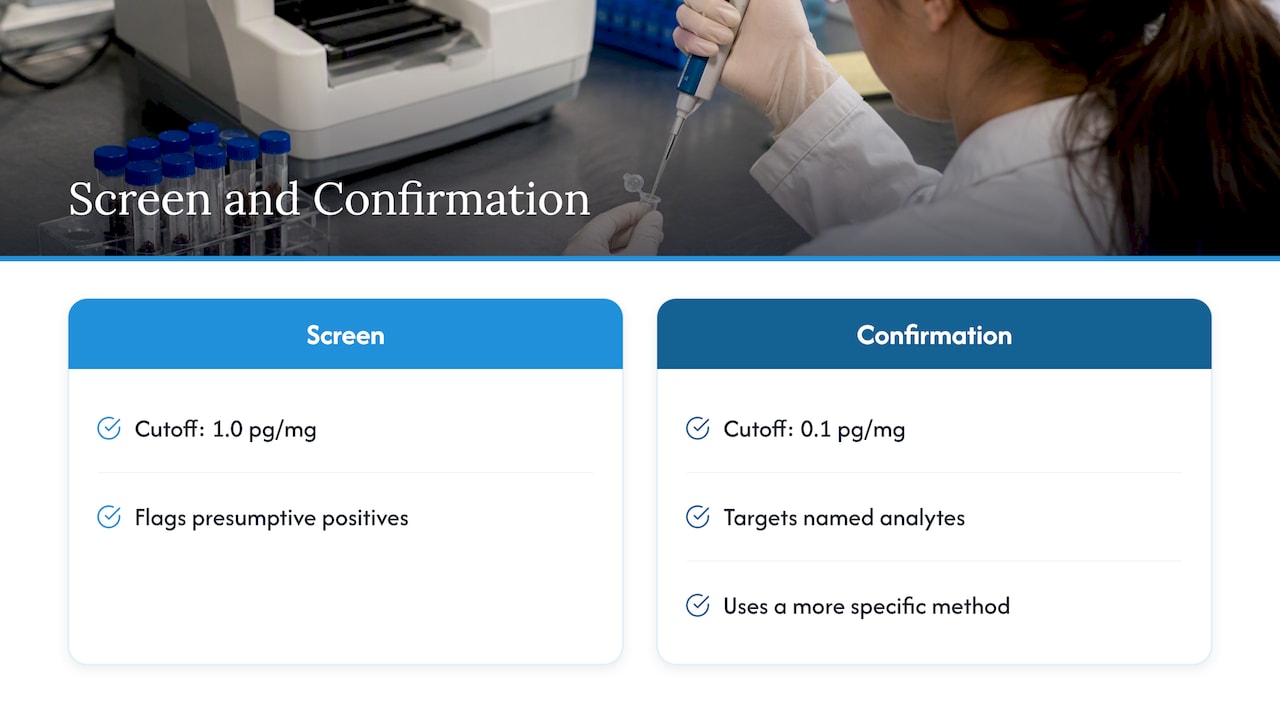
People often treat the screen and the confirmation as one number. They are not. The screen identifies presumptive positives. The confirmation uses a more specific analytical method and targets named analytes. A sample that screens positive but does not confirm above the confirmation cutoff is not reported as a confirmed positive.
The marijuana line shows how this can look: a 1.0 pg/mg screen followed by a 0.1 pg/mg confirmation. The confirmation is lower because it is looking for one specific metabolite with a more selective method.
If you receive a result, ask for the full laboratory report, not a verbal “positive” or “negative.” The report should show the screen cutoff, confirmation cutoff, analyte and units. A result near a threshold can only be understood with those four items in hand.
Cocaine: why a high number is not always proof of use
Cocaine is the hardest drug to interpret in hair, because the parent drug can land on hair from the outside. SAMHSA’s presentation on cocaine in hair notes that cocaine, benzoylecgonine and cocaethylene each have interpretive limits, and that no single cutoff universally separates use from contamination.
For that reason labs may look at metabolites and ratios, including benzoylecgonine, cocaethylene, hydroxy-cocaine markers and anhydroecgonine methyl ester. The 2004 proposed federal rule described in the same material combined a 500 pg/mg cocaine level with a benzoylecgonine ratio or a cocaethylene threshold. The practical lesson: a lab looks at a pattern of analytes and quality controls, not one concentration alone.
Expanded panels: the “5-panel” label can hide extras
A generic “5-panel” description does not tell you everything that is being tested. Quest’s current FAQ says its expanded offering includes fentanyl and methadone analytes:
| Expanded analyte | Screen cutoff | Confirmation |
|---|---|---|
| Fentanyl (norfentanyl confirmation) | 100 pg/mg | 20 pg/mg |
| Methadone (EDDP confirmation) | 200 pg/mg | 50 pg/mg |
Quest states this expanded offering launched in September 2023, and availability depends on the laboratory and the employer. If you are told your test is a “5-panel,” ask whether expanded opiates, fentanyl, methadone, benzodiazepines or alcohol markers are added. We cover one frequently missed add-on in our guide to benzodiazepines in hair tests, and our overview of which drugs show on a hair follicle test lists the common panels.
Is there a federal hair cutoff?
Not a finalized one. As of October 16, 2026, SAMHSA’s Drug-Free Workplace page links the 2020 proposed hair-testing guidelines, while its current mandatory guidelines cover urine and oral fluid programs. So an employer’s hair cutoff should not be described as a universally mandated federal number. It is the cutoff of the laboratory and program the employer chose.
If your job is covered by Department of Transportation rules, the question is different again. We explain it in our guide to DOT hair follicle testing policy.
What the cutoff does not tell you
It does not measure impairment
Hair reflects history, not intoxication on test day. Quest’s collection guidance describes a history of up to 90 days. For how that window compares to a urine test, see our comparison of hair versus urine tests at work, and for cases where 90 days is not the whole story, our hair drug test timeline guide.
It does not tell you how much you used
A concentration above a cutoff means the lab identified use. It does not give a dose. Two people with the same history can produce different results, and hair treatment, segment length and the lab’s own washing and interpretation can all affect how a result is evaluated.
It does not depend on the sample you imagine
Quest says a collection usually takes a cosmetically undetectable lock about one centimeter wide, preferably from the back of the head just below the crown, under direct supervision. LabCorp, another major lab, states that a screen plus confirmation needs 100 milligrams of hair, about 90 to 120 strands. If head hair is too short, collectors may turn to other sites, which we explain in our piece on body hair drug tests.
Before an imminent test: five steps
- Get the panel in writing. Ask the employer or collection site which drugs are included, and which add-ons.
- Get the laboratory name. Then look up that lab’s published screen and confirmation cutoffs, not a general chart.
- Check the units. Convert ng/mg to pg/mg before you compare anything.
- Know your history. The relevant window is the roughly 90 days before collection. Our all-about hair drug testing page walks through how the process works.
- Plan for the report. If a result is positive, request the full lab report. Our guide on a failed hair test and the 90-day window covers verifying and retesting.
Treated, colored or bleached hair adds another variable. We discuss it in dyed hair and hair drug tests.
How we can help if your test is close
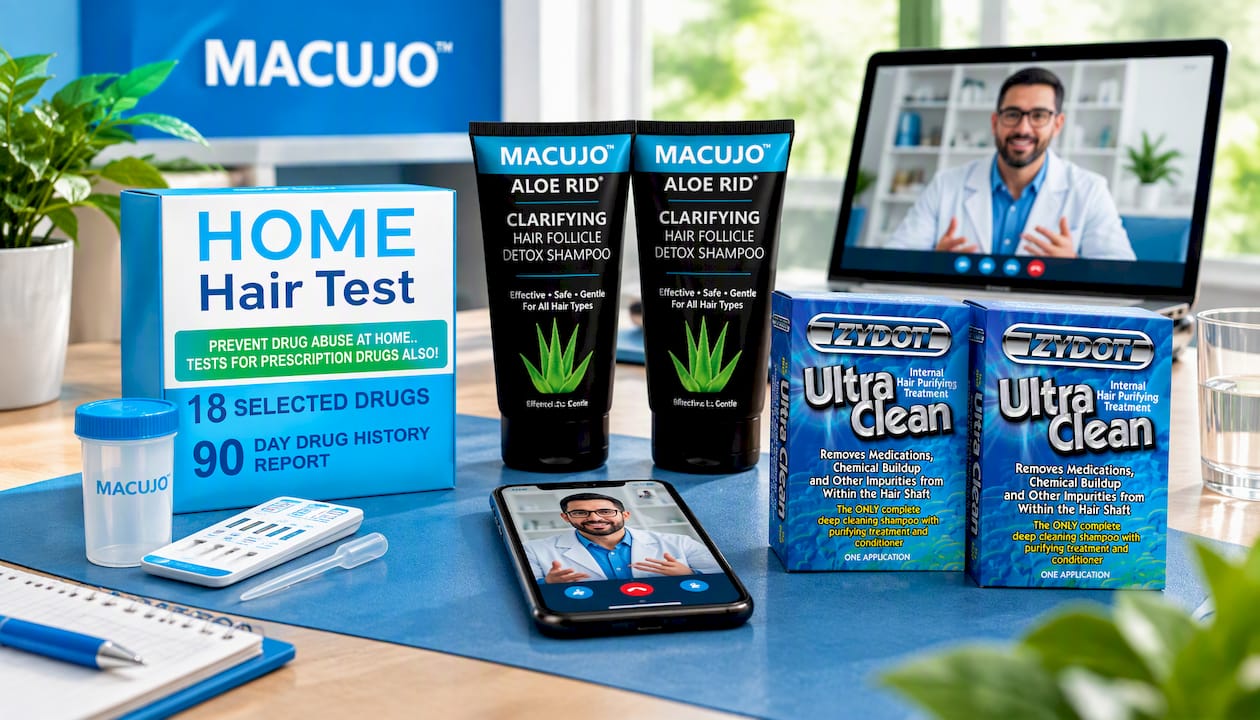
Knowing the cutoff is the first half. The second half is a plan that fits your own history. Mike’s Macujo Method is a nine-step process built for high THC levels and other drugs and alcohol, completed with authentic Macujo Aloe Rid® Shampoo. The number of washes comes from our required-washes calculator, which uses the substance, the date of last use and how often you used in the previous 90 days. When every required wash and direction is completed correctly, we report a success rate of better than 99%.
Be realistic about what any product can do. No shampoo can change what happened before collection or guarantee a negative result, and hair stays clean only if you do not use again. That is why we also offer personal help: the Afterhours Personal Consultation is 100 USD, one-off, and lets you talk through your panel and timeline by phone. Aloe Rid shampoo is in our hair products category, with the Old Formula line priced at 100-150 USD. You can also start from our shop.
Our perspective: numbers help, but your own report decides
We have worked with hair tests since about 1999, and the question we hear most is some version of “what is the number I need to be under?” The honest answer is that the number lives on your laboratory’s report, not in our head or any chart. We have seen people panic over a figure that belonged to a different lab, a different analyte or a different unit.
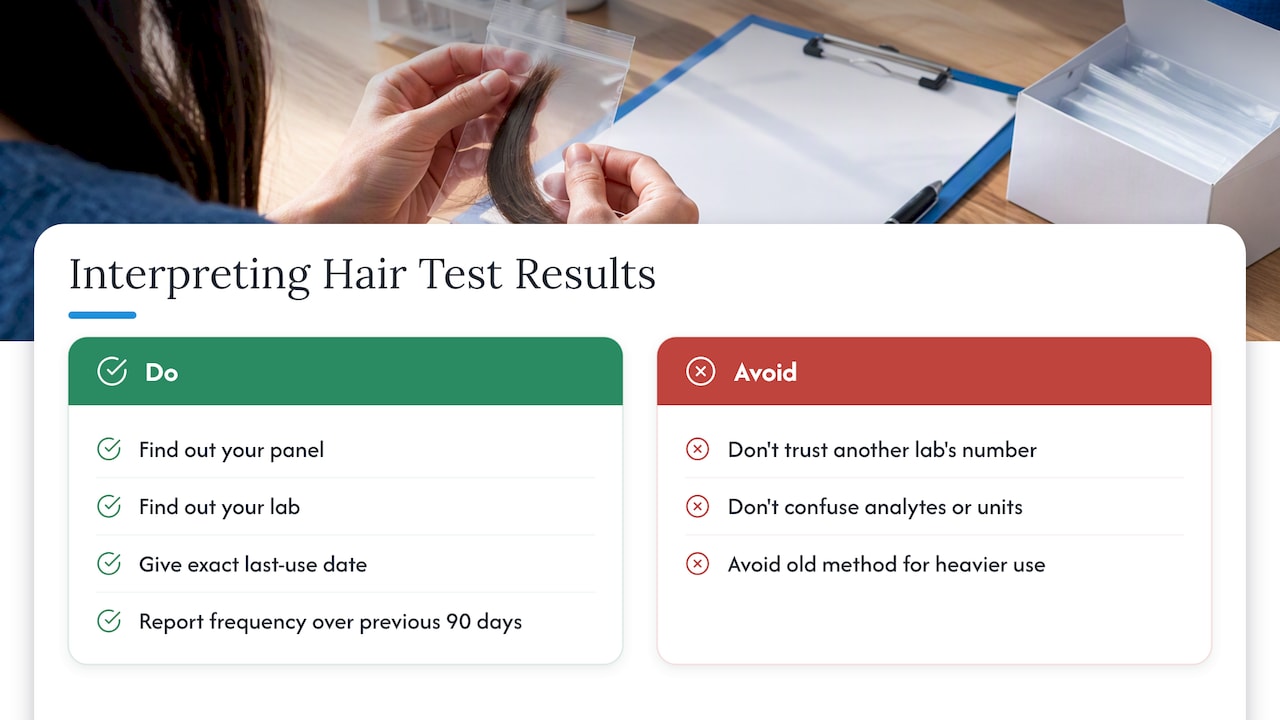
Our advice is always the same. Find out the panel. Find out the lab. Then be exact about your own last-use date and your frequency over the previous 90 days, because that is what the calculator in Mike’s Macujo Method needs. The old Macujo Method was designed mainly for low-to-moderate THC exposure and gives only temporary masking, so we do not treat it as the answer for heavier use. The current method is built for high levels, and it only works as designed when every wash is done as directed with authentic Aloe Rid.
And if you are unsure, call. Unlimited support is part of what we offer for a reason: a ten-minute conversation about your panel can save you a bad week.
— MIchael
FAQ
Are hair follicle cutoff levels the same at every lab?
No. Quest, USDTL and other laboratories publish their own screen and confirmation limits, and these can differ by analyte and change over time. SoHT’s consensus values are a scientific reference rather than a rule every lab follows. Always check the cutoffs of the lab named on your collection form.
What is the cutoff for marijuana in a hair test?
Quest publishes 1.0 pg/mg for the screen and 0.1 pg/mg for confirmation of the marijuana metabolite. SoHT recommends 50 pg/mg for THC itself, which is a different analyte. Compare only like with like.
Is a screen result the same as a confirmed positive?
No. The screen flags presumptive positives, and the confirmation identifies and quantifies specific substances using a more selective method. Ask for the full lab report so you can see both numbers and the analyte.
Does the federal government set hair cutoffs for employers?
Not as a finalized rule. SAMHSA lists proposed hair guidelines from 2020, while its mandatory guidelines cover urine and oral fluid. Your employer’s cutoff comes from the laboratory and program it uses.
Can a 5-panel hair test include more than five drugs?
Yes. A “5-panel” label can hide add-ons such as expanded opiates, fentanyl or methadone, depending on the lab and employer. Ask exactly which analytes are reported before you test.
Sources
- Quest Diagnostics: hair testing certifications and cutoff levels
- Quest Diagnostics: hair testing FAQ (laboratory document)
- Quest Diagnostics: hair testing collection FAQs
- Society of Hair Testing: 2021 consensus on drugs of abuse testing in hair
- SAMHSA: hydroxy-cocaine and cocaine ratios in hair
- SAMHSA: Drug-Free Workplace forms and guidelines
- USDTL: screening and confirmation testing explained
- PubMed Central: hair drug testing results and self-reported drug use
- AttoSure: understanding cut-off levels in hair drug testing
- LabCorp: hair drug testing