Last Updated on October 11, 2026
Yes, modern hair testing can detect many benzodiazepines, typically covering roughly a 90-day window tied to standard scalp hair growth. Confirmation testing with LC-MS/MS reaches sensitivities in the sub-picogram to low-picogram-per-milligram range, but every lab sets its own reporting cutoffs. Dose, frequency, hair characteristics, and cosmetic treatments all shift what actually shows up in a result.
TL;DR:
- Labs usually screen hair first, then confirm positive samples with tandem mass spectrometry; reporting cutoffs vary, so ask for the lab’s method and threshold.
- Common targets include diazepam, nordiazepam, oxazepam, alprazolam, and clonazepam, while compounds that incorporate less readily or follow a single dose may be harder to detect.
- Bleaching or permanent coloring can remove 68% to 91% of certain metabolites, and laboratories may scrutinize treated samples rather than discounting the result.
- Hair and urine results can differ without error: hair may reflect past use after urine clears, while very recent use may appear in urine first.
- Segmented hair samples can suggest when exposure occurred, but differing growth rates and hair cycles prevent exact dates; body hair gives a less precise timeline.
Table of Contents
- How benzodiazepines enter hair and what the detection window really means
- Which benzodiazepines labs typically detect and typical concentration ranges
- Lab workflow: screening, confirmation, and what detection limits mean
- Factors that raise or lower benzodiazepine levels in hair
- Interpreting results: positives, negatives, and discordant readings
- Sample collection: hair amount, alternate sites, and timing
- What two decades preparing clients for hair tests has taught us
- What hair testing can and cannot really tell you
- Getting ready for a benzodiazepine hair test: how we can help
- FAQ
- Sources
How benzodiazepines enter hair and what the detection window really means
Benzodiazepines reach hair mostly through the bloodstream during the anagen, or active growth, phase of the hair follicle. Smaller amounts can also deposit from sweat and sebum as the hair shaft forms and pushes through the scalp. This is why a drug taken weeks ago can still show up in a segment of hair cut today: the hair literally grew around a chemical record of what was circulating in the blood at the time.
Scalp hair grows at an average rate of about 1 cm per month, which is the basis for the standard 3 cm (roughly 1.5 inch) sample that labs collect closest to the scalp. That length maps to approximately 90 days of growth, giving testers a rough three-month history rather than a single moment in time.
Segmental analysis, where a lab cuts one strand into multiple sections and tests each separately, can narrow down when use likely occurred within that window. It is not perfectly precise, though:
- Individual hairs grow at slightly different rates, so a 1 cm segment does not represent exactly the same calendar period across every strand.
- Hair cycles through growth, rest, and shedding phases, and a sample will always contain a mix of hairs at different points in that cycle.
- These factors mean segmental timelines are useful estimates, not forensic-grade timestamps.
Readers who want a broader walkthrough of how hair drug testing actually works can find the full incorporation pathway laid out in more depth, including how this applies across drug classes beyond benzodiazepines.
Which benzodiazepines labs typically detect and typical concentration ranges
Labs commonly target a specific panel of benzodiazepines and their metabolites rather than testing for every drug in the class individually. The most frequently reported analytes include:
- Diazepam and its metabolite nordiazepam, often used as markers of longer-acting benzodiazepine use.
- Oxazepam, which appears both as a prescribed drug and as a metabolite of diazepam and other compounds.
- Alprazolam, the active ingredient in Xanax, and one of the more commonly tested-for benzodiazepines in employment and legal screens.
- Clonazepam, along with its own metabolite, 7-aminoclonazepam.
Measured concentrations vary enormously. A review of analytical challenges in benzodiazepine hair testing notes that reported levels in positive cases range from below the limit of quantification, under 1 pg/mg, up to tens of thousands of pg/mg in heavy, chronic users. That spread reflects differences in dose, frequency, and how efficiently a given drug incorporates into the hair shaft.
Not every benzodiazepine incorporates at the same rate. An early study using radioimmunoassay found that diazepam was readily detected above a set cutoff, while alprazolam and lorazepam were not consistently picked up with that older assay. Short-acting benzodiazepines or those with lower incorporation ratios can be genuinely harder to detect, especially from a single dose, unless the lab uses highly sensitive modern instrumentation and enough sample mass to work with.
Lab workflow: screening, confirmation, and what detection limits mean
Most hair testing programs use a two-step process. The first step is a screening immunoassay, a fast, relatively inexpensive test designed to flag samples that might contain a target drug class. Screening assays are built for throughput, not precision, so they tend to cast a wide net.
Any sample that screens positive moves to confirmatory testing using liquid chromatography tandem mass spectrometry, or LC-MS/MS. This is the step that actually identifies specific compounds and quantifies how much is present, and it is the standard that forensic and workplace testing programs rely on for a defensible result.
LC-MS/MS confirmation for benzodiazepines in hair typically reports detection limits between 0.5 and 5 pg/mg for many compounds in the class, a sensitivity that lets labs distinguish trace exposure from meaningful use.
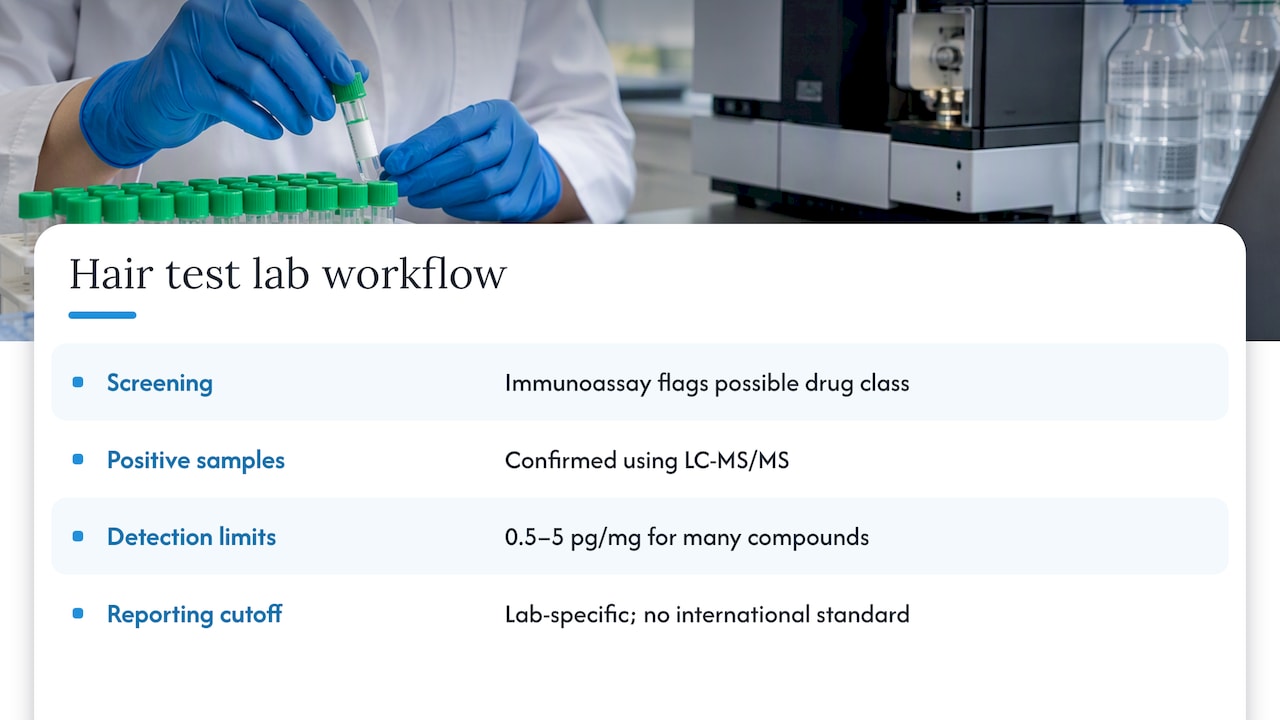
What happens next depends entirely on the lab’s own cutoff. There is no single international standard for benzodiazepine hair cutoffs; different labs and different jurisdictions set their own thresholds, and a concentration that one lab reports as positive might fall below another lab’s reporting line. Federal workplace testing guidance in the United States reflects this layered approach, requiring chromatographic confirmation with mass spectrometry rather than relying on screening results alone. If a result is going to matter to your job or a legal proceeding, it is worth asking the lab directly for its method documentation and specific cutoff values rather than assuming a number means the same thing everywhere.
Factors that raise or lower benzodiazepine levels in hair
Several variables outside the testing process itself can change what a lab measures, sometimes significantly.
On the user side, dose size, frequency of use, and whether use was recent versus chronic all affect how much drug ends up in the hair shaft. Individual metabolism and any co-ingested substances can shift this further.
Hair characteristics matter too. Melanin content, the pigment that gives hair its color, can bind certain drugs more readily, meaning two people with identical use patterns but different natural hair color might show different concentrations. Hair porosity and where a strand sits in its growth cycle add more variability.
Cosmetic treatments are one of the bigger wild cards. Research on hair treatment effects found that bleaching and permanent coloring can leach out 68 to 91 percent of certain drug metabolites from the hair shaft, depending on the compound and treatment. A closer look at how dyed hair affects drug test results breaks down why bleach in particular has such an outsized effect.
- Dose, frequency, and recency of use change baseline concentration.
- Melanin content and hair porosity affect how much drug binds to the shaft.
- Oxidative cosmetic treatments can strip out a large share of embedded drug residue.
- Labs often inspect samples visually and chemically for signs of damage from these treatments, which can trigger additional scrutiny rather than help a sample pass unnoticed.
Pro Tip: If your hair has been recently bleached or permanently colored, treat any informal detection estimate as unreliable until you know the lab’s specific approach to damaged samples.
Interpreting results: positives, negatives, and discordant readings
A lab report is only as useful as the context around the number. A detected concentration has to be read against that specific lab’s cutoff and limit of quantification; a trace amount sitting below the cutoff may not be reported as positive at all, even though the drug is technically present.
Discordant results between hair and urine tests confuse a lot of people, but they usually have a straightforward explanation:
- A positive hair test paired with a negative urine test often points to historical use that has since cleared the urine but remains embedded in hair that grew during that period.
- A positive urine test with a negative hair test can reflect very recent use that has not yet had time to incorporate into new hair growth.
- Neither pattern is necessarily a lab error: they are measuring different biological windows.
When a result carries real consequences for employment or a legal matter, it is worth requesting the laboratory’s method documentation and confirmation data rather than accepting a summary report at face value. A toxicologist or third-party confirmation lab can also review the underlying chromatography if the stakes justify it. For anyone who already failed a screen and wants to understand their options, a breakdown of the 90-day retest window covers realistic next steps.
Sample collection: hair amount, alternate sites, and timing
Standard scalp collection typically involves cutting a sample roughly equivalent to about 1.5 inches (approximately 3 cm) long as close to the scalp as possible, since that segment closest to the root reflects the most recent growth.
- Labs typically request a minimum mass or strand count, often in the range of 20 to 50 strands or a specified milligram weight, to make sure there is enough material for both screening and confirmation.
- Some tests use segmental analysis, cutting the sample into sections to estimate a rough timeline, while others analyze the full length as a single combined result.
- Body hair, including armpit hair, grows on a different and generally slower cycle than scalp hair, so a body hair sample represents a longer, less precise window and is interpreted differently from a standard scalp collection.
Anyone asked to provide a body hair sample instead of scalp hair should understand that the detection window assumptions change. A closer look at armpit hair testing factors explains how those differences play out in practice. More detail on how sample length maps to time generally is covered in how long drugs stay in hair.
What two decades preparing clients for hair tests has taught us
We have worked with people facing hair follicle drug tests for many years, and that experience shapes everything we build. Our cleansing method is a multi-step process paired with a specialized shampoo, and we provide a required-washes calculator that factors in the substance involved, date of last use, and frequency of use over the prior 90 days to recommend a specific number of washes.
If you have time before a test, starting early and checking your status with a home kit gives you room to adjust before the deadline that actually matters. If your situation is more complicated, a real consultation beats guessing.
What hair testing can and cannot really tell you
Hair testing is genuinely powerful for reconstructing a pattern of use over weeks or months, but it was never built to function as a precise clock for a single dose. Treating a number on a lab report as an exact timestamp overstates what the science can currently promise.
If a result has real consequences, get the lab’s method details and confirmation data before drawing conclusions, and loop in a toxicologist if the stakes justify it. If you are preparing for an upcoming test, test early, since that is the only way to course correct in time.
— MIchael
Getting ready for a benzodiazepine hair test: how we can help
If you are facing an upcoming hair test and want to know where you stand before you walk in, checking your status with a Home Hair Test kit gives you a real answer instead of a guess.

From there, our Supreme Klean Detoxifying Tea and Supreme Klean Ultra Mask Detox Drink support a broader preparation plan alongside our cleansing method, and the specialized Aloe Rid Old Formula Shampoo is the shampoo the method is built around. When your situation involves specifics the calculator alone cannot fully address, dose history, timing, hair treatment history, an Afterhours Personal Consultation gets you direct answers from someone who has walked thousands of people through exactly this. Start with a test, then build your plan around what it actually shows you.
This article is general information, not a substitute for advice from a qualified doctor. Consult a qualified healthcare professional about your own circumstances before acting on anything here.
FAQ
Can a hair test detect drugs?
Yes, hair testing can detect many drugs, including several benzodiazepines, because compounds circulating in the bloodstream deposit into the hair shaft as it grows. Laboratories confirm positive screens with LC-MS/MS, which identifies specific compounds rather than just flagging a drug class.
How long can Xanax be detected in hair?
Alprazolam, the active ingredient in Xanax, is generally detectable in a standard 1.5 inch scalp hair sample for roughly the same 90-day window that applies to most benzodiazepines. Actual detectability depends on dose, frequency of use, and the sensitivity of the lab’s LC-MS/MS method, since some older assays struggled to detect alprazolam consistently.
What kind of drug is benzodiazepine?
Benzodiazepines are a class of prescription sedative medications commonly used to treat anxiety, insomnia, and seizures, including drugs like diazepam, alprazolam, and clonazepam. They work on the central nervous system and are tested for in hair, urine, and saliva drug screens.
Can you pass a hair follicle test in 30 days?
A short window is tight because standard scalp samples reflect roughly 90 days of growth, so recent use can still show up even after several weeks of abstinence. Readers with a short timeline often start with a home test to see where they stand, then follow a structured preparation method rather than relying on time alone.