Last Updated on November 13, 2026
Your last use date matters for a hair test, but it does not work the way it does for urine. A standard U.S. hair test looks back about 90 days, and drug use shows up in the hair only after a delay of roughly a week. So the date tells you where in the hair strand your last exposure sits. It does not tell you that you are in the clear. How many days have passed, how often you used during the 90 days before, and which substance was involved all decide what a lab can find, and they are the same three inputs we use in our required-washes calculator.
This guide explains how to read your own last use date against a hair test, with a worked example, and what to do with that date when a test is close.
TL;DR
- A standard hair test covers about 90 days: the first 1.5 inches of hair nearest the scalp, according to Quest Diagnostics.
- Drugs take about 5 to 10 days to reach the part of the hair that can be collected, so very recent use and your last use date do not line up neatly.
- Frequency over the previous 90 days matters as much as the date of last use. Heavy use leaves more in the hair than occasional use.
- Mike’s Macujo Required Washes Calculator takes your substance, last use date and 90-day frequency and returns the number of washes the method requires.
- If your test is close, work from your real dates, not a guess. Our after-hours consultation exists for exactly that.
Table of Contents
- What a hair test actually measures
- The 5 to 10 day gap after your last use
- A worked example: counting from your last use date
- Frequency matters as much as the date
- One-time use and the date
- Hair length, color and body hair change the math
- What to do with your last use date before a test
- What a result does and does not tell an employer
- Where Macujo fits
- Our view on the last use date
- FAQ
- Sources
What a hair test actually measures
A hair test is not a snapshot of today. It is a record of what has been deposited in the hair as it grew. Hair drug testing is the only method that gives up to a 90-day history of repetitive drug use, which is why employers use it as a “lifestyle” screen for pre-employment. By comparison, Labcorp’s FAQ says drugs in urine are generally detectable for one to seven days, longer in chronic users, and in oral fluid for five to 48 hours.
That difference changes what your last use date means. For urine, the last use date is the main question: has enough time passed? For hair, the question is wider: how much of the last 90 days involved use, and where does that use sit along the strand?
The 1.5-inch rule
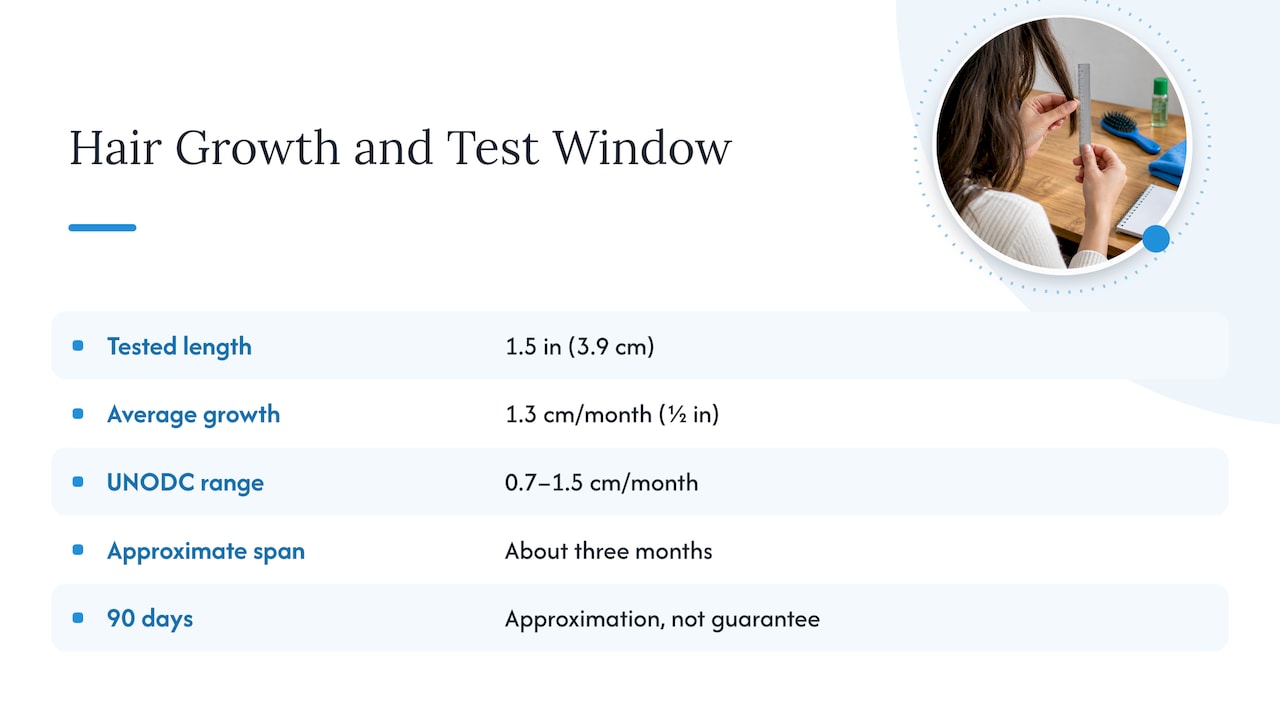
Laboratories typically test the first 1.5 inches of hair measured from the root. Head hair at the crown grows about 1.3 cm, or half an inch, per month, so 1.5 inches (3.9 cm) represents about three months. The UNODC guidelines give a broader range of 0.7 to 1.5 cm of scalp-hair growth per month, which is why the 90 days is an approximation and not a guarantee.
If you want the full picture of how the strand is cut and analyzed, our guide on how hair drug testing actually works walks through it.
The 5 to 10 day gap after your last use
This is the part that confuses people who search for their last use date. Drug use does not appear in the hair on the day it happens. According to Quest, it takes approximately 5 to 10 days for hair containing drugs to reach the scalp surface, where it can be collected.
A 2025 review in the Journal of Applied Laboratory Medicine describes the biology behind that gap. After ingestion, drugs can enter the hair bulb in as little as 30 minutes, and within a day can be found in the entire hair root. But nothing is detectable in hair shaft grown above the scalp for at least a couple of days, and the process can take up to 10 days.
What this means in practice:
- Use in the last week or so before collection may not be in the sample at all, because the hair carrying it has not yet grown out of the scalp.
- Use from about a week ago to 90 days ago sits inside the 1.5-inch segment the lab analyzes.
- Use older than about 90 days has grown past the tested segment, if your hair is short enough that the lab cuts at the standard length.
That is why recent use can slip through a hair test while still being picked up by a urine test. Our page on hair versus urine tests at work covers that difference for employees whose employer uses both. Treat the gap as a fact about timing, not a plan: it protects no one over the 90 days that came before it.
A worked example: counting from your last use date
Let’s make it concrete. These numbers are an illustration, using the half-inch-per-month average.
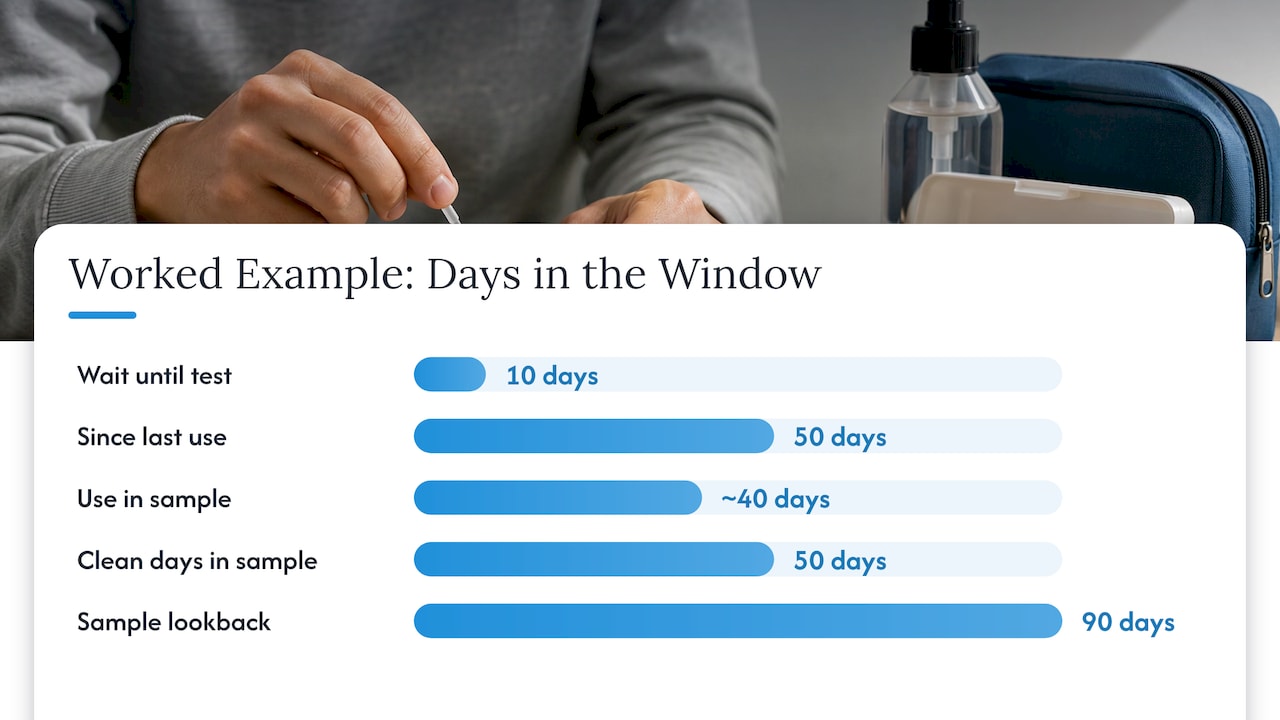
Situation: You used cannabis most days for the past year. Your last use was 40 days ago. Your test is in 10 days.
- Test day relative to last use: On test day, 50 days will have passed since your last use.
- The 90-day window: The lab looks back about 90 days from test day. That is 90 days of hair growth, with your last 40 days of use sitting between day 50 and day 90 back.
- What is in the window: Roughly 40 days of regular use fall inside the sample (day 50 to day 90 before the test), and 50 clean days sit closest to the scalp.
- What changes with time: Each additional day moves your use further from the root, but the older hair is still in the 1.5-inch segment until it grows past it.
The lesson is that waiting alone does not clear the sample on a normal schedule. If you were a regular user over the preceding 90 days, a last use date that is only a few weeks back leaves a lot of history in the segment. The date also cannot account for how heavy your use was, which is why a single number such as “40 days” is never enough.
If your timeline looks tighter than the 90 days, our article on when 90 days isn’t enough for a hair drug test goes through the scenarios.
Frequency matters as much as the date
Two people can share the same last use date and have very different results. Quest describes hair testing as a test of repetitive use, and Drugs.com notes that most hair tests detect heavy or regular use over the past three months. Heavy use leaves a larger deposit along the strand and across more of the 90 days.
That is why we ask three questions, not one:
| Input | Why it matters |
|---|---|
| Substance | Different drugs and metabolites behave differently in hair |
| Date of last use | Places your last exposure along the 1.5-inch segment |
| Frequency during the previous 90 days | Sets how much is in the hair overall |
If you are a heavy user, the last use date alone will under-describe your situation. For THC in particular, our guide to how long THC stays in hair explains why 90 days is not always enough.
One-time use and the date
Many people searching this topic want to know if a single use shows up. A hair test can detect one-time use, but detection is not guaranteed: it depends on timing, dose, drug type and individual biology. The UNODC guidelines add that some drugs are not detected in hair after a single exposure, and that segment analysis cannot pin down the exact day of intake.
So for a one-time user, a last use date within the final week or so before collection will often not be in the sample yet. For anyone with a pattern of use, the date is only one part of the picture.
Hair length, color and body hair change the math
Your last use date assumes a regular head of hair with enough length. Three things shift that:
- Length. The lab typically takes the first 1.5 inches. If your hair is longer, the older part is usually not what is tested. See our guide on when long hair actually affects a drug test.
- Growth rate. Because scalp hair grows 0.7 to 1.5 cm per month according to UNODC, your own 90 days may cover slightly more or less than 1.5 inches.
- Body hair. The Cleveland Clinic states that slower-growing body hair can have a detection window of up to 12 months, against three months for scalp hair. Quest says the detection window for hair from other body sites cannot be reliably determined. If your employer may use body hair, the last use date is much less useful. Our page on eyebrow hair drug tests addresses that case.
The 2025 review also notes that hair color affects how drug is taken up in the bulb, with white hair incorporating almost none that way. Again, an average date does not capture individual biology.
What to do with your last use date before a test
A date is only useful when it goes into a plan. Here is how we recommend working through it.
- Write down real dates. Note the substance, your last use date, and how often you used across the previous 90 days. Estimates made in a panic are usually wrong in a flattering direction.
- Check your test date. Count the days from your last use to the test. If it is under about 10 days, remember that recent use may not have reached the sample yet, and plan around the whole 90 days anyway.
- Identify what is being tested. Scalp hair, body hair, or a panel including alcohol or several drugs changes your approach.
- Run the numbers. Enter the substance, last use date and 90-day frequency into Mike’s Macujo Required Washes Calculator to see how many washes the method requires for your history.
- Complete every wash and every direction. Mike’s Macujo Method is a nine-step process, introduced in 2018 for high THC levels and other drugs and alcohol, and it must be done with authentic Macujo Aloe Rid® Shampoo. When every required wash and direction is completed correctly, the reported success rate is better than 99%, and the hair stays clean unless drugs or alcohol are used again.
- Do not use again. The result holds only as long as you abstain. New use deposits new material in the hair.
One point of confusion is worth clearing up. The old Macujo Method was designed mainly for low-to-moderate THC exposure, has an estimated success rate of about 90% for moderate THC, and provides only temporary masking. Mike’s Macujo Method is the current standard, and it is what the calculator is built around.
The calculator is why your last use date matters to us so much: it is one of the three inputs, and getting it right changes the number of washes. We cover the broader timeline in how far back a hair follicle test goes and in how long drugs stay in your hair. If your concern is a specific drug, our methamphetamine hair test timeline is the page to read.
What a result does and does not tell an employer
A positive result shows a detectable amount of a substance during a window of time. The Cleveland Clinic says it does not by itself mean the person is currently intoxicated or has a substance use disorder. Quest also notes hair is not the right method for post-accident or reasonable-suspicion testing, where urine or oral fluid suits better. If you have already received a result you want to question, read our page on a failed hair test and the 90-day window to verify and retest.
Where Macujo fits
If you have a test coming and a last use date that makes you nervous, the next step is to run your own history through the calculator and follow the nine steps with authentic Macujo Aloe Rid® Shampoo. We have helped customers prepare for hair follicle tests since approximately 1999. Our Macujo Aloe Rid Old Formula Shampoo is listed at $100 to $150.
If your dates are unclear, or your situation is unusual (heavy use, multiple substances, body hair), you can talk it through by phone. The Afterhours Personal Consultation is $100 and is built for people who have a test close and need someone to check their numbers.
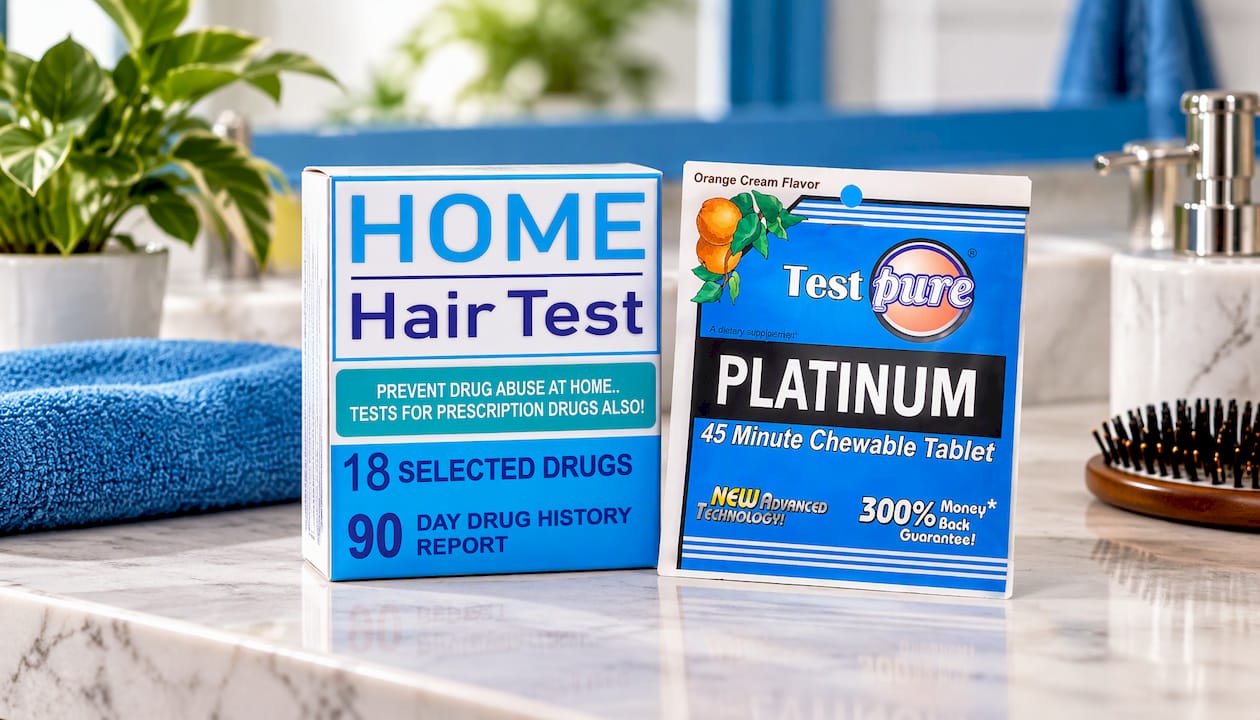
We also sell hair, urine and saliva test kits, including a Home Hair Test kit, at macujo.com.
Our view on the last use date
People come to us with a single question: “I last used on this date, am I fine?” The honest answer is that a hair test does not work like a stopwatch. The date matters, but it is one of three things we need to know.
Over the years we have seen that the people who go wrong are not the ones who lack information. They are the ones who guess. They round their last use date up, they play down how often they used in the 90 days, and they skip a wash because the schedule looked long.
That is why Mike’s Macujo Method is built around the Required Washes Calculator. It takes the substance, the date of last use and the frequency of use in the previous 90 days, and it returns a number. Our method is designed so that when every wash and every direction is completed with authentic Macujo Aloe Rid® Shampoo, the result is a clean hair test, and the hair stays clean unless you use again.
If your dates are messy, call us. That is what the after-hours consultation is for.
MIchael
FAQ
Does a hair test show one-time use?
It can, but it is not guaranteed. Detection depends on timing, dose, drug type and individual biology, and one-time use in the last week or so before collection may not have reached the sample. Hair testing is more dependable for repeated or habitual use.
How far back does my last use date need to be for a hair test?
A standard test covers about 90 days, so use inside that period can be in the sample. Because it takes about 5 to 10 days for drugs to appear in collectable hair, very recent use is a separate matter from older use. Your frequency of use over the 90 days matters as much as the date itself.
Does the last use date count if I have long hair?
Labs usually test the 1.5 inches closest to the scalp, which stands for about 90 days of growth. Longer hair does not extend the standard window, but it does not shorten it either. Our long hair guide explains how collection works in practice.
What information do I need for the Required Washes Calculator?
You need three things: the substance involved, the date of your last use, and how often you used during the previous 90 days. Accurate answers matter, because the number of required washes depends on them.
Sources
- Hair testing - FAQ (Quest Diagnostics)
- Hair Testing - FAQ, 2021 edition (Quest Diagnostics)
- Hair Drugs of Abuse Testing FAQ (Labcorp)
- Guidelines for testing drugs under international control (UNODC)
- Review on Toxicology Testing in Hair (Journal of Applied Laboratory Medicine)
- Drug Test: What It Is, Purpose, Procedure & Types (Cleveland Clinic)
- How far back does a hair follicle test detect drugs? (Drugs.com)
- Can a Hair Follicle Test Detect One-Time Drug Use? (Test Smartly Labs)