Last Updated on November 1, 2026
A scalp detox for a hair drug test is a structured, repeated cleansing of the hair shaft, planned around what you used, when you last used it and how often. A single shampoo, a conditioner or a silicone product will not give you that plan. The lab tests the first 1.5 inches of hair closest to your scalp, so the approach has to match your exposure and your timeline.
This guide explains what the test looks at, what labs do with hair products, where silicone and conditioner fit, and how to prepare in a way that is specific to your situation.
TL;DR
- Hair tests usually cover about 90 days, using roughly 1.5 inches of hair cut close to the scalp.
- Labs wash samples before testing, and routine screening cannot reliably flag a “detox” shampoo as such.
- Silicone products and conditioners are not a cleansing plan. Studies on hair treatments show results that vary by product and substance.
- Our approach, Mike’s Macujo Method, sets the number of washes from your substance, your last use and your 90-day frequency.
- Short on time? Use the required-washes calculator or book a personal consultation before your test date.
Table of Contents
- How a scalp hair drug test works
- What labs do about shampoos and hair products
- Does silicone on your hair change a drug test?
- Conditioner and “hair detox”: where it fits
- What research says about cleansing and cosmetic treatments
- Why the number of washes matters more than the brand name
- Perspective: why we built a method instead of a quick fix
- How to prepare: a practical sequence
- Choosing a detox shampoo for a hair test
- Your Macujo options
- Mistakes that cost people their result
- FAQ
- Sources
How a scalp hair drug test works
When you use a drug, its metabolites travel through your bloodstream and become trapped in the growing hair shaft. Labcorp explains that the test detects these metabolites and typically covers a 90-day window. Quest Diagnostics says the lab usually analyzes the first 1.5 inches of hair from the root, which corresponds to about 90 days of repeated use.
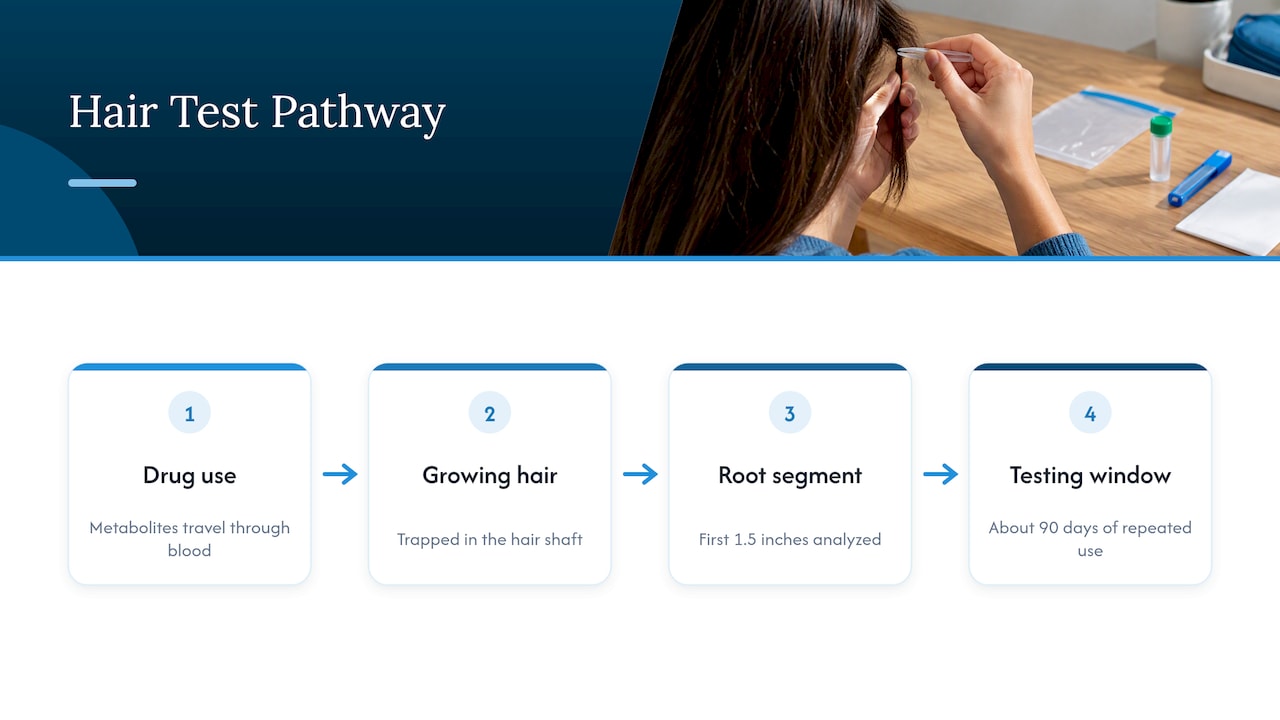
That is why people talk about a “scalp” test. The collector cuts hair as close to the scalp as possible, and the part nearest the root is the part that matters.
What a standard panel looks for
Standard panels commonly include amphetamines (including ecstasy), cocaine, opiates such as codeine, morphine, 6-acetylmorphine and oxycodone, marijuana metabolites (THC-COOH) and PCP, according to Labcorp. Alcohol markers can also be part of some programs, so ask your employer which panel applies to you.
What a hair test is not designed to catch
Hair testing is built to show a pattern of use over months, not what happened in the last day or two. Quest notes that urine or oral fluid testing is generally more effective for very recent use. If you want to see how the two compare at work, we cover it in hair vs. urine tests.
Your own hair matters too. A 2025 review in the Journal of Applied Laboratory Medicine notes that melanin content can influence how much drug is incorporated into hair. Two people with the same use history can end up with different measured levels.
What labs do about shampoos and hair products
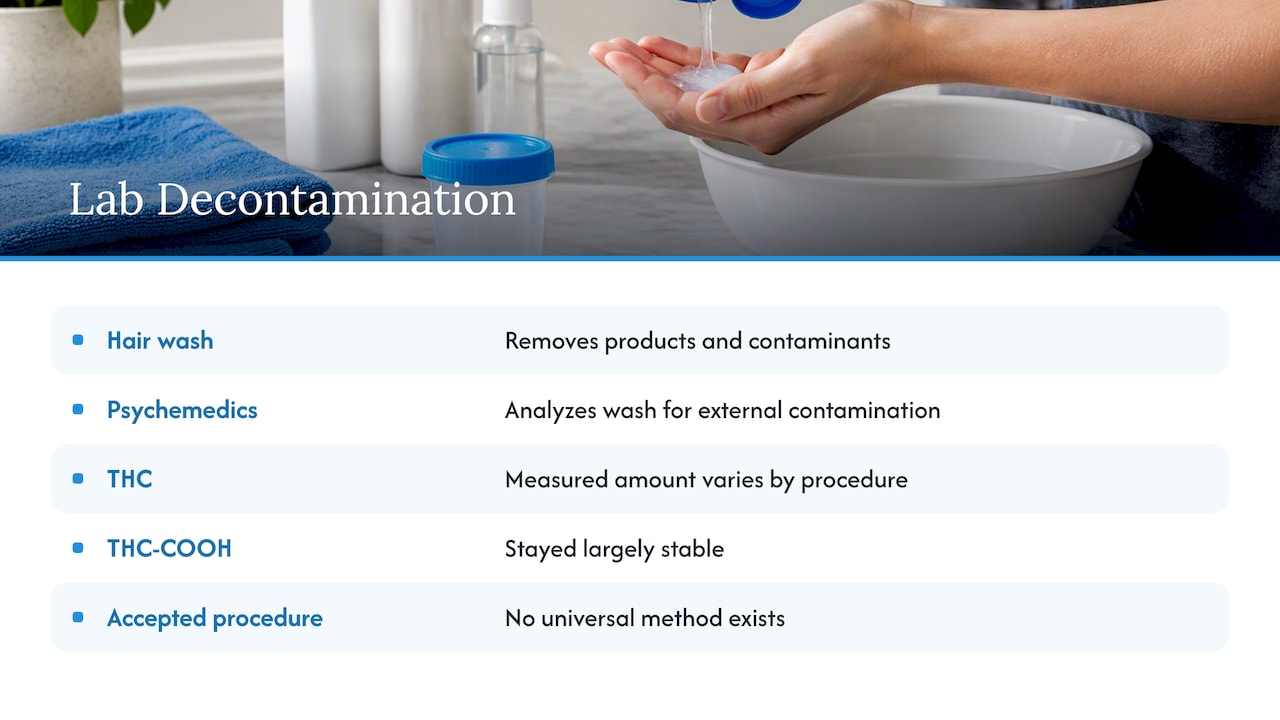
Labs do not test hair straight out of the envelope. According to the same review, laboratories wash hair before testing to remove hair products and environmental contaminants. Psychemedics, a major hair-testing lab, describes an extensive wash procedure and says it analyzes the wash to account for external contamination.
The wash step is also part of why the question of detox shampoo comes up so often. Washing methods differ between labs, and a 2026 study in Drug Testing and Analysis found that the choice of decontamination procedure significantly affects how much THC is measured, while the THC-COOH metabolite stayed largely stable. Notably, the authors state that no universally accepted decontamination procedure exists.
Can a lab tell you used a detox shampoo?
A 2023 review of sample manipulation testing found there is no standardized, routine workflow that can objectively screen for “detox” shampoo use, because these products do not leave unique markers that separate them from standard hair care. The same paper points out that even when a lab sees coloring, telling deliberate manipulation apart from ordinary cosmetic care is a significant challenge.
In practice, collectors and labs document what they can see. The Society of Hair Testing consensus says hair color, length and any topical, chemical or physical treatment should be recorded. So go in with hair that looks like normal, well-kept hair, and answer any collector question honestly and plainly.
Does silicone on your hair change a drug test?
This is the question behind “hair silicone drug test.” Silicone is in many smoothing serums, conditioners and styling products. It coats the outside of the shaft and can change how hair feels and behaves. The JALM review stresses that treatments affecting texture should be documented to help interpret results, and that hair products can interfere with lab decontamination protocols or affect specific markers.
Here is what that means for you:
- Silicone is a coating, not a cleanser. It does not remove drug metabolites from inside the shaft. It sits on top of the hair and can make washing less even.
- Buildup can work against a wash plan. If your hair carries layers of product, a cleansing routine needs to start from a clean surface so every wash does its job.
- Keep your routine plain. Between washes, avoid heavy styling products, and do not introduce new treatments you have not planned for.
The practical takeaway: do not rely on silicone or smoothing products to change your result. Put your effort into a method built around your specific exposure.
Conditioner and “hair detox”: where it fits
People also ask whether a conditioner can detox hair. Conditioner is a care product. Its job is to smooth the cuticle, reduce tangles and add slip. Psychemedics says commonly used products such as shampoos, conditioners, sprays, mousses and gels have no significant effect on its results, and that normal washing helps remove external contamination. We read that as a reminder that ordinary conditioner is not the tool for this job.
A cleansing routine for a hair test is different. It is a defined sequence, with a defined shampoo, and a count of washes. Conditioner can have a place for comfort and manageability when a method calls for it, but it is not the step that does the work.
What research says about cleansing and cosmetic treatments
A 2022 study from Germany, Manipulation of THC Hair Concentrations by Commercially Available Products, reviewed the evidence that cosmetic treatments such as bleaching or dyeing, and the use of various shampoos and hair products, can lower measured drug concentrations in the hair shaft. The same paper notes that results vary: some products produce decreases, and the size of the reduction depends on the product and the starting level.
That variation is the key lesson. Results depend on what is applied, how often, how it is applied and how much drug is in the hair to begin with. A generic product used once is a very different thing from a structured, repeated process matched to your history.
If your hair is dyed or bleached, that is its own factor, and we explain it in our guide to dyed hair and hair drug tests.
Why the number of washes matters more than the brand name
The mistake we see most often is treating hair cleansing like a one-night fix. Heavy exposure needs more washes than light exposure. A person who last used a month ago is in a different position from a person who last used last week. That is why a plan has to start with three facts:
- The substance. THC, cocaine, opiates, amphetamines and alcohol markers do not all behave the same way.
- The date of last use. More time means more of the exposed hair has grown out or been cleansed already.
- How often you used in the previous 90 days. Daily use and occasional use call for different plans.
Those three inputs are exactly what Mike’s Macujo Required Washes Calculator uses to set your count. You are not guessing, and you are not copying a forum recipe that was written for someone else.
Perspective: why we built a method instead of a quick fix
We have helped people prepare for hair follicle tests since about 1999, and the pattern is always the same. People arrive with a test date and a rumor: a conditioner, a silicone serum, one strong shampoo. Then they discover that nothing in the rumor accounts for how much they used or when.
The old Macujo Method was designed mainly for low-to-moderate THC exposure. We estimate about 90% success for moderate THC, and it offers only temporary masking. We do not recommend it for heavy exposure.
In 2018 we introduced Mike’s Macujo Method, a systematic nine-step process developed for high THC levels and for other drugs and alcohol. It has to be done with authentic Macujo Aloe Rid® Shampoo, and the number of washes comes from the calculator, not from a guess. When every required wash and direction is completed correctly, we report a success rate better than 99%, and the hair stays clean unless drugs or alcohol are used again.
What we are proudest of is the support. Customers get unlimited support and after-hours phone consultation, because test dates do not respect business hours. If you are nervous, that is normal. We would rather talk you through the plan step by step than have you improvise.
MIchael
How to prepare: a practical sequence
Here is a sensible order of operations for anyone facing a hair test.
- Find out what is being tested. Ask for the panel, or read your offer letter. Most standard panels follow the substances listed above.
- Count your days. Hair grows slowly, so every day before the test helps. Start planning the moment you get the notice.
- Assess your hair. Is it long enough for a 1.5-inch sample? Is it dyed, bleached, in dreadlocks or very short? Each situation has its own considerations. See our pages on dreadlocks and on whether a shaved head helps.
- Run your numbers. Enter your substance, last use date and 90-day frequency in the calculator to get your required washes.
- Follow the directions exactly. The method is designed to be completed in full. Skipping a wash or a step changes the plan.
- Keep your hair routine plain until the test. No new treatments, no experiments with products stacked on top.
- Do not use again. Any new use puts new drug into new hair.
Body hair is a different timeline
If you do not have enough scalp hair, a collector may take body hair instead. That sample can reflect a much longer window, which is a different planning problem. Our guide to the up to 12-month window for body hair tests explains what that means.
Choosing a detox shampoo for a hair test
Not every shampoo marketed for hair tests is built for the same job. When you compare options, look at:
- A defined method. Is there a step-by-step process, or just a bottle?
- Wash count guidance. Does it tell you how many washes your history needs?
- Support. Can you reach a person if something is unclear the night before?
- Authenticity. For Mike’s Macujo Method, the method must be done with authentic Macujo Aloe Rid® Shampoo.
- What is inside. Understanding ingredients helps you judge a product. We break this down in detox shampoo ingredients and in our guide to the best hair detox shampoo for a drug test.
Your Macujo options
If you have a test coming up, we can help you plan it around your own history. Macujo Aloe Rid Old Formula Shampoo is listed at $100 to $150 depending on the option, and you can see the range on our hair products page. You can browse the full Macujo hair test products, including the method and the calculator.
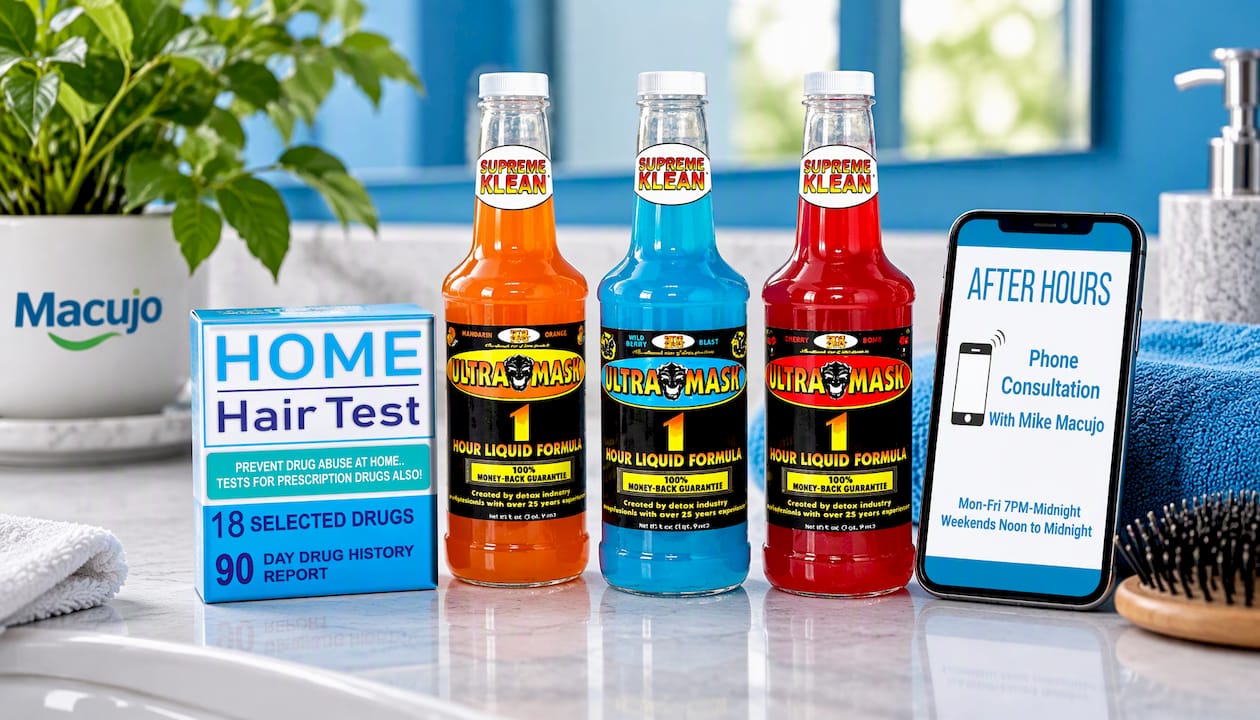
If you would rather talk it through, the Afterhours Personal Consultation is $100. It is a phone consultation with an expert, useful when your date is close and you need a clear plan tonight. Here is what to expect from a consultation.
Want to check where you stand before the real test? The Home Hair Test kit is available in our shop. Our site also carries urine and saliva test products if your employer uses another test type.
Mistakes that cost people their result
- Starting too late. Every wash and every day counts.
- Using the wrong method for your exposure. Light-exposure advice does not carry over to heavy, long-term use.
- Mixing methods. Stacking random products on top of a defined process makes the plan unpredictable.
- Forgetting other test types. Forensic guidance often recommends combining hair with urine or oral fluid, as the JALM review notes. If your employer may do both, plan for both.
- Using again after cleansing. New use puts new drug into new hair.
Protect your hair and scalp while you wash
Frequent washing can leave hair dry and the scalp sensitive. Follow the directions, use only what the method calls for, and stop and contact a doctor or dermatologist if you get a rash, burning or persistent irritation. If you have a scalp condition such as eczema or psoriasis, ask your doctor before starting a repeated wash schedule. Do not leave product on your scalp longer than directions say.
FAQ
Can a hair follicle test detect detox shampoo?
According to a 2023 review, there is no standardized routine workflow that reliably identifies detox shampoo use, since these products leave no unique marker. Labs do wash samples and document visible treatments such as coloring. Keep your hair looking normal and tell the collector the truth if asked about treatments.
Can silicone or conditioner change the result?
Silicone coats the outside of the hair, and conditioner is a care product. Neither is a cleansing plan. Labs wash hair before testing, and one major lab says ordinary conditioners have no significant effect on its results. A plan built around your exposure is a better use of your time.
How many washes do I need?
It depends on the substance, your date of last use and how often you used in the previous 90 days. We use Mike’s Macujo Required Washes Calculator to set that number, and the method works when every required wash and direction is completed.
How long do I need to be clean for a hair test?
Hair tests typically look back about 90 days using the first 1.5 inches of hair from the scalp. More time since your last use means more of the sampled hair reflects the clean period. If your test is sooner than that, a test-specific plan matters.
Does a hair test catch use from the last few days?
Hair testing is built for longer patterns, and urine or oral fluid tests are generally better for very recent use. Because employers may use more than one test, plan for both.
Sources
- Hair Follicle Drug Testing: Process & Benefits, Labcorp
- Hair testing FAQ, Quest Diagnostics
- Review on Toxicology Testing in Hair, Journal of Applied Laboratory Medicine
- Advances in testing for sample manipulation in clinical and forensic toxicology
- Manipulation of THC Hair Concentrations by Commercially Available Products
- General Consensus on Hair Testing, Society of Hair Testing
- Hair Drug Test Facts and FAQs, Psychemedics
- Influence of Different Washing Hair Procedures on THC and THCCOOH, Drug Testing and Analysis