Last Updated on October 8, 2026
Yes, MDMA is detectable in hair, and a standard 1.5 inch scalp sample typically covers about 90 days of use. Labs screen the sample first, then confirm positive results with GC-MS or LC-MS/MS, checking for the metabolite MDA to help rule out surface contamination. Hair color, bleaching, and individual growth rate can all shift what a result actually means.
TL;DR:
- Hair tests typically detect MDMA use within a 90-day window using a 1.5 inch scalp sample, but results can vary based on hair growth rate and cosmetic treatments.
- External contamination from handling drugs, sweat, and bleaching or dyeing can influence test outcomes, prompting labs to perform validation washes to ensure accuracy.
- Confirmed positive results rely on detection of both MDMA and its metabolite MDA, with metabolite ratios helping distinguish genuine ingestion from surface contamination.
- Substituting body hair for scalp hair broadens the detection window but reduces precision, especially since body hair grows more slowly and inconsistently.
- Manipulation tactics like bleaching, excessive washing, or head shaving are largely ineffective against validated laboratory methods designed to flag such interference.
Table of Contents
- How hair follicle testing detects MDMA: incorporation routes and timeline
- Detection windows and lab cutoffs for MDMA in hair
- What affects accuracy: hair color, dyeing/bleaching, sweat, contamination, and cosmetics
- Sample collection and lab process: what to expect
- Metabolites and interpretation: MDMA vs MDA and the role of metabolite ratios
- Manipulation, myths, and what labs can do
- Expert perspective: methods, products, and when to consider professional help
- What this topic gets wrong most often
- Where to get help: products and consultation options
- FAQ
- Sources
How hair follicle testing detects MDMA: incorporation routes and timeline
Once MDMA enters the bloodstream, it gets drawn into the hair follicle as the strand forms, locking in a rough timestamp of use. That’s the main incorporation route, but it isn’t the only one. Sweat and sebum can carry trace amounts of the drug into hair after it has already grown, and external exposure (handling the drug, being in a room where it’s smoked or used) can deposit material directly on the strand’s surface without any ingestion at all.
This is why testing labs care so much about where on the body the sample comes from and how it’s cleaned before analysis. The math behind the standard detection window relies on an assumed growth rate of roughly 1 centimeter, or about half an inch, per month:
- A 1.5 inch scalp sample corresponds to approximately 90 days of growth
- Head hair grows at a more consistent, predictable rate than hair elsewhere on the body
- Body hair (chest, arms, legs) grows slower and less uniformly, making its detection window harder to pin down
That’s why collectors prefer head hair whenever it’s available. Body hair becomes a fallback option only, and when it’s used, labs typically widen their interpretation of the time frame rather than quoting a precise 90-day figure.
Detection windows and lab cutoffs for MDMA in hair
Every hair test follows a two-step workflow. The first pass is a screening assay, usually an immunoassay, designed to flag samples that might contain MDMA or its metabolites. Any sample that screens positive then moves to confirmatory testing, where GC-MS or LC-MS/MS identifies the specific compounds present with much higher specificity. This second step is what actually determines a reportable positive, not the screen.
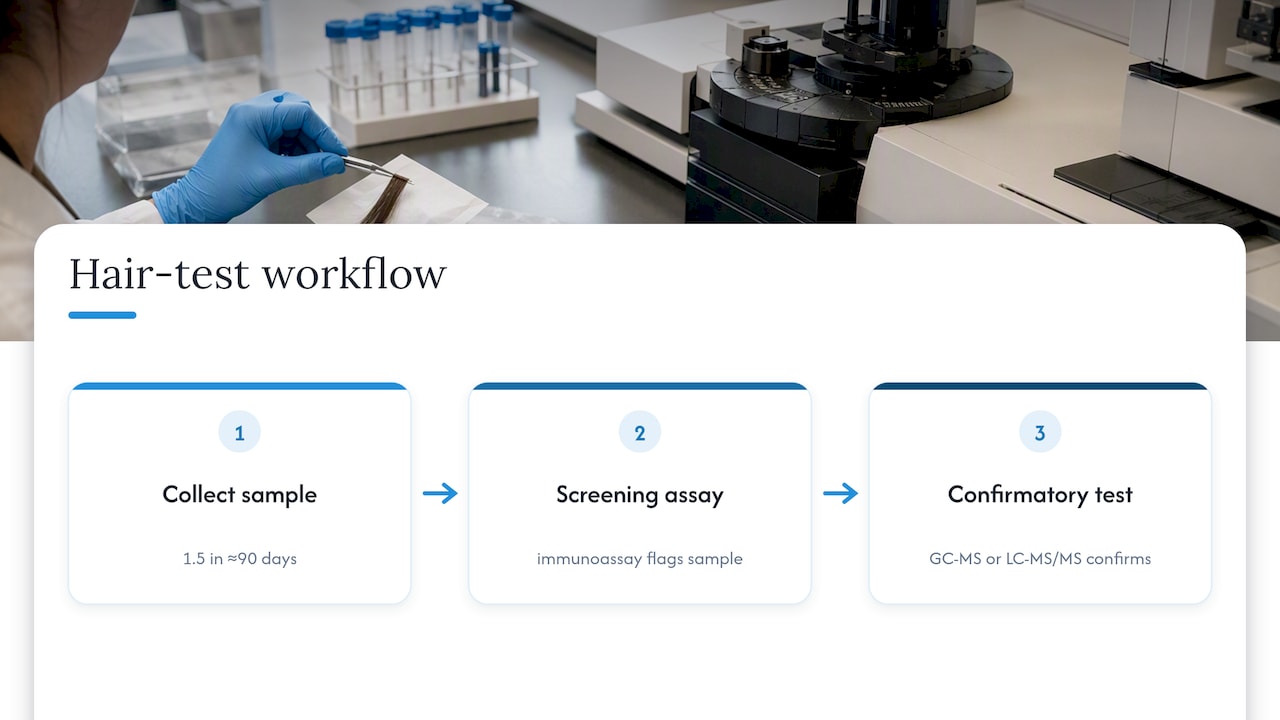
A 1.5 inch hair sample is the industry standard for capturing roughly 90 days of drug use history, a figure echoed in practical guidance on far-back hair testing. Cutoff concentrations vary by laboratory and by the panel being run, so “detectable” isn’t a fixed line across every provider.
Segmental analysis, cutting the hair shaft into smaller sections and testing each one separately, can narrow the window further and sometimes localize use to a specific month rather than a three-month span. That precision depends on having enough hair length to section in the first place, and on growth-rate assumptions holding true for that individual, which they don’t always do.
What affects accuracy: hair color, dyeing/bleaching, sweat, contamination, and cosmetics
Hair testing isn’t a neutral measurement. Several real-world factors can push results higher, lower, or into ambiguous territory. A multivariable analysis of nightclub and festival attendees found that hair dyeing and other cosmetic factors were associated with altered odds and levels of MDMA detection, meaning dyed hair didn’t behave predictably in one direction across the study population.
Some of the clearest influences on a result include:
- Dyeing and bleaching can change how much drug residue remains bound in the hair shaft
- Excessive sweating or hat-wearing may increase surface-level deposition unrelated to ingestion
- External contamination from handling drugs or secondhand exposure can mimic a genuine positive
This is exactly why labs run validated decontamination washes before extraction, stripping away surface residue so the result reflects what’s actually incorporated into the hair rather than what landed on it. Collectors also record recent cosmetic treatments and other relevant details at the time of sampling, since that context matters later if a result is challenged.
Pro Tip: If you’ve recently dyed or bleached your hair, mention it at collection. It can factor into how a lab or employer interprets a borderline result.
Sample collection and lab process: what to expect
A standard collection follows a fairly consistent procedure across accredited labs, and knowing the steps ahead of time removes most of the guesswork.
- Hair is collected from the posterior vertex of the scalp, close to the skin, to minimize growth-rate variability
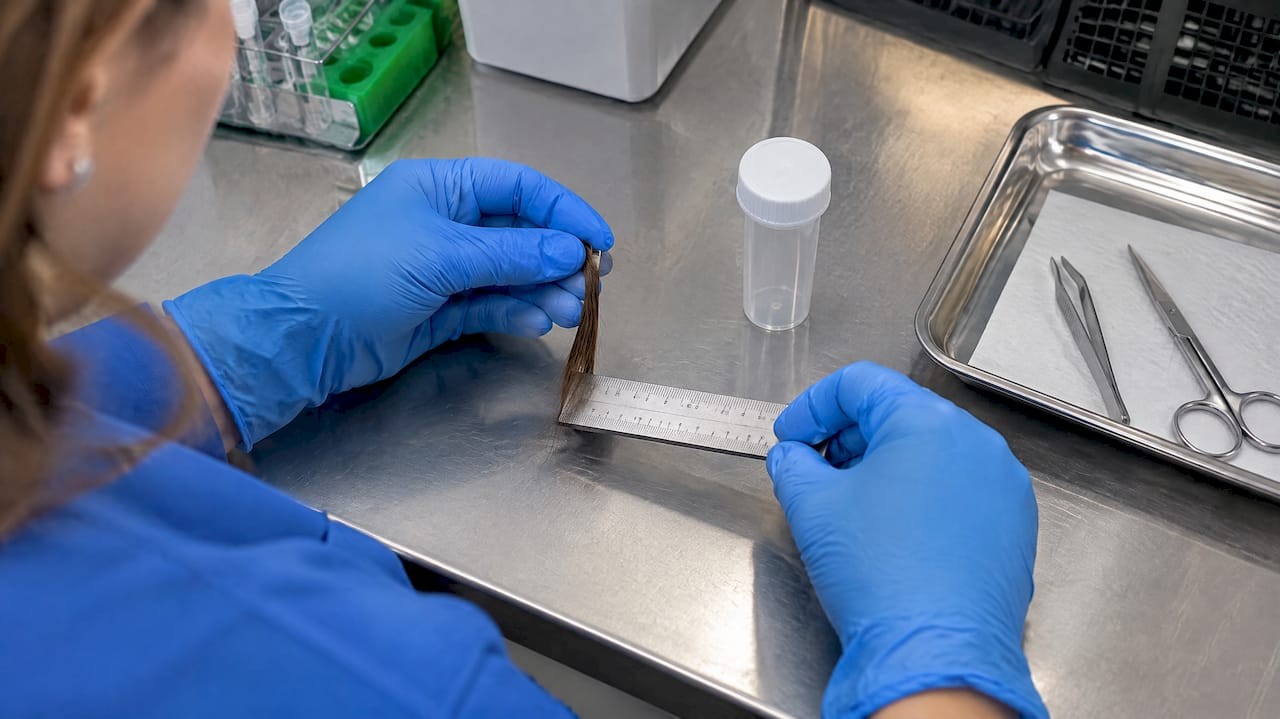
- A sample of roughly 100 milligrams, about 90 to 120 strands, is cut at 1.5 inches, with the proximal (root) end clearly marked
- The specimen is logged into a chain-of-custody record and stored securely before lab processing
- Technicians run a decontamination wash to remove surface residue without stripping the hair’s internal content
- The sample undergoes an initial screening assay, and any positive result moves to confirmatory GC-MS or LC-MS/MS testing
- Results are documented and reported, with lab notes on any collection anomalies
When a person doesn’t have enough scalp hair, whether from short styling or a shaved head, collectors may turn to body hair instead. That substitution changes the math: body hair grows more slowly and less predictably, so the resulting window is described in broader terms rather than a precise 90-day estimate.
Metabolites and interpretation: MDMA vs MDA and the role of metabolite ratios
Labs don’t just look for MDMA itself. They also check for MDA, a metabolite the body produces as it processes MDMA. Finding MDA alongside the parent drug is meaningful because metabolite detection helps distinguish genuine ingestion from external contamination: a surface contaminant is far less likely to carry the metabolic signature that comes from the body actually breaking the drug down.
A few things shape how toxicologists read these results:
- The presence of MDA supports a finding of systemic use rather than passive exposure
- Metabolite-to-drug ratios can offer additional interpretive context, though these ratios vary between individuals and aren’t a fixed standard
- A single data point rarely tells the whole story, so interpretation often draws on collection notes, other test results, or case-specific context
None of this makes a positive result automatically open to debate, but it does explain why forensic toxicologists treat metabolite data as a meaningful cross-check rather than an afterthought.
Manipulation, myths, and what labs can do
People try a handful of common tactics to beat a hair test, and the forensic literature has looked closely at how well they actually work.
- Bleaching can reduce measurable drug concentration in hair, but it alters the hair’s structure in ways a lab can sometimes flag
- Repeated washing may lower surface contamination, yet it does little to remove drug bound inside the hair shaft
- Commercial “detox” shampoos marketed for one-time use rarely match the depth of a validated lab decontamination wash
- Shaving the head simply forces a switch to body hair collection, which doesn’t eliminate detection, just changes the sample source
A review of sample manipulation strategies notes that while cosmetic treatments can lower concentrations, labs are actively developing biomarkers and spectroscopic techniques to flag oxidative treatments like bleaching, which makes distinguishing routine cosmetic care from deliberate tampering an ongoing area of forensic research. Our guide to bleaching and hair testing goes deeper into why this particular shortcut is riskier than it sounds.
Pro Tip: A one-off shortcut rarely holds up against a validated lab wash. A methodical, multi-step approach has a far better track record than any single trick.
Expert perspective: methods, products, and when to consider professional help
We have experience with hair-test preparation that shaped Mike’s Macujo Method, a nine-step process introduced in 2018 and built around the Aloe Rid Old Formula Shampoo. It’s distinct from the older Macujo Method, which targeted lower-to-moderate exposure and only offered temporary masking.
The right number of washes depends on the substance, the date of last use, and frequency over the past 90 days, which is exactly what our required-washes calculator accounts for. If your test date is close, your last-use timeline is unclear, or you want a second opinion before relying on a method alone, a personal consultation may be useful.
What this topic gets wrong most often
The conventional advice treats hair testing like a simple yes-or-no coin flip: either you’re clean or you’re caught. The research tells a messier story. Detection windows shift with hair color, growth rate, and sampling site; cutoffs differ by lab; and a positive screen isn’t the same thing as a confirmed, legally defensible result.
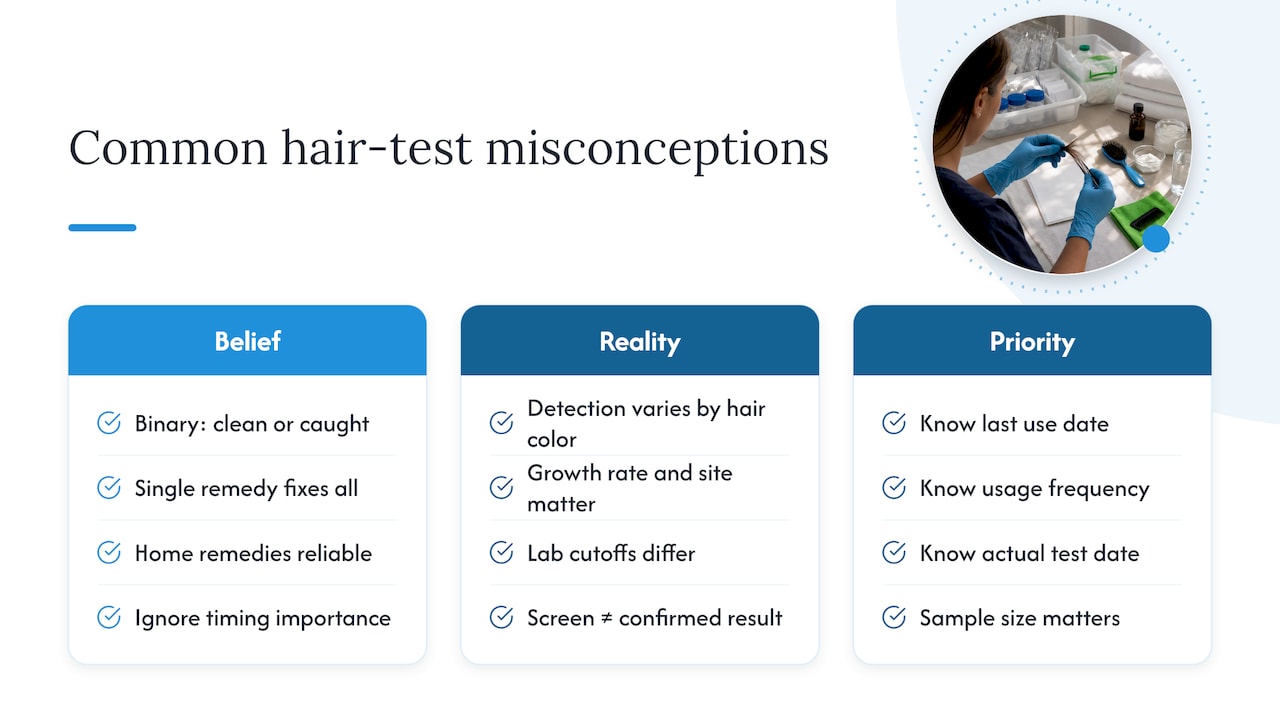
What gets overrated is the idea that a single home remedy, a bleach job, a dozen shampoo washes, works reliably on its own. What gets underrated is how much the process itself (sample size, decontamination washing, metabolite checks) is built specifically to catch inconsistent or half-measured attempts at cleanup.
If there’s one thing worth prioritizing, it’s timeline awareness. Knowing your last use date, your usage frequency, and your actual test date matters more than any single product, because every method, ours included, depends on that information to work correctly. Treat hair testing as a system with known mechanics, not a mystery to outguess.
— MIchael
Where to get help: products and consultation options
If you want to check where you stand before a scheduled test, our Home Hair Test kit gives you a private read on your own results.
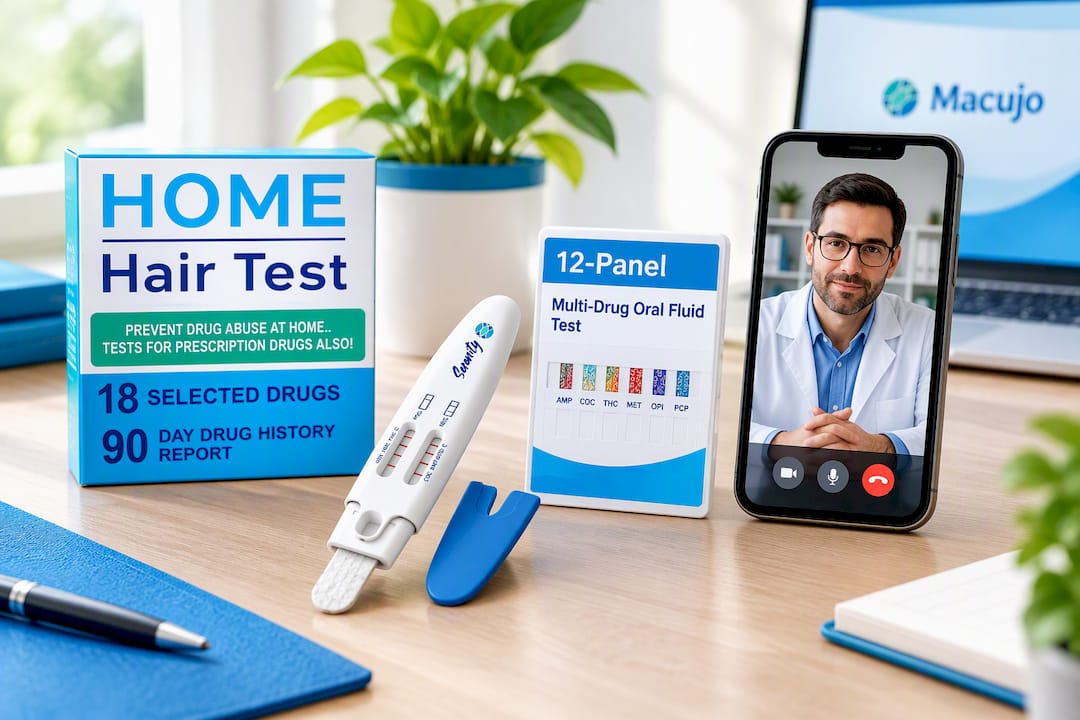
- Use the Home Hair Test kit for a self-check before committing to a full wash protocol
- Pick up Aloe Rid Old Formula Shampoo when you’re following a method that calls for it specifically
- Book an Afterhours Personal Consultation ($100) when your timeline is tight or your use history is complicated
A kit works well for routine prep.
A consultation makes more sense when the stakes are high and you need a wash count tailored to your actual history.
FAQ
What does MDMA test positive for?
A hair test confirms MDMA by detecting the parent drug and its metabolite MDA through GC-MS or LC-MS/MS confirmation. Finding MDA alongside MDMA supports genuine ingestion rather than surface contamination.
What can throw off a hair follicle test?
Hair dyeing, bleaching, excessive sweating, and external contamination from handling drugs can all alter results, according to research on nightclub and festival attendees. Labs run decontamination washes specifically to reduce the impact of surface-level contamination before analysis.
How long will a hair follicle test detect drugs?
A standard 1.5 inch scalp sample, taken close to the root, typically reflects about 90 days of history based on average hair growth rates. Longer samples or segmental analysis can extend or narrow that window depending on the lab’s approach.
Can molly be detected in a hair follicle test?
Yes, MDMA (commonly called molly or ecstasy) is detectable using the same hair-testing methods used for other stimulants. Labs screen the sample, then confirm any positive result with mass spectrometry before reporting it.
What is a normal hair sample size for drug testing?
Labs typically collect about 100 milligrams of hair, roughly 90 to 120 strands, cut to 1.5 inches from the posterior vertex of the scalp. When scalp hair isn’t available, body hair can be collected instead, though it produces a less precise time window.
Sources
- Drugs
- Multivariable analysis of hair color, dyeing, and predictors of cocaine and MDMA detection — PMC
- Forensic toxicology article on distinguishing contamination from ingestion (PubMed)