Key Takeaways:
- Hair follicle drug tests detect drug use over a 90-day window by analyzing metabolites embedded in hair strands, making them far more comprehensive than urine tests.
- Individual factors like hair color, growth rate, and cosmetic treatments can influence test results, but only scientifically-backed detox methods—such as those from Macujo—offer reliable preparation.
- Using a home hair test before your official screening provides objective insight into your status, allowing for informed, effective preparation with authentic detox products and expert support.
Most people assume a hair follicle drug test works like a urine test. That assumption catches more job seekers off guard than anything else. Unlike a urine test, a hair test captures drugs as they get incorporated into the strand while it grows. That builds a record stretching back roughly 90 days.
Knowing how to pass a hair follicle drug test starts with understanding what labs look for. Science-based preparation consistently outperforms internet myths, as Macujo's hair test guidance makes clear. Take the first informed step with Macujo's hair detox products for drug testing.
How Hair Follicle Drug Tests Work and What They Detect
While a urine test looks back days, a hair test can look back months, and that difference changes everything about how you prepare. Understanding how hair follicle drug tests work, and what factors affect the results starts with your body's biology. The science is more straightforward than it sounds.
Why Hair Holds a Longer Record Than You Might Expect
When you consume a substance, it enters your bloodstream and breaks down into byproducts called metabolites. Those metabolites get absorbed into the cells that produce your hair and become locked into the hair shaft during growth. Research from the National Institute of Justice confirms that these trapped metabolites are what labs look for. This is why hair testing can detect substance use over a much longer period than urine or saliva tests.
The 90-Day Window and What Can Shift It
Most employment hair tests collect a 1.5-inch sample from close to the scalp. Since hair grows roughly half an inch per month, that sample reflects roughly 90 days of history. A systematic review found that hair color, texture, and cosmetic treatments like bleaching or dyeing can influence how metabolites appear in the strand. Frequency of use matters too. The 90-day window is a guideline, not a guarantee.
What Labs Are Actually Screening For
Once a sample is collected, labs follow a structured process to analyze it. Standard employment panels cover five standard drug classes: marijuana, cocaine, opioids, amphetamines, and PCP. Labs run an initial screen first, then use a more precise confirmation test on any positive results. This two-step process reduces the chance of false positives before a result is reported. Learn more about how labs process samples and what to expect at each stage.
What Is the Typical Detection Window for THC and Other Drugs in Hair?
How long THC stays in a hair follicle test is one of the most common questions people ask, and the honest answer is that there is no single number that applies to everyone. Understanding those factors is what separates a realistic assessment from a guess.
- The 90-day window is a guideline, not a guarantee. Labs typically analyze a 1.5-inch hair sample, which represents roughly 90 days of growth based on an average rate of about half an inch per month, according to hair testing standards. Your actual growth rate may be faster or slower.
- Very recent use may not be detectable yet. Use within the past five to seven days may still be too close to the scalp to be included in the collected sample, which means a lab cannot flag it yet.
- Frequency of use has a measurable impact on detectability. Repeated exposure leads to higher, more consistent levels in the strand, while cannabis detection research confirms that infrequent use is harder to detect, though it can still appear depending on potency and individual metabolism.
- Lab cutoff thresholds determine what counts as a positive. Each lab sets a minimum concentration that must be present before a result is flagged. Whether your levels clear that threshold depends on individual biology, substance concentration, and how your body processes what you have used.
- Individual factors add meaningful variability. Hair growth rate, hair color, and cosmetic treatments like bleaching or dyeing can all influence how much of a substance is retained in the strand. These are among the factors affecting THC detection that make broad online timelines a starting point, not a personal prediction.
What LabCorp and Quest Procedures Usually Involve, and Why Home Testing Can Help
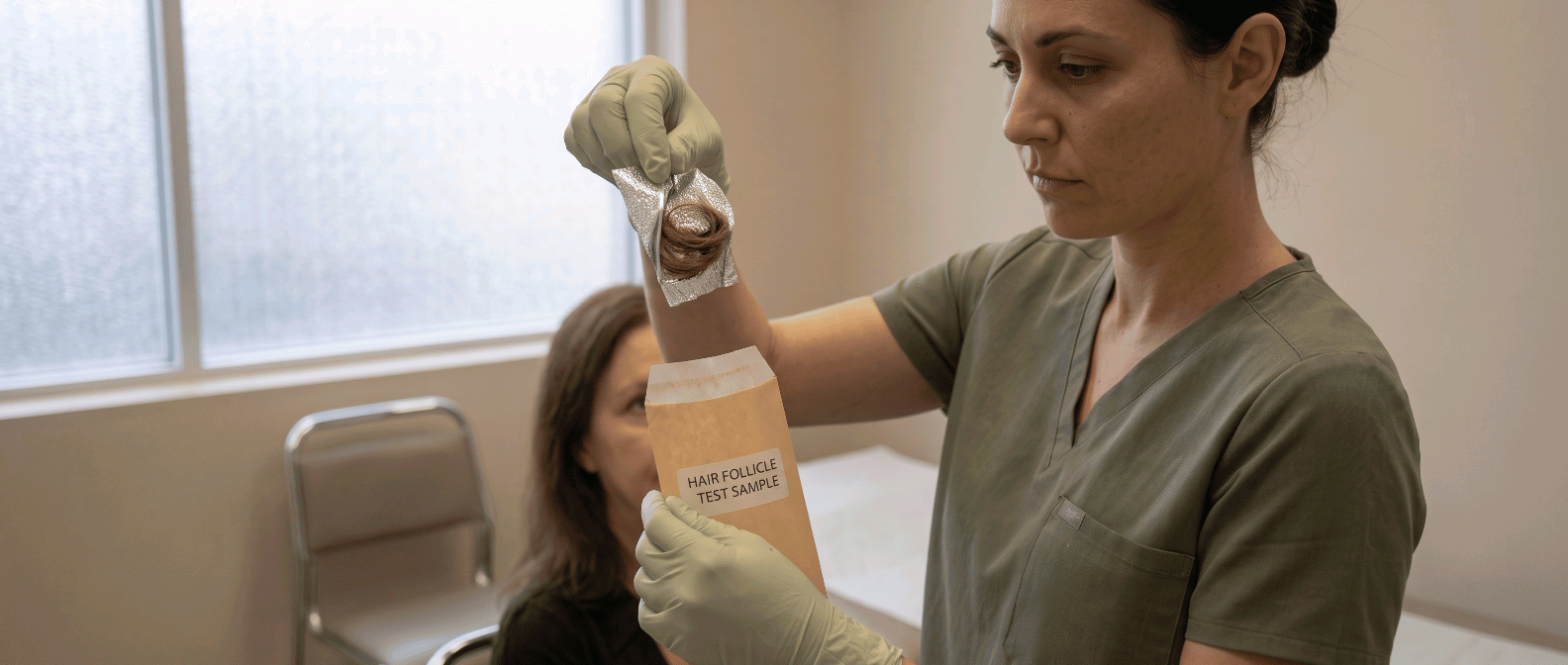
Labs like LabCorp follow a structured process from the moment your sample is collected. A technician collects roughly 100 mg of hair and seals it with a chain-of-custody form that follows the sample through every step. The sample then goes through an initial immunoassay screen, checking for substances such as marijuana, cocaine, opioids, and amphetamines. Any flagged result is confirmed with mass spectrometry, a more precise chemical analysis that reduces false positives. A Medical Review Officer then reviews confirmed findings before the employer receives a final report.
Before your official screening, a home hair test gives you an objective picture of where you stand. Macujo's Home Hair Test Kit screens for 18 drugs using lab-grade analysis and offers a detection window of up to 90 days. Objective results are far more useful than assumptions, especially when you're working against a deadline. You can also review hair testing procedures in detail so you know exactly what to expect on test day.
Hair Follicle Drug Test FAQ: Timelines, Accuracy, and Preparation
A lot of what circulates online about hair follicle drug tests is either oversimplified or flat-out wrong. Getting answers grounded in science, rather than what just sounds reassuring, makes a real difference when you are preparing for an employment screening.
How far back does a hair follicle drug test go, and do all labs use the same window?
Most labs use the 3 cm of hair closest to the scalp as the standard sample. According to consensus guidelines from the Society of Hair Testing, the length reflects roughly 90 days of growth. Published research confirms that segment length and confirmatory methods can differ between providers, meaning the exact lookback period is not uniform across labs.
Can bleaching, dyeing, or shaving change the outcome of a hair test?
These approaches are less effective than most people expect. A cosmetic treatment study found that bleaching can reduce drug residues by roughly 30 to 60 percent, though it rarely eliminates them entirely. Dyeing produces smaller reductions than bleaching, and shaving simply redirects collection to body hair, since labs can use it as an alternative sample.
What does an effective hair follicle detox timeline look like?
The most effective hair follicle detox timeline begins three to four weeks before your scheduled test date. Stopping use and following a structured cleansing protocol are the most responsible steps you can take. Widely circulated shortcuts like vinegar rinses or baking soda have no credible scientific support and won't give you the reliable outcome you need.
When is the right time to use a home hair test before an employment screening?
Using a home hair test before your official screening gives you an objective read on where you actually stand. The kit screens for 18 drugs with a 90-day detection window and delivers results within days. That kind of real data is far more useful than guessing when you are working against a deadline.
Does drinking more water or exercising more help clear drugs from hair?
No. Unlike urine tests, hair testing is not affected by hydration or sweat. Once drug metabolites are embedded in the hair shaft, they stay there until that portion of hair grows out or is cut. Water intake and exercise have no effect on what a lab detects in a hair sample.
Your Next Step: Prepare With Accurate Information and Trusted Hair Cleansing Support
Preparation works best when it starts with honest information. Research shows that hair treatment outcomes vary significantly from person to person. A home hair test before your screening gives you a clear, objective starting point.
Once you know where you stand, product authenticity and expert support matter most when working against a deadline. Choosing hair detox products for drug testing backed by science gives you a real, informed advantage. At Macujo, you can explore options like Macujo Aloe Rid® Shampoo, Zydot Ultra Clean Shampoo, and the Home Hair Test Kit.